
布罗达卢单抗与高完全清除率和生活质量改善相关:伴有银屑病和并发银屑病关节炎患者的亚组分析。
Brodalumab Is Associated with High Rates of Complete Clearance and Quality of Life Improvement: A Subgroup Analysis of Patients with Psoriasis and Concomitant Psoriatic Arthritis.
机构信息
Psoriasis Research and Treatment Centre, Clinic of Dermatology, Venereology and Allergology, Charité - Universitätsmedizin Berlin, Berlin, Germany.
LEO Pharma A/S, Ballerup, Denmark.
出版信息
Dermatology. 2022;238(4):620-629. doi: 10.1159/000520290. Epub 2021 Nov 25.
BACKGROUND
Psoriatic arthritis (PsA) is a chronic inflammatory disease associated with psoriasis that significantly impairs physical function and quality of life (QoL). Prompt therapeutic intervention is crucial for limiting PsA progression and preventing disability.
OBJECTIVES
The aim of this study was to compare the efficacy of brodalumab versus ustekin-umab and the impact on QoL in patients with moderate-to-severe plaque psoriasis, by concomitant PsA status.
METHODS
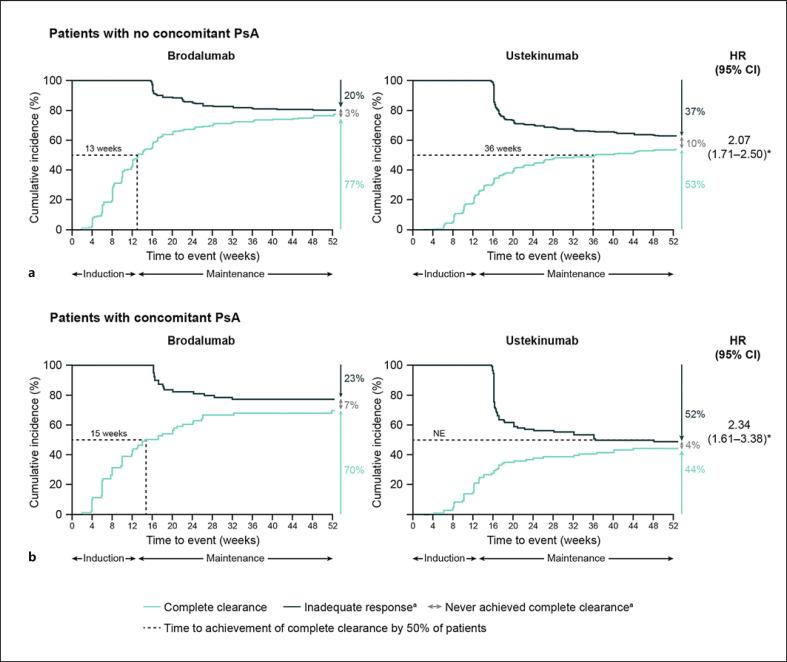
This post hoc analysis of pooled data from the phase 3 AMAGINE-2 and -3 trials evaluated complete skin clearance (100% improvement of Psoriasis Area and Severity Index [PASI 100]), improvement in symptom severity (Psoriasis Symptom Inventory [PSI] response), and QoL (Dermatology Life Quality Index [DLQI] score of 0/1) by concomitant PsA status. A competing risk model assessed cumulative incidence over 52 weeks with outcomes of PASI 100 or inadequate response.
RESULTS
This analysis included 929 patients with moderate-to-severe psoriasis. Concomitant PsA was present in 79/339 (23%) and 110/590 (19%) patients receiving brodalumab 210 mg and ustekinumab, respectively. At Week 52, odds ratios (ORs) (95% confidence intervals [CIs]) for complete clearance with brodalumab versus ustekin-umab were 3.15 (1.52-6.55, p = 0.0015) in patients with concomitant PsA and 3.05 (2.19-4.26, p < 0.0001) in patients without concomitant PsA. Corresponding Week 52 ORs (95% CIs) for DLQI 0/1 with brodalumab versus ustekinumab were 2.05 (1.07-3.90, p = 0.0277) and 1.83 (1.32-2.53, p = 0.0002); Week 52 ORs (95% CIs) for PSI ≤8 with brodalumab versus ustekinumab were 3.42 (1.43-8.18, p = 0.0036) and 1.40 (1.01-1.95, p = 0.0434). The 52-week cumulative incidence of patients achieving PASI 100 was significantly higher for brodalumab versus ustekinumab in patients with concomitant PsA (p = 0.0001) and in those without concomitant PsA (p < 0.0001).
CONCLUSIONS
Treatment with brodalumab rapidly results in high levels of complete and sustained skin clearance and greater cumulative treatment benefit in patients with moderate-to-severe psoriasis versus ustekinumab, regardless of concomitant PsA status.
背景
银屑病关节炎(PsA)是一种与银屑病相关的慢性炎症性疾病,会严重影响身体功能和生活质量(QoL)。及时进行治疗干预对于限制 PsA 进展和预防残疾至关重要。
目的
本研究旨在比较 Brodalumab 与 Ustekinumab 治疗中重度斑块状银屑病患者的疗效,并根据同时存在的 PsA 情况评估对生活质量的影响。
方法
这项对 AMAGINE-2 和 -3 期 3 项研究的汇总数据进行的事后分析,评估了同时存在 PsA 时,完全皮肤清除(100%改善银屑病面积和严重程度指数[PASI 100])、症状严重程度改善(银屑病症状清单[PSI]应答)和生活质量(皮肤病生活质量指数[DLQI]评分 0/1)的情况。竞争风险模型评估了 52 周内的累积发生率,结局为 PASI 100 或应答不足。
结果
这项分析纳入了 929 名中重度银屑病患者。同时存在 PsA 的患者分别有 79/339(23%)和 110/590(19%)接受 Brodalumab 210mg 和 Ustekinumab。第 52 周时,与 Ustekinumab 相比,Brodalumab 的完全清除率的优势比(OR)(95%置信区间[CI])在同时存在 PsA 的患者中为 3.15(1.52-6.55,p=0.0015),在不存在同时存在 PsA 的患者中为 3.05(2.19-4.26,p<0.0001)。第 52 周时,与 Ustekinumab 相比,Brodalumab 的 DLQI 0/1 的相应 OR(95%CI)为 2.05(1.07-3.90,p=0.0277)和 1.83(1.32-2.53,p=0.0002);第 52 周时,与 Ustekinumab 相比,Brodalumab 的 PSI≤8 的 OR(95%CI)为 3.42(1.43-8.18,p=0.0036)和 1.40(1.01-1.95,p=0.0434)。与 Ustekinumab 相比,同时存在 PsA(p=0.0001)和不存在同时存在 PsA(p<0.0001)的患者中,接受 Brodalumab 治疗的患者第 52 周时达到 PASI 100 的累积发生率显著更高。
结论
与 Ustekinumab 相比,Brodalumab 可迅速实现中重度斑块状银屑病患者更高水平的完全和持续皮肤清除,并且在治疗获益方面更具累积优势,无论同时存在 PsA 情况如何。


 Zotero 插件