
美洛昔康对利塞膦酸钠诱导犬(D-17)和人(U-2 OS)骨肉瘤细胞系细胞毒性活性影响的体外研究
In Vitro Studies on the Influence of Meloxicam on Cytotoxic Activity Induced by Risedronate Sodium in Canine (D-17) and Human (U-2 OS) Osteosarcoma Cell Lines.
作者信息
Poradowski Dominik, Janus Izabela, Chrószcz Aleksander, Obmińska-Mrukowicz Bożena
机构信息
Department of Animal Physiology and Biostructure, Division of Animal Anatomy, Faculty of Veterinary Medicine, Wroclaw University of Environmental and Life Science, Kożuchowska 1, 51-631 Wrocław, Poland.
Department of Pathology, Division of Pathomorphology and Veterinary Forensics, Faculty of Veterinary Medicine, Wroclaw University of Environmental and Life Sciences, C. K. Norwida 31, 50-375 Wrocław, Poland.
出版信息
Animals (Basel). 2021 Nov 2;11(11):3135. doi: 10.3390/ani11113135.
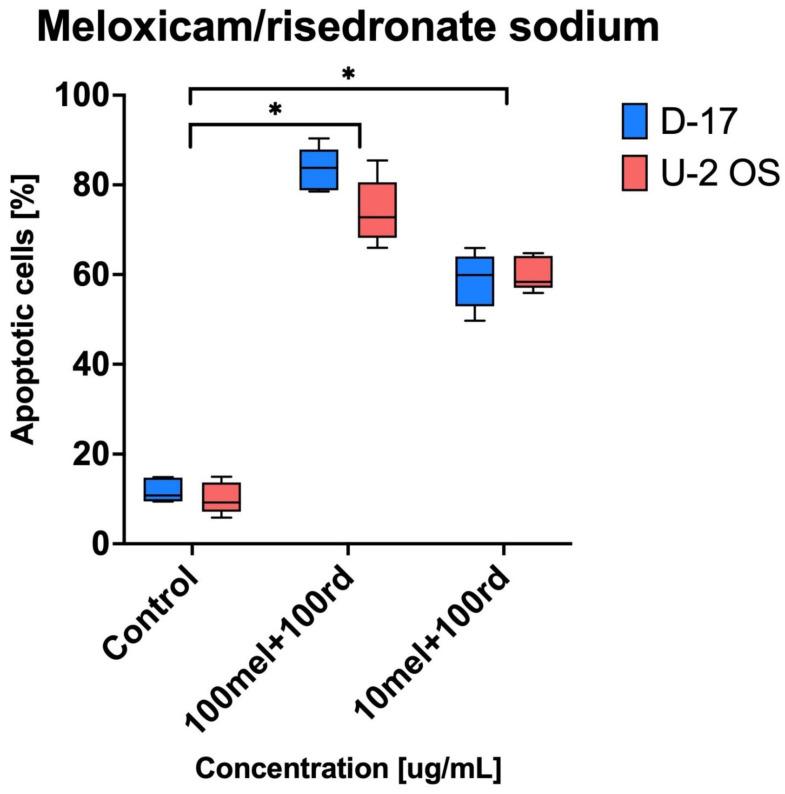
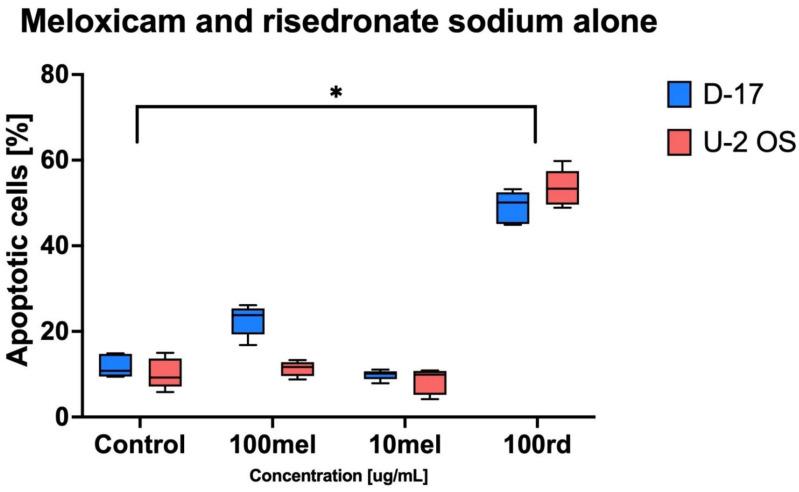
The study describes the cytotoxic effect against human and canine osteosarcoma (U-2 OS and D-17) cell lines induced by risedronate sodium and meloxicam per se and in combination. Both cell lines were prepared according to standard procedures for cell cultures studies. The cell viability was estimated in both cell lines treated with chosen concentrations of risedronate sodium and meloxicam. The apoptosis assessment was carried out using TUNEL (terminal deoxynucleotidyl transferase dUTP nick end labeling) assay. EC values, computed for risedronate sodium and meloxicam cytotoxicity, showed comparable effects against the canine OS cell line in similar concentration of both drugs. In case of human OS, the stronger cytotoxic effect of risedronate sodium was proved. The EC values for meloxicam in both cell lines were, statistically, significantly different (* < 0.05). Moreover, the cytotoxic effect of a combined administration of meloxicam and risedronate sodium in doses 100 µg/mL, compared with the negative control showed statistically significant differences. The human OS cell line was more resistant to both compounds than the canine OS cell line. The apoptotic effect in canine and human osteosarcoma triggered by risedronate sodium and meloxicam was statistically significant ( < 0.05). The cytotoxic effect induced with 100 µg/mL of risedronate sodium proved statistically significant differences between both tested cell lines compared to negative control. The results obtained with 10 and 100 µg/mL of meloxicam were not statistically significant. The study showed the synergic mechanism of action of risedronate sodium and meloxicam, but the concentrations used in vitro will not be possible to achieve in in vivo. Therefore, our results serve as basis only to design future studies on the tissue level.
该研究描述了利塞膦酸钠和美洛昔康本身及联合使用对人骨肉瘤(U-2 OS)和犬骨肉瘤(D-17)细胞系的细胞毒性作用。两种细胞系均按照细胞培养研究的标准程序制备。用选定浓度的利塞膦酸钠和美洛昔康处理两种细胞系后,评估细胞活力。使用TUNEL(末端脱氧核苷酸转移酶dUTP缺口末端标记)法进行凋亡评估。计算得出的利塞膦酸钠和美洛昔康细胞毒性的EC值显示,在两种药物浓度相似的情况下,对犬骨肉瘤细胞系的作用相当。对于人骨肉瘤,已证明利塞膦酸钠具有更强的细胞毒性作用。两种细胞系中美洛昔康的EC值在统计学上有显著差异(*P < 0.05)。此外,与阴性对照相比,100 µg/mL剂量的美洛昔康和利塞膦酸钠联合给药的细胞毒性作用显示出统计学上的显著差异。人骨肉瘤细胞系比犬骨肉瘤细胞系对这两种化合物更具抗性。利塞膦酸钠和美洛昔康引发的犬和人骨肉瘤中的凋亡作用在统计学上具有显著意义(P < 0.05)。与阴性对照相比,100 µg/mL利塞膦酸钠诱导的细胞毒性作用在两种测试细胞系之间显示出统计学上的显著差异。10和100 µg/mL美洛昔康获得的结果无统计学意义。该研究显示了利塞膦酸钠和美洛昔康的协同作用机制,但体外使用的浓度在体内无法达到。因此,我们的结果仅作为未来组织水平研究设计的基础。

 Zotero 插件