
新型药物治疗多发性骨髓瘤的成本效益分析系统评价
A Systematic Review of Cost-Effectiveness Analyses of Novel Agents in the Treatment of Multiple Myeloma.
作者信息
Seefat Maarten R, Cucchi David G J, Dirven Stijn, Groen Kaz, Zweegman Sonja, Blommestein Hedwig M
机构信息
Department of Hematology, Amsterdam UMC, Cancer Center Amsterdam, Vrije Universiteit Amsterdam, 1081 HV Amsterdam, The Netherlands.
Erasmus School of Health Policy and Management, Erasmus University Rotterdam, 3062 PA Rotterdam, The Netherlands.
出版信息
Cancers (Basel). 2021 Nov 9;13(22):5606. doi: 10.3390/cancers13225606.
BACKGROUND
Novel therapies for multiple myeloma (MM) promise to improve outcomes but are also associated with substantial increasing costs. Evidence regarding cost-effectiveness of novel treatments is necessary, but a comprehensive up-to-date overview of the cost-effectiveness evidence of novel treatments is currently lacking.
METHODS
We searched Embase, Medline via Ovid, Web of Science and EconLIT ProQuest to identify all cost-effectiveness evaluations of novel pharmacological treatment of MM reporting cost per quality-adjusted life year (QALY) and cost per life year (LY) gained since 2005. Quality and completeness of reporting was assessed using the Consolidated Health Economic Evaluation Reporting Standards.
RESULTS
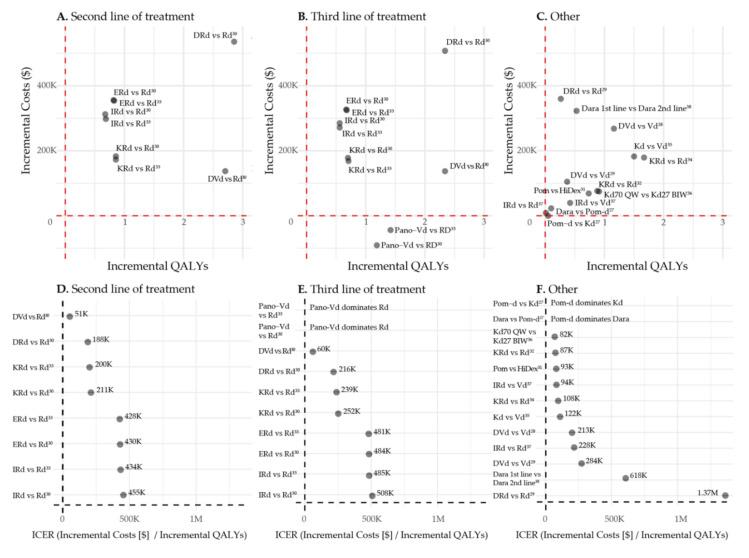
We identified 13 economic evaluations, comprising 32 comparisons. Our results show that novel agents generate additional LYs (range: 0.311-3.85) and QALYs (range: 0.1-2.85) compared to backbone regimens and 0.02 to 1.10 LYs and 0.01 to 0.91 QALYs for comparisons between regimens containing two novel agents. Lifetime healthcare costs ranged from USD 60,413 to 1,434,937 per patient. The cost-effectiveness ratios per QALY gained ranged from dominating to USD 1,369,062 for novel agents compared with backbone therapies and from dominating to USD 618,018 for comparisons between novel agents.
CONCLUSIONS
Cost-effectiveness ratios of novel agents were generally above current willingness-to-pay thresholds. To ensure access, cost-effectiveness should be improved or cost-effectiveness ratios above current thresholds should be accepted.
背景
多发性骨髓瘤(MM)的新型疗法有望改善治疗效果,但同时也伴随着成本大幅增加。关于新型治疗方法成本效益的证据很有必要,但目前缺乏对新型治疗方法成本效益证据的全面最新概述。
方法
我们检索了Embase、通过Ovid检索的Medline、Web of Science和EconLIT ProQuest,以识别自2005年以来所有关于MM新型药物治疗的成本效益评估,这些评估报告了每获得一个质量调整生命年(QALY)的成本和每获得一个生命年(LY)的成本。使用《卫生经济评估报告标准合并版》评估报告的质量和完整性。
结果
我们确定了13项经济评估,包括32项比较。我们的结果表明,与主干方案相比,新型药物可产生额外的生命年(范围:0.311 - 3.85)和质量调整生命年(范围:0.1 - 2.85),而在含两种新型药物方案之间的比较中,可产生0.02至1.10个生命年和0.01至0.91个质量调整生命年。每位患者的终身医疗成本从60,413美元到1,434,937美元不等。与主干疗法相比,新型药物每获得一个质量调整生命年的成本效益比范围从占优到1,369,062美元,而新型药物之间比较的成本效益比范围从占优到618,018美元。
结论
新型药物的成本效益比通常高于当前的支付意愿阈值。为确保可及性,应提高成本效益,或接受高于当前阈值的成本效益比。

 Zotero 插件