
未折叠蛋白反应、炎症与感染在囊性纤维化中的相互作用。
The Interplay between the Unfolded Protein Response, Inflammation and Infection in Cystic Fibrosis.
机构信息
Inserm, Univ Brest, EFS, UMR 1078, GGB, F-29200 Brest, France.
出版信息
Cells. 2021 Nov 2;10(11):2980. doi: 10.3390/cells10112980.
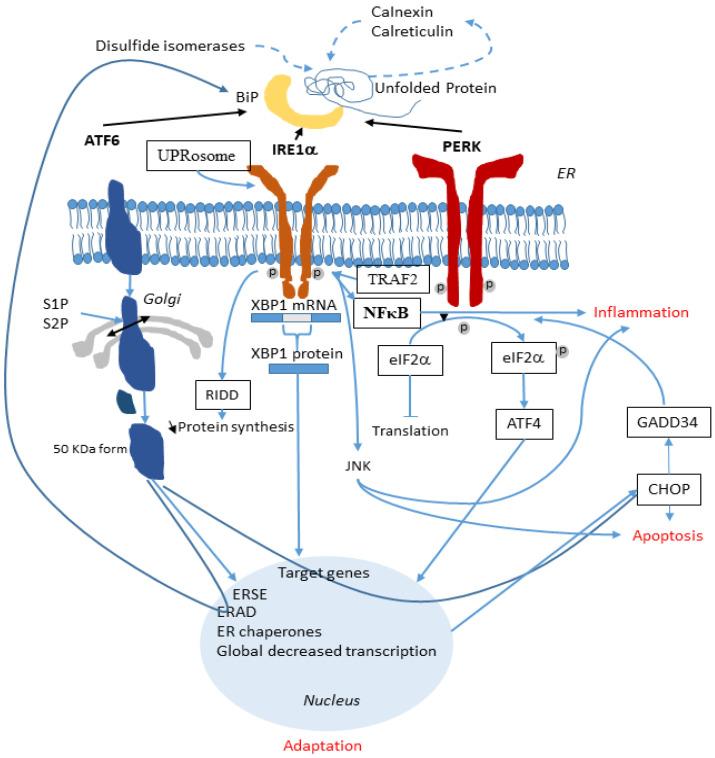
In cystic fibrosis (CF), p.Phe508del is the most frequent mutation in the Cystic Fibrosis Transmembrane conductance Regulator () gene. The p.Phe508del-CFTR protein is retained in the ER and rapidly degraded. This retention likely triggers an atypical Unfolded Protein Response (UPR) involving ATF6, which reduces the expression of p.Phe508del-CFTR. There are still some debates on the role of the UPR in CF: could it be triggered by the accumulation of misfolded CFTR proteins in the endoplasmic reticulum as was proposed for the most common CFTR mutation p.Phe508del? Or, is it the consequence of inflammation and infection that occur in the disease? In this review, we summarize recent findings on UPR in CF and show how infection, inflammation and UPR act together in CF. We propose to rethink their respective role in CF and to consider them as a whole.
在囊性纤维化 (CF) 中,p.Phe508del 是囊性纤维化跨膜电导调节因子 () 基因中最常见的突变。p.Phe508del-CFTR 蛋白滞留在内质网中并迅速降解。这种滞留可能会引发一种涉及 ATF6 的非典型未折叠蛋白反应 (UPR),从而降低 p.Phe508del-CFTR 的表达。关于 UPR 在 CF 中的作用仍存在一些争议:它是否会因内质网中错误折叠的 CFTR 蛋白积累而引发,就像最常见的 CFTR 突变 p.Phe508del 所提出的那样?或者,它是疾病中发生的炎症和感染的后果?在这篇综述中,我们总结了 CF 中 UPR 的最新发现,并展示了感染、炎症和 UPR 如何共同作用于 CF。我们建议重新思考它们在 CF 中的各自作用,并将它们视为一个整体。



 Zotero 插件