
来自安大略省人口健康数据的266324例首次发生的上肢骨折患者的4年队列骨折概况。
Fracture profiles of a 4-year cohort of 266,324 first incident upper extremity fractures from population health data in Ontario.
作者信息
MacDermid Joy C, McClure J Andrew, Richard Lucie, Faber Kenneth J, Jaglal Susan
机构信息
School of Physical Therapy, Western University, London, ON, Canada.
ICES Western, London, ON, Canada.
出版信息
BMC Musculoskelet Disord. 2021 Nov 29;22(1):996. doi: 10.1186/s12891-021-04849-7.
BACKGROUND
Understanding the profiles of different upper extremity fractures, particularly those presenting as a 1st incident can inform prevention and management strategies. The purpose of this population-level study was to describe first incident fractures of the upper extremity in terms of fracture characteristics and demographics.
METHODS
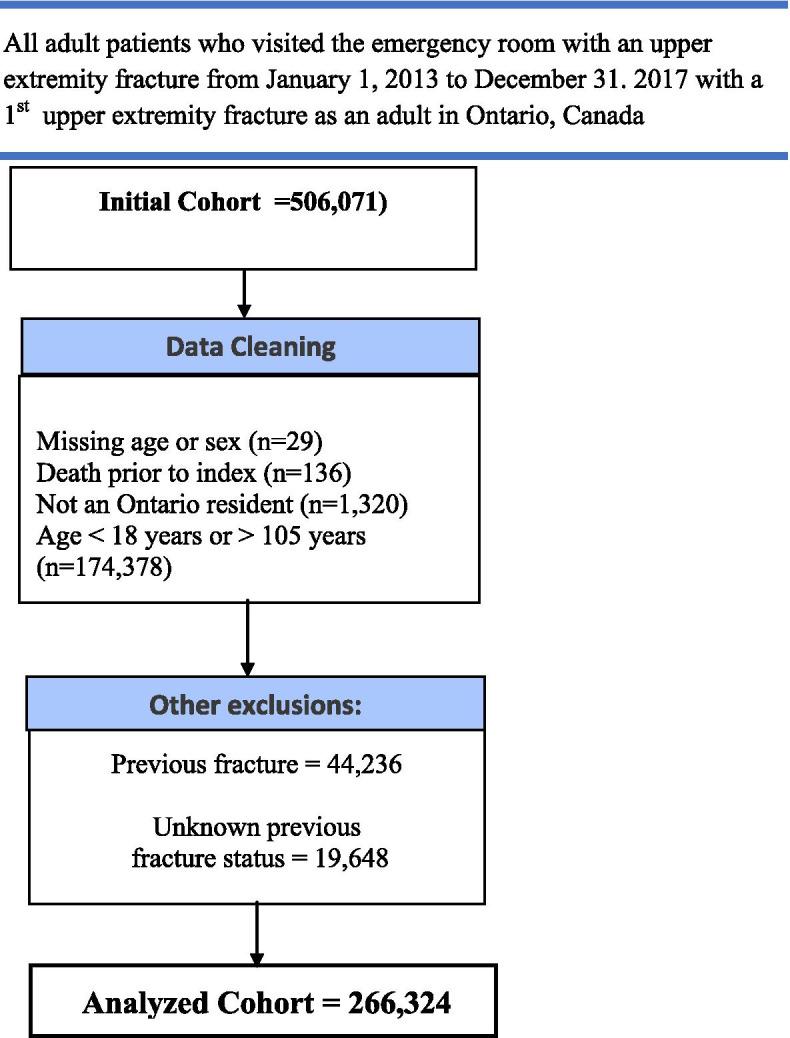
Cases with a first adult upper extremity (UE) fracture from the years 2013 to 2017 were extracted from administrative data in Ontario. Fracture locations (ICD-10 codes) and associated characteristics (open/closed, associated hospitalization within 1-day, associated nerve, or tendon injury) were described by fracture type, age category and sex. Standardized mean differences of at least 10% (clinical significance) and statistical significance (p < 0.01) in ANOVA were used to identify group differences (age/sex).
RESULTS
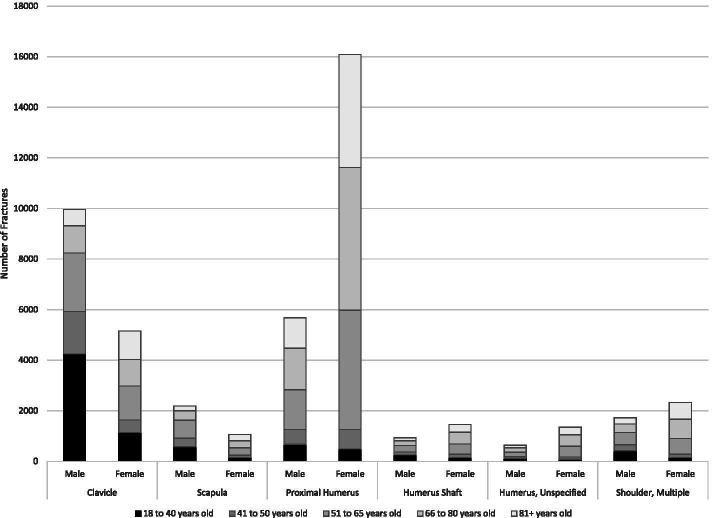
We identified 266,324 first incident UE fractures occurring over 4 years. The most commonly affected regions were the hand (93 K), wrist/forearm(80 K), shoulder (48 K) or elbow (35 K). The highest number of specific fractures were: distal radius (DRF, 47.4 K), metacarpal (30.4 K), phalangeal (29.9 K), distal phalangeal (24.4 K), proximal humerus (PHF, 21.7 K), clavicle (15.1 K), radial head (13.9 K), and scaphoid fractures (13.2 K). The most prevalent multiple fractures included: multiple radius and ulna fractures (11.8 K), fractures occurring in multiple regions of the upper extremity (8.7 K), or multiple regions in the forearm (8.4 K). Tendon (0.6% overall; 8.2% in multiple finger fractures) or nerve injuries were rarely reported (0.3% overall, 1.5% in distal humerus). Fractures were reported as being open in 4.7% of cases, most commonly for distal phalanx (23%). A similar proportion of females (51.5%) and males were present in this fracture cohort, but there were highly variant age-sex profiles across fracture subtypes. Fractures most common in 18-40-year-old males included metacarpal and finger fractures. Fractures common in older females were: DRF, PHF and radial head, which exhibited a dramatic increase in the over-50 age group.
CONCLUSIONS
UE fracture profiles vary widely by fracture type. Fracture specific prevention and management should consider fracture profiles that are highly variable according to age and sex.
背景
了解不同上肢骨折的特征,尤其是首次发生的骨折,可为预防和管理策略提供依据。这项基于人群的研究旨在根据骨折特征和人口统计学描述上肢首次发生的骨折情况。
方法
从安大略省的行政数据中提取2013年至2017年首次发生成人上肢(UE)骨折的病例。按骨折类型、年龄类别和性别描述骨折部位(ICD-10编码)及相关特征(开放性/闭合性、1天内相关住院治疗、相关神经或肌腱损伤)。方差分析中标准化平均差异至少为10%(临床意义)且具有统计学意义(p < 0.01)用于识别组间差异(年龄/性别)。
结果
我们确定了4年期间发生的266,324例首次发生的UE骨折。最常受影响的区域是手部(93,000例)、腕部/前臂(80,000例)、肩部(48,000例)或肘部(35,000例)。特定骨折数量最多的是:桡骨远端骨折(DRF,47,400例)、掌骨骨折(30,400例)、指骨骨折(29,900例)、远端指骨骨折(24,400例)、肱骨近端骨折(PHF,21,700例)、锁骨骨折(15,100例)、桡骨头骨折(13,900例)和舟骨骨折(13,200例)。最常见的多发骨折包括:桡骨和尺骨多发骨折(11,800例)、上肢多个区域发生的骨折(8,700例)或前臂多个区域的骨折(8,400例)。肌腱损伤(总体0.6%;多指骨折中8.2%)或神经损伤很少见(总体0.3%,肱骨远端骨折中1.5%)。4.7%的病例报告骨折为开放性,最常见于远端指骨(23%)。该骨折队列中女性(51.5%)和男性比例相似,但不同骨折亚型的年龄 - 性别分布差异很大。18 - 40岁男性中最常见的骨折包括掌骨和指骨骨折。老年女性中常见的骨折是:桡骨远端骨折、肱骨近端骨折和桡骨头骨折,在年龄超过50岁的人群中显著增加。
结论
上肢骨折情况因骨折类型而异。针对特定骨折的预防和管理应考虑根据年龄和性别高度变化的骨折情况。




 Zotero 插件