
说服美国白人福音派信徒接种 COVID-19 疫苗:2020 年秋季和 2021 年春季测试信息有效性。
Persuading US White evangelicals to vaccinate for COVID-19: Testing message effectiveness in fall 2020 and spring 2021.
机构信息
Institution for Social and Policy Studies, Yale University, New Haven, CT 06511.
Center for the Study of American Politics, Yale University, New Haven, CT 06511.
出版信息
Proc Natl Acad Sci U S A. 2021 Dec 7;118(49). doi: 10.1073/pnas.2114762118.
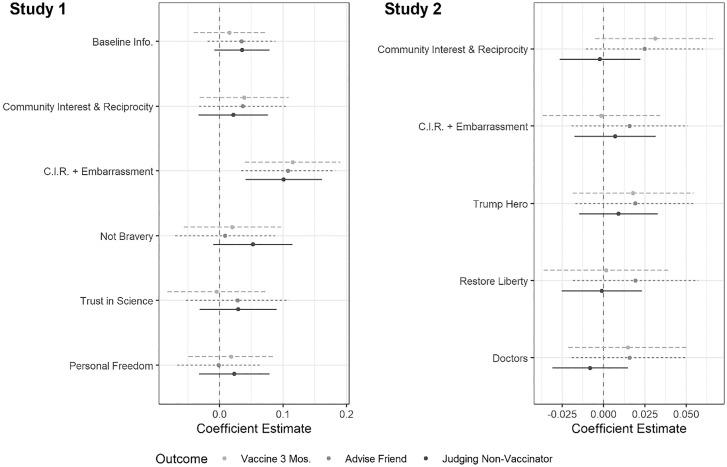
The development of COVID-19 vaccines was an important breakthrough for ending the pandemic. However, people refusing to get vaccinated diminish the level of community protection afforded to others. In the United States, White evangelicals have proven to be a particularly difficult group to convince to get vaccinated. Here we investigate whether this group can be persuaded to get vaccinated. To do this, we leverage data from two survey experiments, one fielded prior to approval of COVID-19 vaccines (study 1) and one fielded after approval (study 2). In both experiments, respondents were randomly assigned to treatment messages to promote COVID-19 vaccination. In study 1, we find that a message that emphasizes community interest and reciprocity with an invocation of embarrassment for choosing not to vaccinate is the most effective at increasing uptake intentions, while values-consistent messaging appears to be ineffective. In contrast, in study 2 we observe that this message is no longer effective and that most messages produce little change in vaccine intent. This inconsistency may be explained by the characteristics of White evangelicals who remain unvaccinated vis à vis those who got vaccinated. These results demonstrate the importance of retesting messages over time, the apparent limitations of values-targeted messaging, and document the need to consider heterogeneity even within well-defined populations. This work also cautions against drawing broad conclusions from studies carried out at a single point in time during the COVID-19 pandemic.
COVID-19 疫苗的研发是终结大流行的重要突破。然而,拒绝接种疫苗的人会降低对他人的社区保护水平。在美国,白人福音派教徒已被证明是一个特别难以说服接种疫苗的群体。在这里,我们调查了这一群体是否可以被说服接种疫苗。为此,我们利用了两项调查实验的数据,一项在 COVID-19 疫苗获得批准之前进行(研究 1),一项在批准之后进行(研究 2)。在这两项实验中,受访者被随机分配到促进 COVID-19 疫苗接种的治疗信息中。在研究 1 中,我们发现,强调社区利益和互惠,以及援引不接种疫苗会让人感到尴尬的信息,是最能提高接种意愿的,而与价值观一致的信息则似乎没有效果。相比之下,在研究 2 中,我们观察到这种信息不再有效,而且大多数信息对疫苗接种意愿几乎没有改变。这种不一致可能是由于未接种疫苗的白人福音派教徒的特征与已接种疫苗的教徒的特征不同所导致的。这些结果表明,随着时间的推移,重新测试信息非常重要,针对价值观的信息传递存在明显的局限性,即使在明确界定的人群中,也需要考虑异质性。这项工作还告诫人们,不要从 COVID-19 大流行期间的单一时间点进行的研究中得出广泛的结论。
 Zotero 插件