
多黏菌素敏感和耐药鲍曼不动杆菌临床分离株属于国际克隆 7 型之间的重组事件。
Recombination Events among Colistin-Susceptible and -Resistant Acinetobacter baumannii Clinical Isolates Belonging to International Clone 7.
机构信息
Universidade Federal de São Paulo-UNIFESP, Laboratório Alerta, Division of Infectious Diseases, Department of Internal Medicine, Escola Paulista de Medicina (EPM), São Paulo, Brazil.
Institute for Medical Microbiology, Immunology and Hygiene, Faculty of Medicine and University Hospital Cologne, University of Colognegrid.6190.e, Cologne, Germany.
出版信息
mSphere. 2021 Dec 22;6(6):e0074621. doi: 10.1128/msphere.00746-21. Epub 2021 Dec 1.
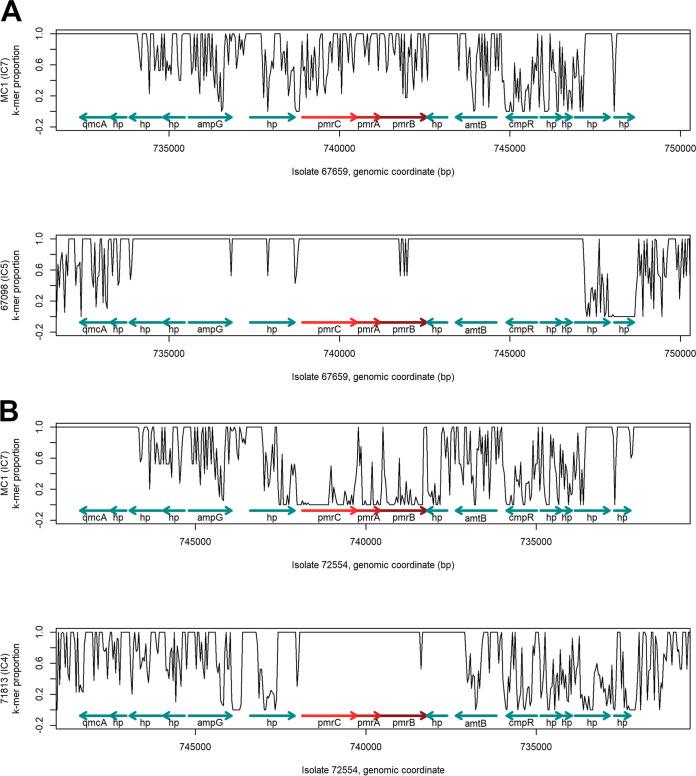
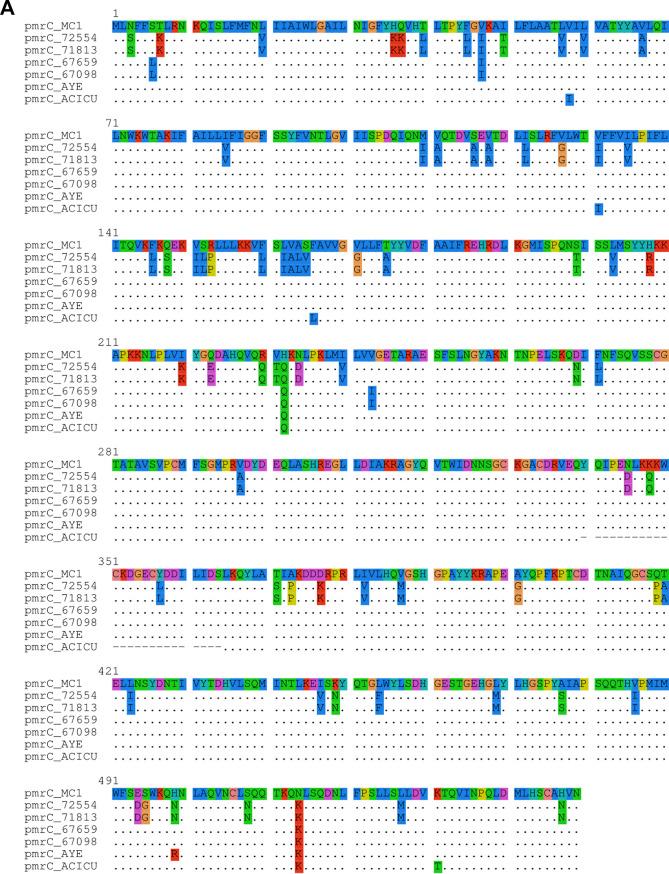
Acinetobacter baumannii is a successful nosocomial pathogen due to its genomic plasticity. Homologous recombination allows genetic exchange and allelic variation among different clonal lineages and is one of the mechanisms associated with horizontal gene transfer (HGT) of resistance determinants. The main mechanism of colistin resistance in A. baumannii is mediated through mutations in the operon. Here, we describe two A. baumannii clinical isolates belonging to International Clone 7 (IC7) that have undergone recombination in the operon and evaluate the contribution of mobile genetic elements (MGE) to this phenomenon. Isolates 67569 and 72554 were colistin susceptible and resistant, respectively, and were submitted for short- and long-read genome sequencing using Illumina MiSeq and MinION platforms. Hybrid assemblies were built with Unicycler, and the assembled genomes were compared to reference genomes using NUCmer, Cortex, and SplitsTree. Genomes were annotated using Prokka, and MGEs were identified with ISfinder and repeat match. Both isolates presented a 21.5-kb recombining region encompassing . In isolate 67659, this region originated from IC5, while in isolate 72554 multiple recombination events might have happened, with the 5-kb recombining region encompassing associated with an isolate representing IC4. We could not identify MGEs involved in the mobilization of in these isolates. In summary, A. baumannii belonging to IC7 can present additional sequence divergence due to homologous recombination across clonal lineages. Such variation does not seem to be driven by antibiotic pressure but could contribute to HGT mediating colistin resistance. Colistin resistance rates among Acinetobacter baumannii clinical isolates have increased over the last 20 years. Despite reports of the spread of plasmid-mediated colistin resistance among , the presence of -type genes in Acinetobacter spp. remains rare, and reduced colistin susceptibility is mainly associated with the acquisition of nonsynonymous mutations in . We have recently demonstrated that distinct sequences are associated with different A. baumannii International Clones (IC). In this study, we identified the presence of homologous recombination as an additional cause of genetic variation in this operon, which, to the best of our knowledge, was not mediated by mobile genetic elements. Even though this phenomenon was observed in both colistin-susceptible and -resistant isolates, it has the potential to contribute to the spread of resistance-conferring alleles, leading to reduced susceptibility to this last-resort antimicrobial agent.
鲍曼不动杆菌由于其基因组的可塑性,成为一种成功的医院病原体。同源重组允许不同克隆谱系之间的基因交换和等位基因变异,是与耐药决定因素水平基因转移(HGT)相关的机制之一。鲍曼不动杆菌中多粘菌素耐药的主要机制是通过 操纵子中的突变介导的。在这里,我们描述了属于国际克隆 7(IC7)的两个鲍曼不动杆菌临床分离株,它们在 操纵子中发生了重组,并评估了移动遗传元件(MGE)对此现象的贡献。分离株 67569 和 72554 分别对多粘菌素敏感和耐药,并使用 Illumina MiSeq 和 MinION 平台进行了短读长和长读长基因组测序。使用 Unicycler 构建杂交组装,并使用 NUCmer、Cortex 和 SplitsTree 将组装的基因组与参考基因组进行比较。使用 Prokka 对基因组进行注释,并使用 ISfinder 和重复匹配识别 MGE。两个分离株均呈现 21.5kb 的重组区域,包含 。在分离株 67659 中,该区域来源于 IC5,而在分离株 72554 中,可能发生了多次重组事件,与代表 IC4 的分离株相关的 5kb 重组区域包含 。我们无法确定参与该区域 移动的 MGE。总之,属于 IC7 的鲍曼不动杆菌由于克隆谱系之间的同源重组,可以呈现额外的序列差异。这种变异似乎不是由抗生素压力驱动的,但可能有助于介导多粘菌素耐药的 HGT。过去 20 年来,鲍曼不动杆菌临床分离株的多粘菌素耐药率有所增加。尽管有报道称质粒介导的多粘菌素耐药在 中传播,但 型基因在不动杆菌属中的存在仍然很少见,而对多粘菌素的低敏感性主要与 中非同义突变的获得有关。我们最近证明,不同的 序列与不同的鲍曼不动杆菌国际克隆(IC)相关。在这项研究中,我们确定了同源重组的存在是该操纵子中遗传变异的另一个原因,据我们所知,这种重组不是由移动遗传元件介导的。尽管这种现象在多粘菌素敏感和耐药的分离株中都观察到,但它有可能导致耐药等位基因的传播,导致对这种最后手段的抗菌药物的敏感性降低。
 Zotero 插件