
老挝人民民主共和国人类和动物部门的抗菌药物使用和耐药数据:为政策提供信息的证据。
Antimicrobial use and resistance data in human and animal sectors in the Lao PDR: evidence to inform policy.
机构信息
Microbiology Laboratory, Mahosot Hospital, Vientiane, Lao People's Democratic Republic
Lao-Oxford-Mahosot Hospital-Wellcome Trust Research Unit (LOMWRU), Mahosot Hospital, Vientiane, Lao People's Democratic Republic.
出版信息
BMJ Glob Health. 2021 Nov;6(12). doi: 10.1136/bmjgh-2021-007009.
OBJECTIVES
To review the scientific evidence base on antimicrobial use (AMU) and antimicrobial resistance (AMR) in human and animal sectors in the Lao PDR (Laos).
METHODS
We reviewed all publications from July 1994 (the first article describing AMR in Laos) to December 2020. Electronic searches were conducted using Google Scholar and PubMed with specific terms relating to AMR and AMU in Lao, French and English languages.
FINDINGS
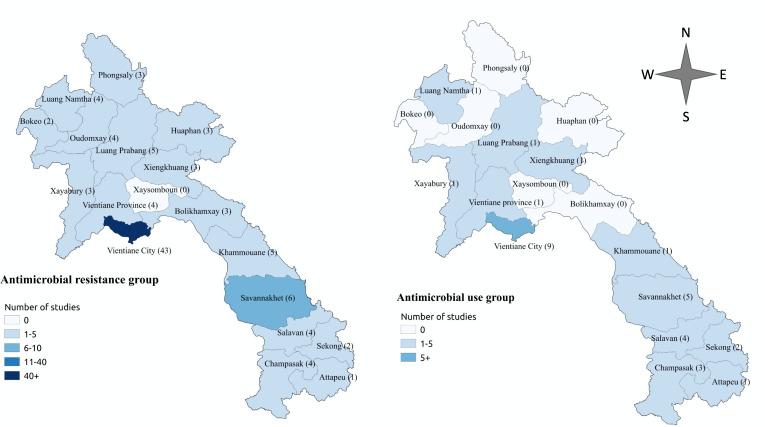
We screened 1,357 peer-reviewed and grey reports by title and abstract and then full articles/reports. Of 80 included, 66 (83%) related to human health, nine (11%) to animal health, four (5%) to both animal and human health and one (1%) to the environment. Sixty-two (78%) were on AMR and 18 (22%) on AMU. Extended spectrum beta lactamase-producing was the greatest concern identified; the proportion of isolates increased fivefold from 2004 to 2016 (2/28 (7%) to 27/78 (35%)) from blood cultures submitted to the Microbiology Laboratory, Mahosot Hospital, Vientiane. Carbapenem resistant was first identified in 2015. Methicillin-resistant (MRSA) was uncommon, with 15 cases of MRSA from blood cultures between its first identification in 2017 and December 2020. AMR patterns of global antimicrobial resistance surveillance system (GLASS) target pathogens from livestock were less well documented. There were few data on AMU in human health and none on AMU in livestock. The first hospital AMU survey in Laos showed that 70% (1,386/1,981) of in-patients in five hospitals from 2017 to 2018 received antimicrobial(s). Antibiotic self-medication was common.
CONCLUSION
AMR in Laos is occurring at relatively low proportions for some GLASS pathogens, giving the country a window of opportunity to act quickly to implement strategies to protect the population from a worsening situation. Urgent interventions to roll out new guidelines with enhanced one-health antibiotic stewardship, reduce antibiotic use without prescriptions, enhance surveillance and improve understanding of AMU and AMR are needed.
目的
审查老挝人民民主共和国(老挝)人畜部门抗菌药物使用(AMU)和抗菌药物耐药性(AMR)的科学依据。
方法
我们检索了 1994 年 7 月(第一篇描述老挝 AMR 的文章)至 2020 年 12 月期间的所有出版物。使用 Google Scholar 和 PubMed 以老挝语、法语和英语特定术语进行电子检索,涉及 AMR 和 AMU。
发现
我们通过标题和摘要以及全文/报告筛选了 1357 篇同行评议和灰色报告。80 篇纳入的文章中,66 篇(83%)与人类健康有关,9 篇(11%)与动物健康有关,4 篇(5%)与动物和人类健康有关,1 篇(1%)与环境有关。62 篇(78%)涉及 AMR,18 篇(22%)涉及 AMU。产超广谱β-内酰胺酶的情况最为令人担忧;2004 年至 2016 年,送检万象玛霍索医院微生物实验室的血培养标本中,分离株的比例增加了五倍(2/28(7%)至 27/78(35%))。2015 年首次发现耐碳青霉烯类肠杆菌科细菌。耐甲氧西林金黄色葡萄球菌(MRSA)少见,2017 年首次发现 MRSA 至 2020 年 12 月,从血培养中分离出 15 例 MRSA。全球抗菌药物耐药性监测系统(GLASS)目标病原体在牲畜中的耐药模式记录较少。人类健康中 AMU 的数据很少,牲畜中则没有。老挝的首次医院 AMU 调查显示,2017 年至 2018 年,五家医院的 1386/1981 名住院患者接受了抗菌药物治疗。抗生素自我用药很常见。
结论
对于一些 GLASS 病原体,老挝的 AMR 发生率相对较低,该国还有机会迅速采取行动,实施保护民众免受情况恶化的战略。迫切需要开展新的干预措施,推广具有增强的一体化卫生抗生素管理的新指南,减少无处方使用抗生素,加强监测,提高对抗生素使用和耐药性的认识。


 Zotero 插件