
由表皮生长因子受体靶向脂质多聚体介导的胶质母细胞瘤选择性钠碘同向转运体()基因治疗。
Selective sodium iodide symporter () genetherapy of glioblastoma mediatedby EGFR-targeted lipopolyplexes.
作者信息
Spellerberg Rebekka, Benli-Hoppe Teoman, Kitzberger Carolin, Berger Simone, Schmohl Kathrin A, Schwenk Nathalie, Yen Hsi-Yu, Zach Christian, Schilling Franz, Weber Wolfgang A, Kälin Roland E, Glass Rainer, Nelson Peter J, Wagner Ernst, Spitzweg Christine
机构信息
Department of Internal Medicine IV, University Hospital, LMU Munich, 81377 Munich, Germany.
Pharmaceutical Biotechnology, Department of Pharmacy, LMU Munich, 81377 Munich, Germany.
出版信息
Mol Ther Oncolytics. 2021 Oct 30;23:432-446. doi: 10.1016/j.omto.2021.10.011. eCollection 2021 Dec 17.
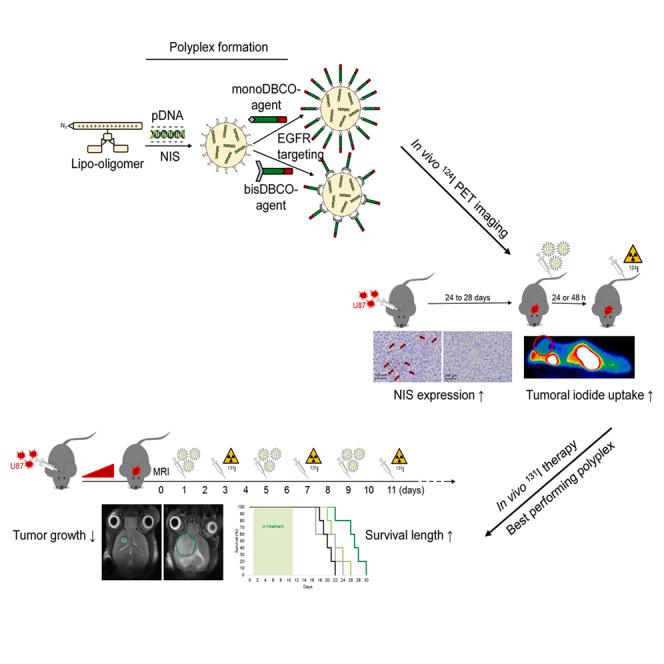
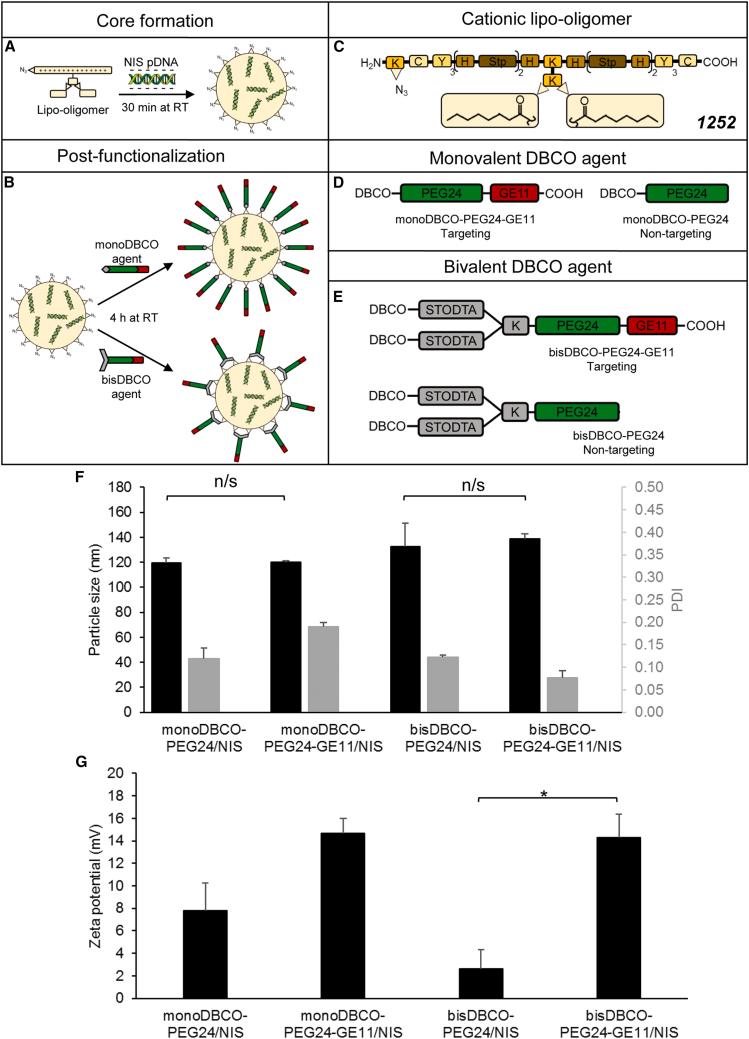
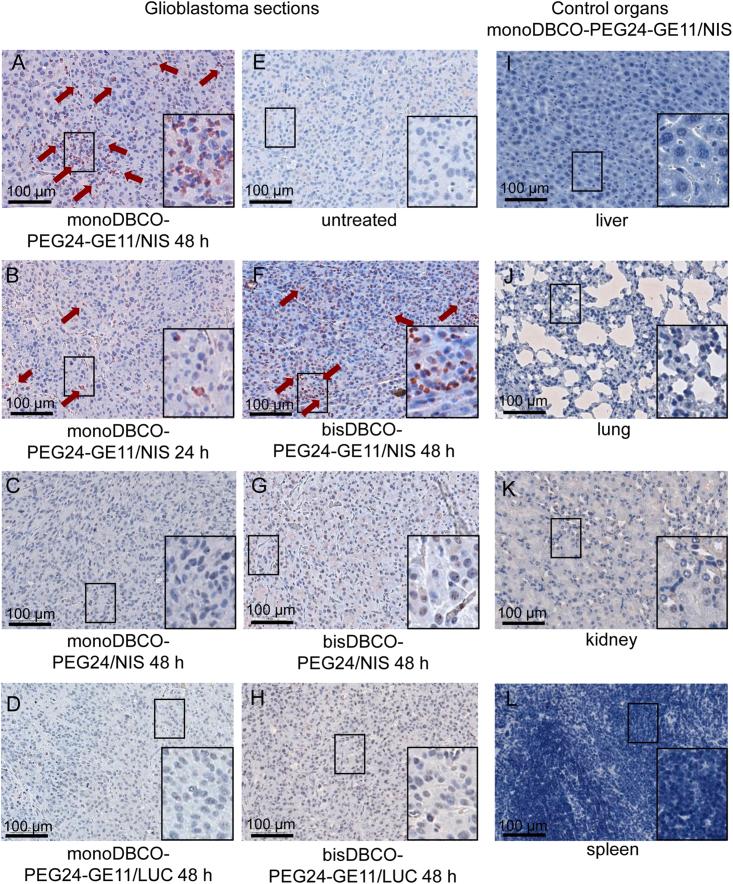
Lipo-oligomers, post-functionalized with ligands to enhance targeting, represent promising new vehicles for the tumor-specific delivery of therapeutic genes such as the sodium iodide symporter (). Due to its iodide trapping activity, NIS is a powerful theranostic tool for diagnostic imaging and the application of therapeutic radionuclides. I PET imaging allows non-invasive monitoring of the biodistribution of functional NIS expression, and application of I enables cytoreduction. In our experimental design, we used epidermal growth factor receptor (EGFR)-targeted polyplexes (GE11) initially characterized using I uptake assays. Mice bearing an orthotopic glioblastoma were treated subsequently with mono-dibenzocyclooctyne (DBCO)-PEG-GE11/NIS or bisDBCO-PEG-GE11/NIS, and 24-48 h later, I uptake was assessed by positron emission tomography (PET) imaging. The best-performing polyplex in the imaging studies was then selected for I therapy studies. The studies showed EGFR-dependent and NIS-specific transfection efficiency of the polyplexes. The injection of monoDBCO-PEG-GE11/NIS polyplexes 48 h before I application was characterized to be the optimal regime in the imaging studies and was therefore used for an I therapy study, showing a significant decrease in tumor growth and a significant extension of survival in the therapy group. These studies demonstrate the potential of EGFR-targeted polyplex-mediated gene therapy as a new strategy for the therapy of glioblastoma.
通过配体进行后功能化以增强靶向性的脂寡聚物,是用于肿瘤特异性递送治疗性基因(如碘化钠同向转运体)的有前景的新型载体。由于其碘捕获活性,NIS是用于诊断成像和治疗性放射性核素应用的强大诊疗工具。¹²⁵I正电子发射断层扫描(PET)成像可对功能性NIS表达的生物分布进行非侵入性监测,而¹³¹I的应用可实现细胞减灭。在我们的实验设计中,我们使用了最初通过¹²⁵I摄取试验表征的表皮生长因子受体(EGFR)靶向性多聚体(GE11)。随后,对携带原位胶质母细胞瘤的小鼠用单二苯并环辛炔(DBCO)-聚乙二醇(PEG)-GE11/NIS或双DBCO-PEG-GE11/NIS进行治疗,24至48小时后,通过正电子发射断层扫描(PET)成像评估¹²⁵I摄取情况。然后选择成像研究中表现最佳的多聚体进行¹³¹I治疗研究。研究表明多聚体具有EGFR依赖性和NIS特异性转染效率。在¹³¹I应用前48小时注射单DBCO-PEG-GE11/NIS多聚体被确定为成像研究中的最佳方案,因此用于¹³¹I治疗研究,结果显示治疗组肿瘤生长显著减少,生存期显著延长。这些研究证明了EGFR靶向性多聚体介导的基因治疗作为胶质母细胞瘤治疗新策略的潜力。




 Zotero 插件