
特发性肺纤维化中的端粒功能障碍
Telomere Dysfunction in Idiopathic Pulmonary Fibrosis.
作者信息
Zhang Kexiong, Xu Lu, Cong Yu-Sheng
机构信息
Key Laboratory of Aging and Cancer Biology of Zhejiang Province, School of Basic Medical Sciences, Hangzhou Normal University, Hangzhou, China.
出版信息
Front Med (Lausanne). 2021 Nov 11;8:739810. doi: 10.3389/fmed.2021.739810. eCollection 2021.
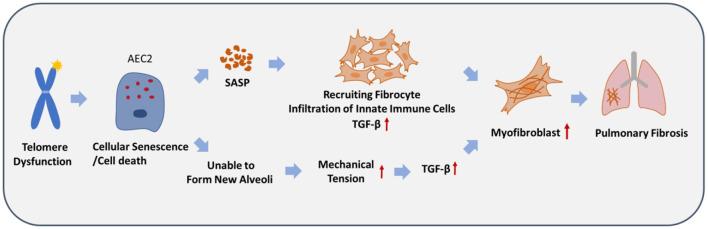
Idiopathic pulmonary fibrosis is an age-dependent progressive and fatal lung disease of unknown etiology, which is characterized by the excessive accumulation of extracellular matrix inside the interstitial layer of the lung parenchyma that leads to abnormal scar architecture and compromised lung function capacity. Recent genetic studies have attributed the pathological genes or genetic mutations associated with familial idiopathic pulmonary fibrosis (IPF) and sporadic IPF to telomere-related components, suggesting that telomere dysfunction is an important determinant of this disease. In this study, we summarized recent advances in our understanding of how telomere dysfunction drives IPF genesis. We highlighted the key role of alveolar stem cell dysfunction caused by telomere shortening or telomere uncapping, which bridged the gap between telomere abnormalities and fibrotic lung pathology. We emphasized that senescence-associated secretory phenotypes, innate immune cell infiltration, and/or inflammation downstream of lung stem cell dysfunction influenced the native microenvironment and local cell signals, including increased transforming growth factor-beta (TGF-β) signaling in the lung, to induce pro-fibrotic conditions. In addition, the failed regeneration of new alveoli due to alveolar stem cell dysfunction might expose lung cells to elevated mechanical tension, which could activate the TGF-β signaling loop to promote the fibrotic process, especially in a periphery-to-center pattern as seen in IPF patients. Understanding the telomere-related molecular and pathophysiological mechanisms of IPF would provide new insights into IPF etiology and therapeutic strategies for this fatal disease.
特发性肺纤维化是一种病因不明、与年龄相关的进行性致命性肺部疾病,其特征是肺实质间质层内细胞外基质过度积聚,导致异常瘢痕结构和肺功能受损。最近的基因研究已将与家族性特发性肺纤维化(IPF)和散发性IPF相关的病理基因或基因突变归因于端粒相关成分,这表明端粒功能障碍是该疾病的一个重要决定因素。在本研究中,我们总结了目前对端粒功能障碍如何驱动IPF发生的理解方面的最新进展。我们强调了端粒缩短或端粒解帽导致的肺泡干细胞功能障碍的关键作用,它弥合了端粒异常与肺纤维化病理之间的差距。我们强调,肺干细胞功能障碍下游的衰老相关分泌表型、固有免疫细胞浸润和/或炎症影响了天然微环境和局部细胞信号,包括肺中转化生长因子-β(TGF-β)信号增加,从而诱导促纤维化状态。此外,由于肺泡干细胞功能障碍导致的新肺泡再生失败可能使肺细胞暴露于升高的机械张力下,这可能激活TGF-β信号回路以促进纤维化过程,尤其是在IPF患者中所见的从外周到中心的模式。了解IPF与端粒相关的分子和病理生理机制将为IPF的病因和这种致命疾病的治疗策略提供新的见解。
 Zotero 插件