
外泌体非编码 RNA:癌细胞和巨噬细胞之间双向通讯的新兴作用。
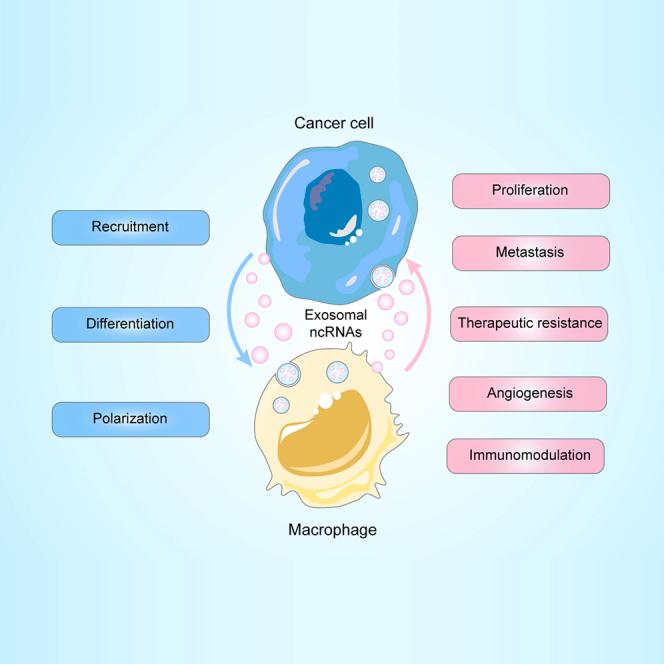
Exosomal non-coding RNAs: Emerging roles in bilateral communication between cancer cells and macrophages.
机构信息
Department of Breast Surgery, General Surgery, Qilu Hospital, Cheeloo College of Medicine, Shandong University, Jinan, Shandong 250012, China.
Department of Breast Surgery, General Surgery, Qilu Hospital, Cheeloo College of Medicine, Shandong University, Jinan, Shandong 250012, China; Department of Pathology Tissue Bank, Qilu Hospital, Cheeloo College of Medicine, Shandong University, Jinan, Shandong 250012, China; Research Institute of Breast Cancer, Shandong University, Jinan, Shandong 250012, China.
出版信息
Mol Ther. 2022 Mar 2;30(3):1036-1053. doi: 10.1016/j.ymthe.2021.12.002. Epub 2021 Dec 2.
The tumor microenvironment (TME) is a dynamic network of cellular organization that comprises diverse cell types and significantly contributes to cancer development. As pivotal immune stromal cells in the TME, macrophages are extensively heterogeneous and exert both antitumor and protumor functions. Exosomes are nanosized extracellular membranous vesicles with diameters between 30 and 150 nm. By transferring multiple bioactive substances such as proteins, lipids, and nucleic acids, exosomes play an important role in the communication between cells. Recently, growing evidence has demonstrated that non-coding RNAs (ncRNAs) are enriched in exosomes and that exosomal ncRNAs are involved in the crosstalk between cancer cells and macrophages. Furthermore, circulating exosomal ncRNAs can be detected in biofluids, serving as promising noninvasive biomarkers for the early diagnosis and prognostic prediction of cancer. Exosome-based therapies are emerging as potent strategies that can be utilized to alleviate tumor progression. Herein, the present knowledge of exosomal ncRNAs and their vital roles in regulating the interplay between cancer cells and macrophages, as well as their clinical applications are summarized.
肿瘤微环境(TME)是一个动态的细胞组织网络,包含多种细胞类型,对癌症的发展有重要贡献。巨噬细胞作为 TME 中的主要免疫基质细胞,具有广泛的异质性,并发挥着抗肿瘤和促肿瘤的双重作用。外泌体是直径在 30 至 150nm 之间的纳米尺寸的细胞外膜囊泡。通过传递多种生物活性物质,如蛋白质、脂质和核酸,外泌体在细胞间通讯中发挥着重要作用。最近的研究证据表明,非编码 RNA(ncRNA)在外泌体中富集,外泌体 ncRNA 参与癌细胞与巨噬细胞之间的串扰。此外,循环外泌体 ncRNA 可以在生物体液中检测到,作为癌症早期诊断和预后预测的有前途的非侵入性生物标志物。基于外泌体的治疗方法作为一种有效的策略正在兴起,可以用来减轻肿瘤的进展。本文总结了外泌体 ncRNA 的现有知识及其在调节癌细胞和巨噬细胞相互作用中的重要作用,以及它们的临床应用。
 Zotero 插件