
化疗联合卡培他滨治疗三阴性乳腺癌的临床价值——一项荟萃分析
The Clinical Value of Chemotherapy Combined With Capecitabine in Triple-Negative Breast Cancer-A Meta-Analysis.
作者信息
Zhang Zilin, Ma Kai, Li Jing, Guan Yeneng, Yang Chaobo, Yan Aqin, Zhu Hongda
机构信息
Key Laboratory of Fermentation Engineering (Ministry of Education), Hubei Key Laboratory of Industrial Microbiology, National "111" Center for Cellular Regulation and Molecular Pharmaceutics, School of Food and Biological Engineering, Hubei University of Technology, Wuhan, China.
Pharmaceutical Department, Hubei Cancer Hospital, Tongji Medical College, Huazhong University of Science and Technology, Wuhan, China.
出版信息
Front Pharmacol. 2021 Nov 15;12:771839. doi: 10.3389/fphar.2021.771839. eCollection 2021.
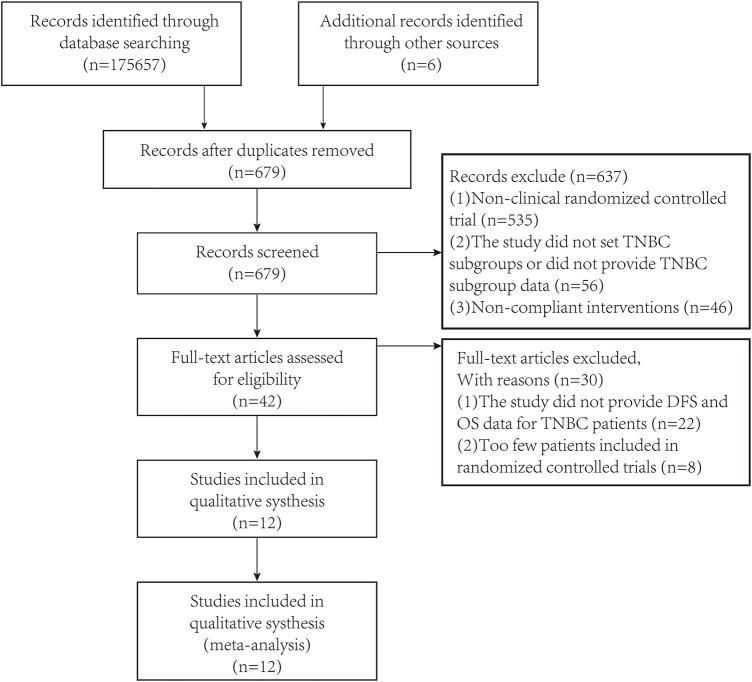
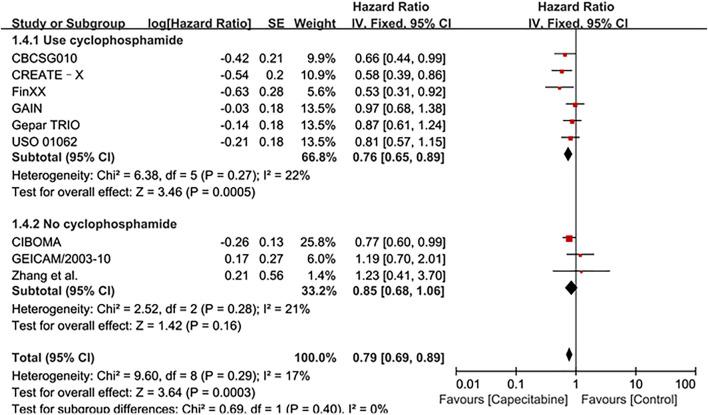
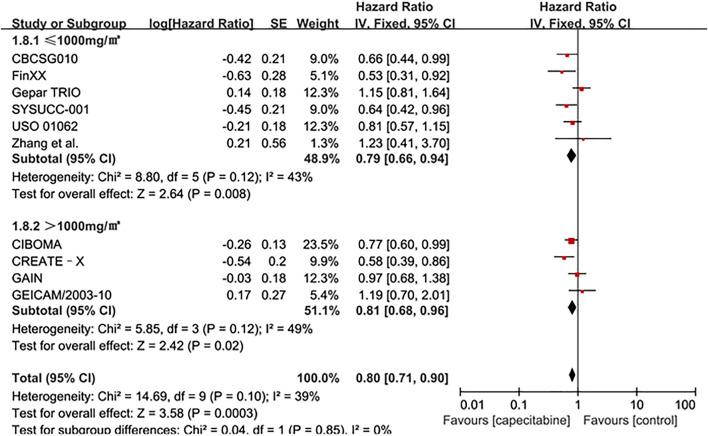
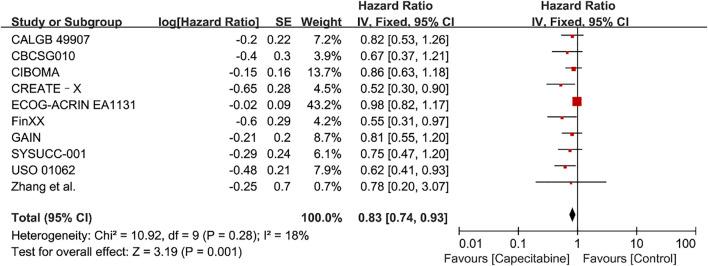
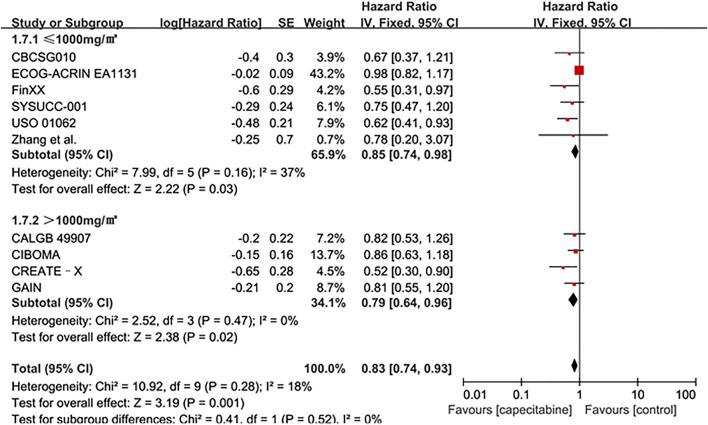
Triple-negative breast cancer (TNBC) is the most dangerous subtype of breast cancer with high rates of metastasis and recurrence. The efficacy of capecitabine in chemotherapy for TNBC is still controversial. This study evaluated the efficacy and safety of capecitabine combining with standard, adjuvant or neoadjuvant chemotherapy for TNBC. We systematically searched clinical studies through PubMed, Cochrane library, Embase, Wanfang Database, China Academic Journals (CNKI), and American Society of Clinical Oncology's (ASCO) annual conference report. Studies were assessed for design and quality by the Cochrane risk of bias tool. A meta-analysis was performed using Review Manager to quantify the effect of capecitabine combined with standard, adjuvant or neoadjuvant chemotherapy on the disease-free survival (DFS) rate and overall survival (OS) rate of TNBC patients. Furthermore, safety analysis was performed to evaluate the adverse events. Twelve randomized controlled clinical trials involving totally 4854 TNBC patients were included, of which 2,214 patients received chemotherapy as control group, and 2,278 patients received capecitabine combining with chemotherapy. The results indicated that capecitabine could significantly improve the DFS [hazard ratio (HR) 0.80, 95% confidence interval (CI) 0.71-0.90, = 0.0003] and OS (HR 0.83, 95% CI 0.74-0.93, = 0.001). In subgroup analysis, the combination of capecitabine and cyclophosphamide exhibited a significant benefit in all outcomes (DFS HR 0.75, 95% CI 0.63-0.90, = 0.002; OS HR 0.65, 95% CI 0.52-0.80, 0.0001). Additionally, defferent dose of capecitabine subgroup showed same significant effect on the results. Safety analysis showed that the addition of capecitabine was associated with a much higher risk of hand-foot syndrome, diarrhea and mucositis or stomatitis. The results showed that adjuvant capecitabine could bring significant benefits on DFS and OS to unselected TNBC patients, the combination of capecitabine and cyclophosphamide could improve the survival rate of patients, although the addition of capecitabine could bring significant side effects such as hand foot syndrome (HFS) and diarrhea.
三阴性乳腺癌(TNBC)是最危险的乳腺癌亚型,转移和复发率高。卡培他滨用于TNBC化疗的疗效仍存在争议。本研究评估了卡培他滨联合标准、辅助或新辅助化疗治疗TNBC的疗效和安全性。我们通过PubMed、Cochrane图书馆、Embase、万方数据库、中国学术期刊全文数据库(CNKI)以及美国临床肿瘤学会(ASCO)年会报告系统检索了临床研究。采用Cochrane偏倚风险工具对研究的设计和质量进行评估。使用Review Manager进行荟萃分析,以量化卡培他滨联合标准、辅助或新辅助化疗对TNBC患者无病生存率(DFS)和总生存率(OS)的影响。此外,进行安全性分析以评估不良事件。纳入了12项随机对照临床试验,共涉及4854例TNBC患者,其中2214例患者接受化疗作为对照组,2278例患者接受卡培他滨联合化疗。结果表明,卡培他滨可显著提高DFS[风险比(HR)0.80,95%置信区间(CI)0.71 - 0.90,P = 0.0003]和OS(HR 0.83,95%CI 0.74 - 0.93,P = 0.001)。亚组分析中,卡培他滨与环磷酰胺联合在所有结局方面均显示出显著益处(DFS HR 0.75,95%CI 0.63 - 0.90,P = 0.002;OS HR 0.65,95%CI 0.52 - 0.80,P = 0.0001)。此外,不同剂量的卡培他滨亚组对结果显示出相同的显著效果。安全性分析表明,加用卡培他滨与手足综合征、腹泻以及粘膜炎或口腔炎的风险显著更高相关。结果显示,辅助性卡培他滨可为未筛选的TNBC患者的DFS和OS带来显著益处,卡培他滨与环磷酰胺联合可提高患者生存率,尽管加用卡培他滨会带来诸如手足综合征(HFS)和腹泻等显著副作用。



 Zotero 插件