
胆道癌:精准医学与免疫肿瘤学时代的治疗进展与未来方向
Biliary Tract Cancers: Treatment Updates and Future Directions in the Era of Precision Medicine and Immuno-Oncology.
作者信息
Manne Ashish, Woods Edward, Tsung Allan, Mittra Arjun
机构信息
Department of Internal Medicine, Division of Medical Oncology at the Arthur G. James Cancer Hospital and Richard J. Solove Research Institute, The Ohio State University Comprehensive Cancer Center, Columbus, OH, United States.
Department of Internal Medicine, The Ohio State University College of Medicine, Columbus, OH, United States.
出版信息
Front Oncol. 2021 Nov 15;11:768009. doi: 10.3389/fonc.2021.768009. eCollection 2021.
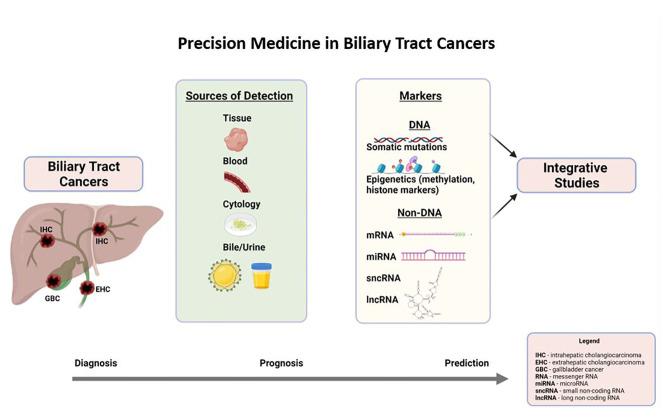
The effective management of biliary tract cancers (BTCs) has been hampered by limited options for systemic therapy. In recent years, the focus on precision medicine has made technologies such as next-generation sequencing (NGS) accessible to clinicians to identify targetable mutations in BTCs in tumor tissue (primarily) as well as blood, and to treat them with targeted therapies when possible. It has also expanded our understanding of functional pathways associated with genetic alterations and opened doors for identifying novel targets for treatment. Recent advances in the precision medicine approach allowed us to identify new molecular markers in BTCs, such as epigenetic changes (methylation and histone modification) and non-DNA markers such as messenger RNA, microRNA, and long non-coding RNA. It also made detecting these markers from non-traditional sources such as blood, urine, bile, and cytology (from fine-needle aspiration and biliary brushings) possible. As these tests become more accessible, we can see the integration of different molecular markers from all available sources to aid physicians in diagnosing, assessing prognosis, predicting tumor response, and screening BTCs. Currently, there are a handful of approved targeted therapies and only one class of immunotherapy agents (immune checkpoint inhibitors or ICIs) to treat BTCs. Early success with new targets, vascular endothelial growth factor receptor (VEGFR), HER2, protein kinase receptor, and Dickkopf-1 (DKK1); new drugs for known targets, fibroblast growth factor receptors (FGFRs) such as futabatinib, derazantinib, and erdafitinib; and ICIs such as durvalumab and tremelimumab is encouraging. Novel immunotherapy agents such as bispecific antibodies (bintrafusp alfa), arginase inhibitors, vaccines, and cellular therapy (chimeric antigen receptor-T cell or CAR-T, natural killer cells, tumor-infiltrating lymphocytes) have the potential to improve outcomes of BTCs in the coming years.
胆道癌(BTC)的有效管理一直受到全身治疗选择有限的阻碍。近年来,对精准医学的关注使临床医生能够使用诸如二代测序(NGS)等技术,以识别肿瘤组织(主要是)以及血液中BTC的可靶向突变,并在可能的情况下用靶向疗法进行治疗。它还扩展了我们对与基因改变相关的功能通路的理解,并为识别新的治疗靶点打开了大门。精准医学方法的最新进展使我们能够在BTC中识别新的分子标志物,如表观遗传变化(甲基化和组蛋白修饰)以及非DNA标志物,如信使RNA、微小RNA和长链非编码RNA。它还使从血液、尿液、胆汁和细胞学(来自细针穿刺和胆道刷检)等非传统来源检测这些标志物成为可能。随着这些检测变得更加容易获得,我们可以看到整合来自所有可用来源的不同分子标志物,以帮助医生进行诊断、评估预后、预测肿瘤反应和筛查BTC。目前,有少数几种获批的靶向疗法,而治疗BTC的免疫治疗药物只有一类(免疫检查点抑制剂或ICI)。针对新靶点血管内皮生长因子受体(VEGFR)、HER2、蛋白激酶受体和Dickkopf-1(DKK1)取得的早期成功;针对已知靶点成纤维细胞生长因子受体(FGFR)的新药,如futabatinib、derazantinib和erdafitinib;以及durvalumab和tremelimumab等ICI,都令人鼓舞。新型免疫治疗药物,如双特异性抗体(bintrafusp alfa)、精氨酸酶抑制剂、疫苗和细胞疗法(嵌合抗原受体T细胞或CAR-T、自然杀伤细胞、肿瘤浸润淋巴细胞)有可能在未来几年改善BTC的治疗效果。
 Zotero 插件