
COVID-19 相关急性肾损伤行透析治疗的危重症患者的肾脏恢复和死亡:STOP-COVID 队列研究。
Kidney Recovery and Death in Critically Ill Patients With COVID-19-Associated Acute Kidney Injury Treated With Dialysis: The STOP-COVID Cohort Study.
机构信息
Tufts Medical Center, Tufts University, Boston, Massachusetts.
Brigham and Women's Hospital, Boston, Massachusetts.
出版信息
Am J Kidney Dis. 2022 Mar;79(3):404-416.e1. doi: 10.1053/j.ajkd.2021.11.004. Epub 2021 Dec 4.
RATIONALE & OBJECTIVE: Acute kidney injury treated with kidney replacement therapy (AKI-KRT) occurs frequently in critically ill patients with coronavirus disease 2019 (COVID-19). We examined the clinical factors that determine kidney recovery in this population.
STUDY DESIGN
Multicenter cohort study.
SETTING & PARTICIPANTS: 4,221 adults not receiving KRT who were admitted to intensive care units at 68 US hospitals with COVID-19 from March 1 to June 22, 2020 (the "ICU cohort"). Among these, 876 developed AKI-KRT after admission to the ICU (the "AKI-KRT subcohort").
EXPOSURE
The ICU cohort was analyzed using AKI severity as the exposure. For the AKI-KRT subcohort, exposures included demographics, comorbidities, initial mode of KRT, and markers of illness severity at the time of KRT initiation.
OUTCOME
The outcome for the ICU cohort was estimated glomerular filtration rate (eGFR) at hospital discharge. A 3-level outcome (death, kidney nonrecovery, and kidney recovery at discharge) was analyzed for the AKI-KRT subcohort.
ANALYTICAL APPROACH
The ICU cohort was characterized using descriptive analyses. The AKI-KRT subcohort was characterized with both descriptive analyses and multinomial logistic regression to assess factors associated with kidney nonrecovery while accounting for death.
RESULTS
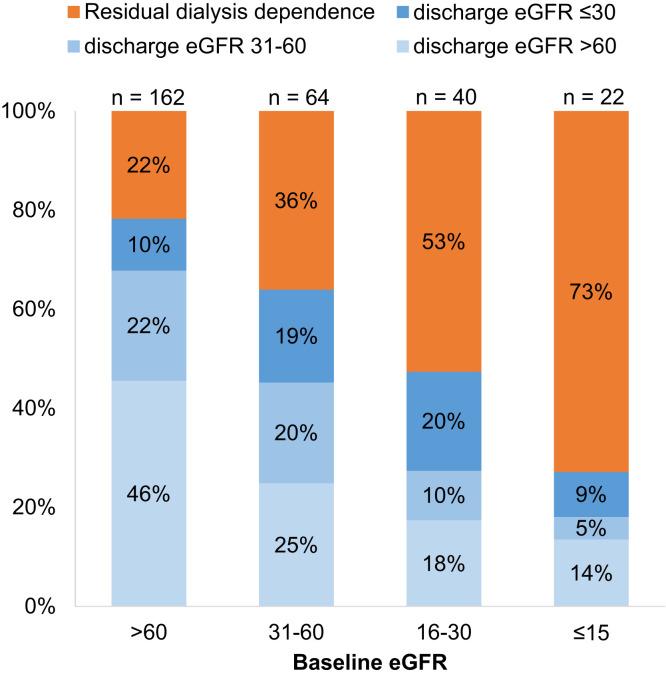
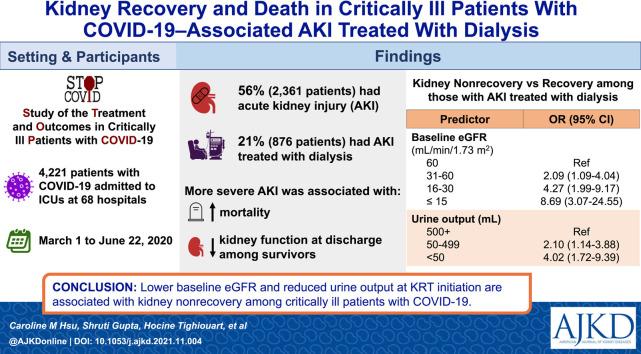
Among a total of 4,221 patients in the ICU cohort, 2,361 (56%) developed AKI, including 876 (21%) who received KRT. More severe AKI was associated with higher mortality. Among survivors, more severe AKI was associated with an increased rate of kidney nonrecovery and lower kidney function at discharge. Among the 876 patients with AKI-KRT, 588 (67%) died, 95 (11%) had kidney nonrecovery, and 193 (22%) had kidney recovery by the time of discharge. The odds of kidney nonrecovery was greater for lower baseline eGFR, with ORs of 2.09 (95% CI, 1.09-4.04), 4.27 (95% CI, 1.99-9.17), and 8.69 (95% CI, 3.07-24.55) for baseline eGFR 31-60, 16-30, ≤15 mL/min/1.73 m, respectively, compared with eGFR > 60 mL/min/1.73 m. Oliguria at the time of KRT initiation was also associated with nonrecovery (ORs of 2.10 [95% CI, 1.14-3.88] and 4.02 [95% CI, 1.72-9.39] for patients with 50-499 and <50 mL/d of urine, respectively, compared to ≥500 mL/d of urine).
LIMITATIONS
Later recovery events may not have been captured due to lack of postdischarge follow-up.
CONCLUSIONS
Lower baseline eGFR and reduced urine output at the time of KRT initiation are each strongly and independently associated with kidney nonrecovery among critically ill patients with COVID-19.
背景与目的
在患有 2019 年冠状病毒病(COVID-19)的危重症患者中,接受肾脏替代治疗的急性肾损伤(AKI-KRT)的发生率很高。我们研究了决定该人群肾脏恢复的临床因素。
研究设计
多中心队列研究。
设置和参与者
2020 年 3 月 1 日至 6 月 22 日,68 家美国医院的重症监护病房收治了 4221 名未接受 KRT 的成年人,这些患者患有 COVID-19(“ICU 队列”)。其中,876 名患者在入住 ICU 后发生 AKI-KRT(“AKI-KRT 亚组”)。
暴露
使用 AKI 严重程度作为 ICU 队列的暴露因素。对于 AKI-KRT 亚组,暴露因素包括人口统计学特征、合并症、初始 KRT 模式以及 KRT 开始时疾病严重程度的标志物。
结局
ICU 队列的结局为出院时估计的肾小球滤过率(eGFR)。分析 AKI-KRT 亚组的 3 级结局(死亡、肾脏未恢复和出院时肾脏恢复)。
分析方法
ICU 队列的特征采用描述性分析。AKI-KRT 亚组采用描述性分析和多项逻辑回归分析,以评估在考虑死亡的情况下与肾脏未恢复相关的因素。
结果
在 ICU 队列的 4221 名患者中,2361 名(56%)发生 AKI,其中 876 名(21%)接受了 KRT。更严重的 AKI与更高的死亡率相关。在幸存者中,更严重的 AKI与更高的肾脏未恢复率和出院时更低的肾功能相关。在 876 名 AKI-KRT 患者中,588 名(67%)死亡,95 名(11%)肾脏未恢复,193 名(22%)出院时肾脏恢复。较低的基线 eGFR 与肾脏未恢复的几率增加相关,OR 值分别为 2.09(95%CI,1.09-4.04)、4.27(95%CI,1.99-9.17)和 8.69(95%CI,3.07-24.55),分别为基线 eGFR 31-60、16-30 和≤15 mL/min/1.73 m,与 eGFR > 60 mL/min/1.73 m相比。KRT 开始时少尿也与未恢复相关(分别为 2.10 [95%CI,1.14-3.88]和 4.02 [95%CI,1.72-9.39],与 50-499 和<50 mL/d 的尿液相比,尿液分别为≥500 mL/d)。
局限性
由于缺乏出院后随访,可能无法捕获后期的恢复事件。
结论
COVID-19 危重症患者中,基线 eGFR 较低和 KRT 开始时尿输出量减少均与肾脏未恢复密切相关。


 Zotero 插件