
老年社区获得性尿路感染住院患者中多重耐药菌的临床影响。
Clinical impact of multidrug-resistant bacteria in older hospitalized patients with community-acquired urinary tract infection.
机构信息
Internal Medicine Department, Doctor Peset University Hospital, Avda. Gaspar Aguilar, n 90, 46017, Valencia, Spain.
Microbiology Department, Doctor Peset University Hospital, Avda. Gaspar Aguilar, n 90, 46017, Valencia, Spain.
出版信息
BMC Infect Dis. 2021 Dec 7;21(1):1232. doi: 10.1186/s12879-021-06939-2.
INTRODUCTION
Previous studies have described some risk factors for multidrug-resistant (MDR) bacteria in urinary tract infection (UTI). However, the clinical impact of MDR bacteria on older hospitalized patients with community-acquired UTI has not been broadly analyzed. We conducted a study in older adults with community-acquired UTI in order to identify risk factors for MDR bacteria and to know their clinical impact.
METHODS
Cohort prospective observational study of patients of 65 years or older, consecutively admitted to a university hospital, diagnosed with community-acquired UTI. We compared epidemiological and clinical variables and outcomes, from UTI due to MDR and non-MDR bacteria. Independent risk factors for MDR bacteria were analyzed using logistic regression.
RESULTS
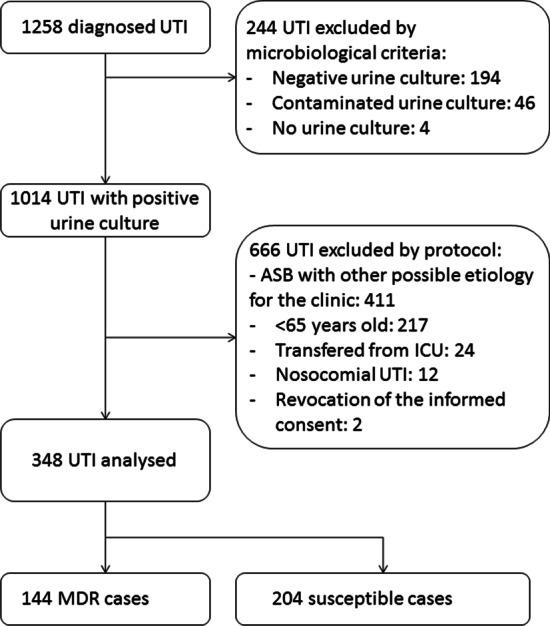
348 patients were included, 41.4% of them with UTI due to MDR bacteria. Median age was 81 years. Hospital mortality was 8.6%, with no difference between the MDR and non-MDR bacteria groups. Median length of stay was 5 [4-8] days, with a longer stay in the MDR group (6 [4-8] vs. 5 [4-7] days, p = 0.029). Inadequate empirical antimicrobial therapy (IEAT) was 23.3%, with statistically significant differences between groups (33.3% vs. 16.2%, p < 0.001). Healthcare-associated UTI variables, in particular previous antimicrobial therapy and residence in a nursing home, were found to be independent risk factors for MDR bacteria.
CONCLUSIONS
The clinical impact of MDR bacteria was moderate. MDR bacteria cases had higher IEAT and longer hospital stay, although mortality was not higher. Previous antimicrobial therapy and residence in a nursing home were independent risk factors for MDR bacteria.
介绍
先前的研究已经描述了尿路感染(UTI)中多重耐药(MDR)细菌的一些危险因素。然而,MDR 细菌对社区获得性 UTI 的老年住院患者的临床影响尚未广泛分析。我们对患有社区获得性 UTI 的老年人进行了一项研究,以确定 MDR 细菌的危险因素,并了解其临床影响。
方法
对连续入住一所大学医院的 65 岁或以上的社区获得性 UTI 患者进行队列前瞻性观察研究。我们比较了 MDR 和非 MDR 细菌引起的 UTI 的流行病学和临床变量以及结局。使用逻辑回归分析 MDR 细菌的独立危险因素。
结果
共纳入 348 例患者,其中 41.4%的患者 UTI 由 MDR 细菌引起。中位年龄为 81 岁。医院死亡率为 8.6%,MDR 和非 MDR 细菌组之间无差异。中位住院时间为 5 [4-8] 天,MDR 组的住院时间更长(6 [4-8] 与 5 [4-7] 天,p = 0.029)。经验性抗菌治疗不足(IEAT)为 23.3%,两组之间存在统计学差异(33.3%比 16.2%,p < 0.001)。医疗保健相关 UTI 变量,特别是先前的抗菌治疗和居住在疗养院,被发现是 MDR 细菌的独立危险因素。
结论
MDR 细菌的临床影响中等。MDR 细菌病例的 IEAT 更高,住院时间更长,但死亡率并未更高。先前的抗菌治疗和居住在疗养院是 MDR 细菌的独立危险因素。
 Zotero 插件