
肌肉协同作用和临床结果测量在虚拟现实环境中对接受康复治疗的脑卒中幸存者的上肢运动功能描述了不同的因素。
Muscle Synergies and Clinical Outcome Measures Describe Different Factors of Upper Limb Motor Function in Stroke Survivors Undergoing Rehabilitation in a Virtual Reality Environment.
机构信息
Laboratory of Rehabilitation Technologies, IRCCS San Camillo Hospital, 30126 Venice, Italy.
Medical Physics Department-Clinical Engineering, Salford Care Organisation, Salford M6 8HD, UK.
出版信息
Sensors (Basel). 2021 Nov 30;21(23):8002. doi: 10.3390/s21238002.
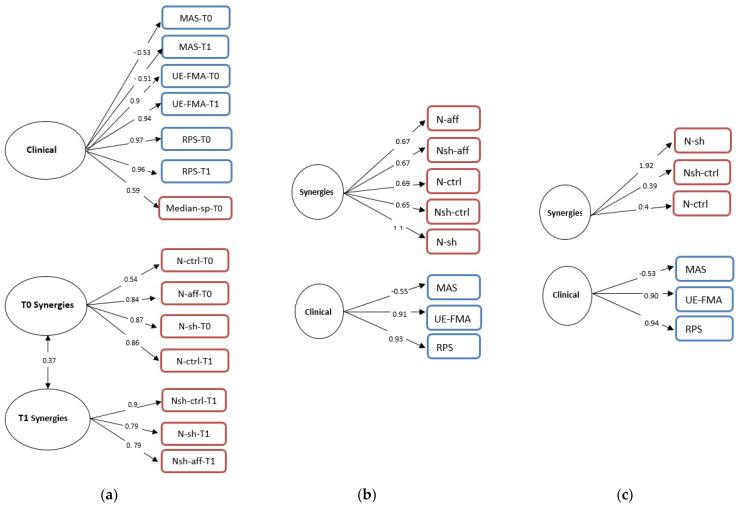
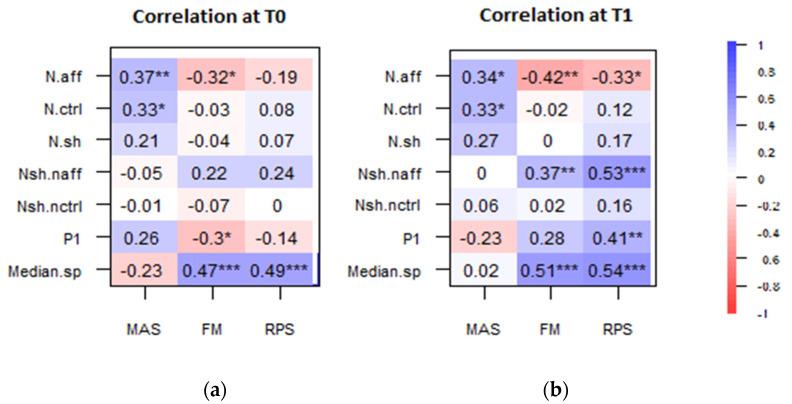
Recent studies have investigated muscle synergies as biomarkers for stroke, but it remains controversial if muscle synergies and clinical observation convey the same information on motor impairment. We aim to identify whether muscle synergies and clinical scales convey the same information or not. Post-stroke patients were administered an upper limb treatment. Before (T0) and after (T1) treatment, we assessed motor performance with clinical scales and motor output with EMG-derived muscle synergies. We implemented an exploratory factor analysis (EFA) and a confirmatory factor analysis (CFA) to identify the underlying relationships among all variables, at T0 and T1, and a general linear regression model to infer any relationships between the similarity between the affected and unaffected synergies (Median-sp) and clinical outcomes at T0. Clinical variables improved with rehabilitation whereas muscle-synergy parameters did not show any significant change. EFA and CFA showed that clinical variables and muscle-synergy parameters (except Median-sp) were grouped into different factors. Regression model showed that Median-sp could be well predicted by clinical scales. The information underlying clinical scales and muscle synergies are therefore different. However, clinical scales well predicted the similarity between the affected and unaffected synergies. Our results may have implications on personalizing rehabilitation protocols.
最近的研究已经调查了肌肉协同作用作为中风的生物标志物,但肌肉协同作用和临床观察是否传达相同的运动障碍信息仍然存在争议。我们旨在确定肌肉协同作用和临床量表是否传达相同的信息。对中风后患者进行上肢治疗。在治疗前(T0)和治疗后(T1),我们使用临床量表评估运动表现,并使用肌电图衍生的肌肉协同作用评估运动输出。我们在 T0 和 T1 时进行了探索性因素分析(EFA)和验证性因素分析(CFA),以确定所有变量之间的潜在关系,并进行了一般线性回归模型,以推断 T0 时受影响和未受影响的协同作用之间的相似性(中位数-sp)与临床结果之间的任何关系。临床变量随着康复而改善,而肌肉协同作用参数没有显示出任何显著变化。EFA 和 CFA 表明,临床变量和肌肉协同作用参数(中位数-sp 除外)分为不同的因素。回归模型表明,临床量表可以很好地预测受影响和未受影响的协同作用之间的相似性。因此,临床量表和肌肉协同作用所包含的信息是不同的。然而,临床量表很好地预测了受影响和未受影响的协同作用之间的相似性。我们的结果可能对个性化康复方案有影响。
 Zotero 插件