
加拿大艾伯塔省期待生育家庭和 24 个月以下儿童的十大(加一)研究重点:来自家庭研究议程倡议设定(FRAISE)优先事项设定伙伴关系项目的结果。
Top 10 (plus 1) research priorities for expectant families and those with children to age 24 months in Alberta, Canada: results from the Family Research Agenda Initiative Setting (FRAISE) priority setting partnership project.
机构信息
Pediatrics and Child Health, University of Manitoba Faculty of Health Sciences, Winnipeg, Manitoba, Canada.
Faculty of Nursing, University of Calgary, Calgary, Alberta, Canada.
出版信息
BMJ Open. 2021 Dec 9;11(12):e047919. doi: 10.1136/bmjopen-2020-047919.
OBJECTIVE
The study objective was to identify the top 10 research priorities for expectant parents and caregivers of children up to age 24 months.
DESIGN
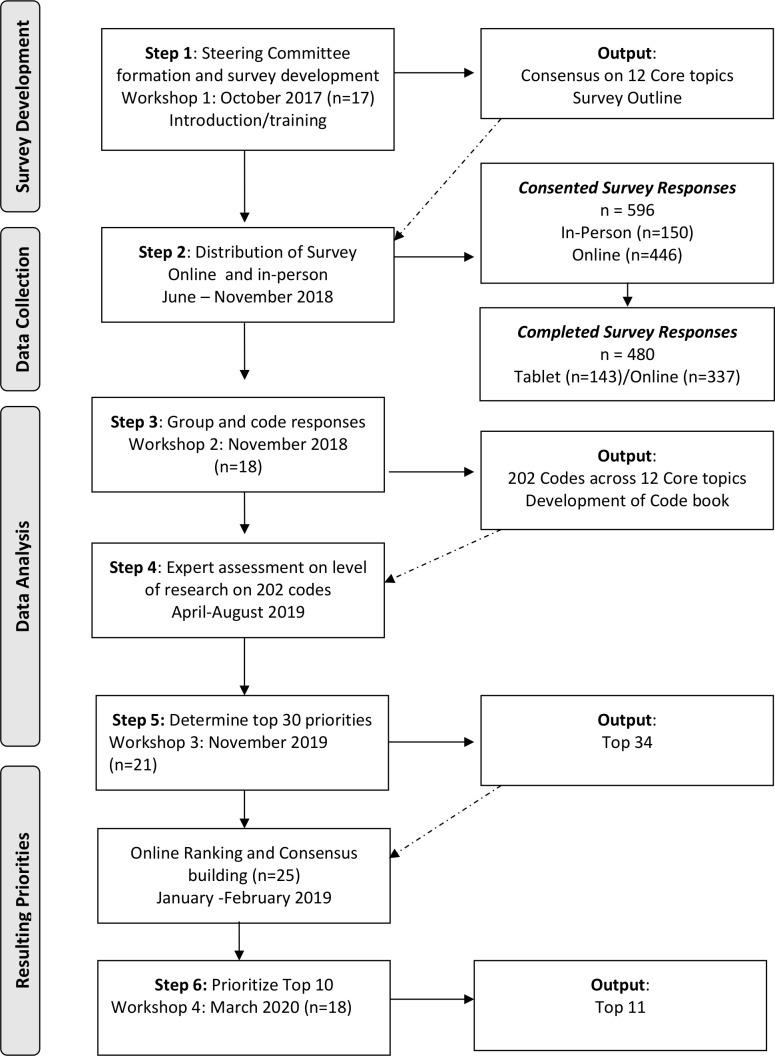
A priority setting partnership using a modified James Lind Alliance approach was implemented. First, a core steering committee was formed, consisting of 17 parents, clinicians and community agency representatives. Second, through in-person collaboration with steering committee members, we developed and distributed a survey to identify research priorities across 12 topics. In total, 596 participants consented and 480 completed the survey. Survey responses were grouped and themed into codes during a consensus-building workshop with steering committee members (n=18). Research and practice experts were consulted to provide feedback on which themes had already been researched. An in-person (n=21) workshop was used to establish the top 34 priorities, which were circulated to the broader steering committee (n=25) via an online survey. Finally, the core steering committee members (n=18) met to determine and rank a top 10 (plus 1) list of research priorities.
SETTING
This study was conducted in Alberta, Canada.
PARTICIPANTS
Expectant parents and caregivers of children up to age 24 months.
RESULTS
Survey results provided 3232 responses, with 202 unique priorities. After expert feedback and steering committee consensus, a list of 34 priorities was moved forward for final consideration. The final top 10 (plus 1) research priorities included three priorities on mental health/relationships, two priorities on each of access to information, immunity and child development, and one priority on each of sleep, pregnancy/labour and feeding. Selecting 11 instead of 10 priorities was based on steering committee consensus.
CONCLUSIONS
The findings will direct future maternal-child research, ensuring it is rooted in parent-identified priorities that represent contemporary needs. To provide meaningful outcomes, research in these priority areas must consider diverse socioeconomic backgrounds and experiences.
目的
本研究旨在确定 0-24 月龄婴幼儿的父母和照顾者的 10 项研究重点。
设计
采用改良的 James Lind 联盟方法实施了优先事项设定伙伴关系。首先,成立了一个由 17 名父母、临床医生和社区机构代表组成的核心指导委员会。其次,通过与指导委员会成员的现场合作,我们开发并分发了一项调查,以确定 12 个主题的研究重点。共有 596 名参与者同意并完成了调查。在与指导委员会成员(n=18)进行的共识建设研讨会上,对调查回复进行了分组和主题分类。研究和实践专家被咨询,以提供哪些主题已经得到研究的反馈。使用现场(n=21)研讨会确定前 34 项重点,并通过在线调查分发给更广泛的指导委员会(n=25)。最后,核心指导委员会成员(n=18)开会确定并排名前 10 名(加 1 名)研究重点。
地点
本研究在加拿大艾伯塔省进行。
参与者
0-24 月龄婴幼儿的父母和照顾者。
结果
调查结果提供了 3232 条回复,有 202 条独特的重点。在专家反馈和指导委员会达成共识后,列出了 34 项重点供最终审议。最终的前 10 名(加 1 名)研究重点包括 3 项心理健康/关系重点,2 项信息获取、免疫和儿童发育重点,1 项睡眠、怀孕/分娩和喂养重点。选择 11 项而不是 10 项重点是基于指导委员会的共识。
结论
这些发现将指导未来的母婴研究,确保其植根于父母确定的重点,代表当代需求。为了提供有意义的结果,这些重点领域的研究必须考虑到不同的社会经济背景和经验。

 Zotero 插件