
MRD 在 iNHL 的治疗中是否发挥作用?
Does MRD have a role in the management of iNHL?
机构信息
Hematology, Department of Translational and Precision Medicine, Sapienza University, Rome, Italy.
出版信息
Hematology Am Soc Hematol Educ Program. 2021 Dec 10;2021(1):320-330. doi: 10.1182/hematology.2021000312.
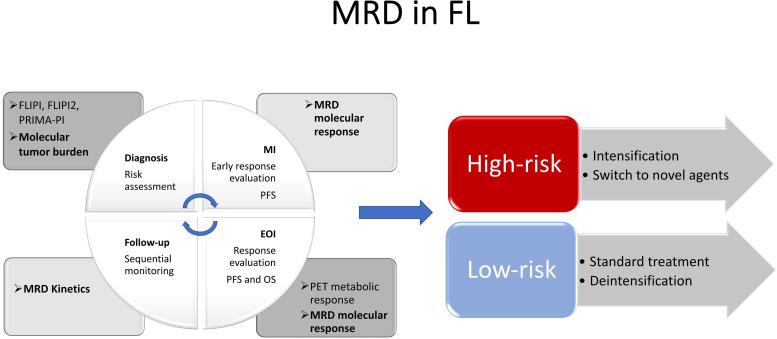
Among indolent non-Hodgkin lymphomas (iNHLs), the analysis of measurable/minimal residual disease (MRD) has been extensively applied to follicular lymphoma (FL). Treatment combinations have deeply changed over the years, as well as the techniques to measure MRD, which is currently evaluated only in the setting of clinical trials. Here, we discuss the evidence on the role of molecular monitoring in the management of FL. Mature data support the quantification of molecular tumor burden at diagnosis as a tool to stratify patients in risk categories and of MRD evaluation at the end of treatment to predict progression-free survival and overall survival. Moreover, MRD deserves further studies as a tool to refine the clinical/metabolic response and to modulate treatment intensity/duration. Patients with a higher relapse probability can be identified, but the relevance of continuous molecular follow-up should be clarified by kinetic models of MRD analysis. Being the BCL2/heavy chain immunoglobulin gene hybrid rearrangement detectable in about 50% to 60% of advanced FL and in 30% of positron emission tomography/computed tomography-staged localized FL, technical advancements such as next-generation sequencing/target locus amplification may allow broadening the FL population carrying a molecular marker. Droplet digital polymerase chain reaction can better quantify MRD at low levels, and novel sources of DNA, such as cell-free DNA, may represent a noninvasive tool to monitor MRD. Finally, MRD in other iNHLs, such as lymphoplasmacytic lymphoma/Waldenström macroglobulinemia and marginal zone lymphoma, is beginning to be explored.
在惰性非霍奇金淋巴瘤(iNHL)中,可测量/微小残留病(MRD)的分析已广泛应用于滤泡性淋巴瘤(FL)。多年来,治疗组合发生了深刻变化,MRD 的检测技术也发生了变化,目前仅在临床试验中进行评估。在这里,我们讨论了分子监测在 FL 管理中的作用的证据。成熟的数据支持在诊断时量化分子肿瘤负担作为分层患者风险类别的工具,以及在治疗结束时评估 MRD 以预测无进展生存期和总生存期。此外,MRD 作为一种工具来细化临床/代谢反应并调整治疗强度/持续时间,值得进一步研究。可以识别出具有更高复发概率的患者,但通过 MRD 分析的动力学模型应阐明连续分子随访的相关性。BCL2/重链免疫球蛋白基因杂交重排在大约 50%到 60%的晚期 FL 和 30%的正电子发射断层扫描/计算机断层扫描分期局限性 FL 中可检测到,技术进步,如下一代测序/靶标扩增,可能会扩大携带分子标志物的 FL 人群。液滴数字聚合酶链反应可以更好地定量低水平的 MRD,并且新型 DNA 来源,如无细胞 DNA,可能成为监测 MRD 的非侵入性工具。最后,其他 iNHL,如淋巴浆细胞淋巴瘤/华氏巨球蛋白血症和边缘区淋巴瘤中的 MRD 开始被探索。
 Zotero 插件