
在 COVID-19 大流行期间,用开阿片类药物替代非药物疗法治疗疼痛。
Substitution of Nonpharmacologic Therapy With Opioid Prescribing for Pain During the COVID-19 Pandemic.
机构信息
Department of Sociology, Indiana University Bloomington, Bloomington.
Luddy School of Informatics, Computing, and Engineering, Indiana University Bloomington, Bloomington.
出版信息
JAMA Netw Open. 2021 Dec 1;4(12):e2138453. doi: 10.1001/jamanetworkopen.2021.38453.
IMPORTANCE
During the pandemic, access to medical care unrelated to COVID-19 was limited because of concerns about viral spread and corresponding policies. It is critical to assess how these conditions affected modes of pain treatment, given the addiction risks of prescription opioids.
OBJECTIVE
To assess the trends in opioid prescription and nonpharmacologic therapy (ie, physical therapy and complementary medicine) for pain management during the COVID-19 pandemic in 2020 compared with the patterns in 2019.
DESIGN, SETTING, AND PARTICIPANTS: This retrospective, cross-sectional study used weekly claims data from 24 million US patients in a nationwide commercial insurance database (Optum's deidentified Clinformatics Data Mart Database) from January 1, 2019, to September 31, 2020. Among patients with diagnoses of limb, extremity, or joint pain, back pain, and neck pain for each week, patterns of treatment use were identified and evaluated. Data analysis was performed from April 1, 2021, to September 31, 2021.
MAIN OUTCOMES AND MEASURES
The main outcomes of interest were weekly rates of opioid prescriptions, the strength and duration of related opioid prescriptions, and the use of nonpharmacologic therapy. Transition rates between different treatment options before the outbreak and during the early months of the pandemic were also assessed.
RESULTS
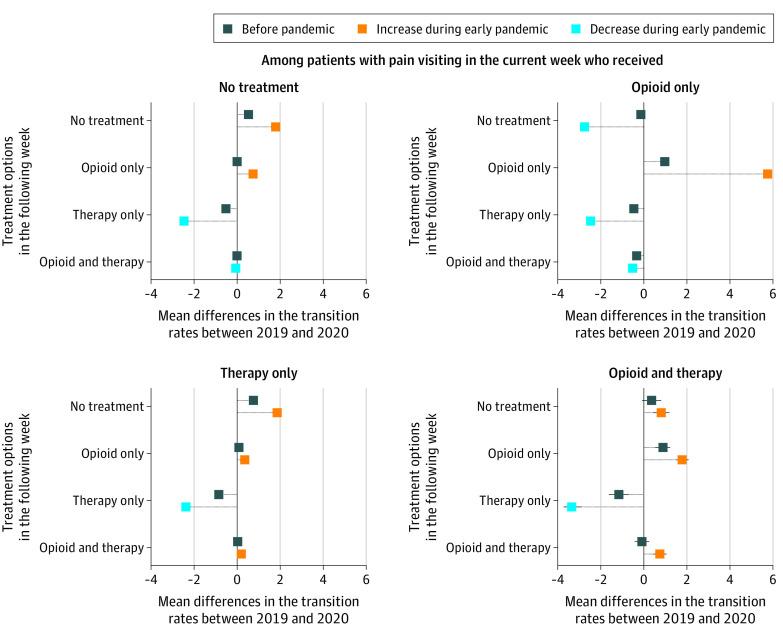
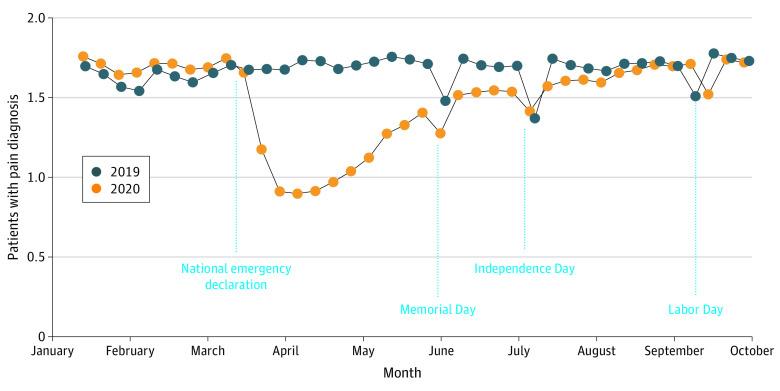
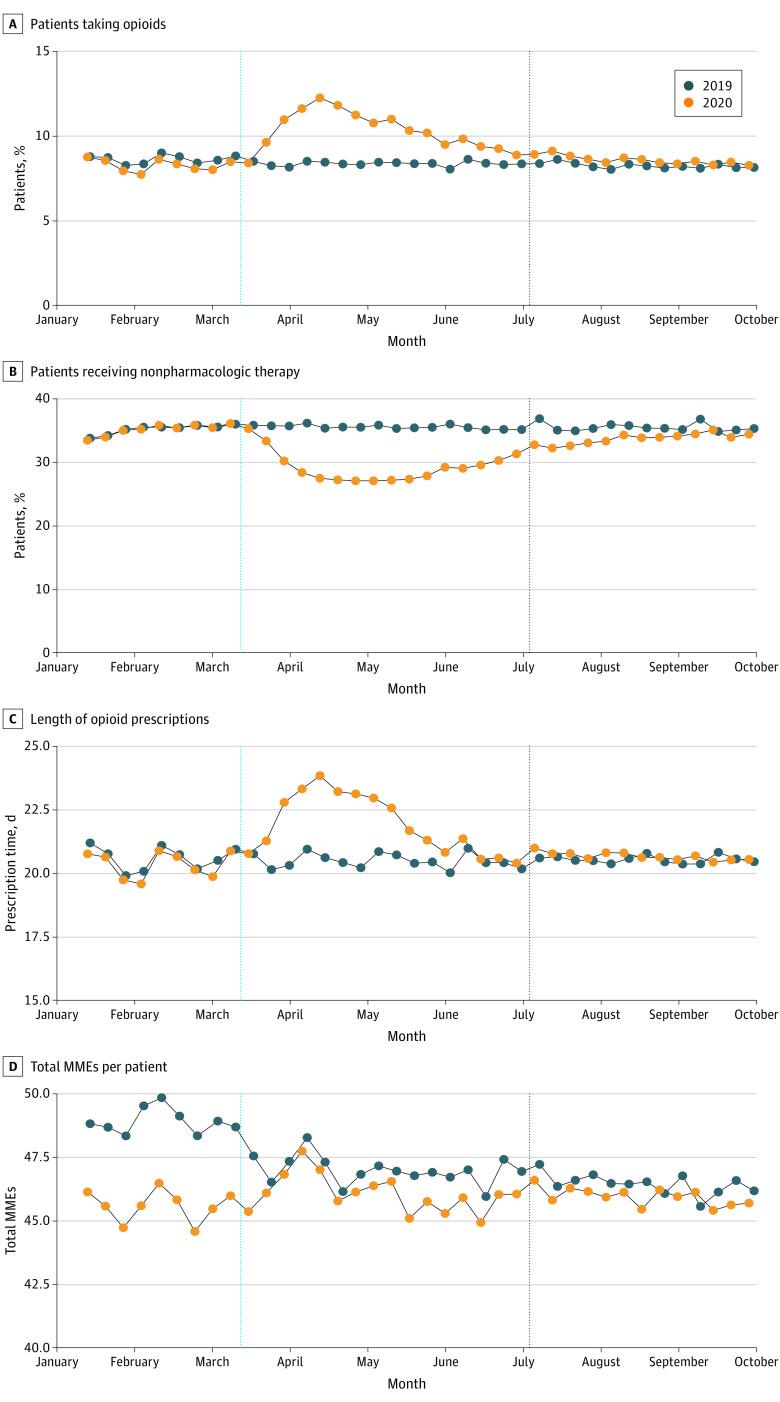
A total of 21 430 339 patients (mean [SD] age, 48.6 [24.0] years; 10 960 507 [51.1%] female; 909 061 [4.2%] Asian, 1 688 690 [7.9%] Black, 2 276 075 [10.6%] Hispanic, 11 192 789 [52.2%] White, and 5 363 724 [25.0%] unknown) were enrolled during the first 3 quarters in 2019 and 20 759 788 (mean [SD] age, 47.0 [23.8] years; 10 695 690 [51.5%] female; 798 037 [3.8%] Asian; 1 508 023 [7.3%] Black, 1 976 248 [9.5%] Hispanic, 10 059 597 [48.5%] White, and 6 417 883 [30.9%] unknown) in the first 3 quarters of 2020. During the COVID-19 pandemic, the proportion of patients receiving a pain diagnosis was smaller than that for the same period in 2019 (mean difference, -15.9%; 95% CI, -16.1% to -15.8%). Patients with pain were more likely to receive opioids (mean difference, 3.5%; 95% CI, 3.3%-3.7%) and less likely to receive nonpharmacologic therapy (mean difference, -6.0%; 95% CI, -6.3% to -5.8%), and opioid prescriptions were longer and more potent during the early pandemic in 2020 relative to 2019 (mean difference, 1.07 days; 95% CI, 1.02-1.17 days; mean difference, 0.96 morphine milligram equivalents; 95% CI, 0.76-1.20). Analysis of individuals' transitions between treatment options for pain found that patients were more likely to transition out of nonpharmacologic therapy, replacing it with opioid prescriptions for pain management during the COVID-19 pandemic than in the year before.
CONCLUSIONS AND RELEVANCE
Nonpharmacologic therapy is a benign treatment for pain often recommended instead of opioid therapy. The decrease in nonpharmacologic therapy and increase in opioid prescription during the COVID-19 pandemic found in this cross-sectional study, especially given longer days of prescription and more potent doses, may exacerbate the US opioid epidemic. These findings suggest that it is imperative to investigate the implications of limited medical access on treatment substitution, which may increase patient risk, and implement policies and guidelines to prevent those substitutions.
重要性:由于担心病毒传播和相应的政策,在大流行期间,获得与 COVID-19 无关的医疗服务受到限制。鉴于处方类阿片类药物存在成瘾风险,评估这些情况如何影响疼痛治疗模式至关重要。
目的:评估 2020 年 COVID-19 大流行期间与 2019 年相比,阿片类药物处方和非药物治疗(即物理治疗和补充医学)治疗疼痛的趋势。
设计、环境和参与者:这是一项回顾性、横断面研究,使用来自全国商业保险数据库(Optum 的匿名 Clinformatics Data Mart 数据库)中 2400 万美国患者的每周索赔数据,时间为 2019 年 1 月 1 日至 2020 年 9 月 31 日。在每周有肢体、四肢或关节疼痛、背痛和颈部疼痛诊断的患者中,确定并评估了治疗使用模式。数据分析于 2021 年 4 月 1 日至 2021 年 9 月 31 日进行。
主要结局和措施:主要结局是每周阿片类药物处方的发生率、相关阿片类药物处方的强度和持续时间以及非药物治疗的使用情况。还评估了在疫情爆发前和疫情早期不同治疗选择之间的转换率。
结果:在 2019 年的前 3 个季度,共有 21430339 名患者(平均[标准差]年龄为 48.6[24.0]岁;5070607 名[51.1%]为女性;909061 名[4.2%]为亚洲人,1688690 名[7.9%]为黑人,2276275 名[10.6%]为西班牙裔,11192789 名[52.2%]为白人,5363724 名[25.0%]为未知)和 20759788 名(平均[标准差]年龄为 47.0[23.8]岁;5695690 名[51.5%]为女性;798037 名[3.8%]为亚洲人;1508023 名[7.3%]为黑人,1976248 名[9.5%]为西班牙裔,10059597 名[48.5%]为白人,6417883 名[30.9%]为未知)在 2019 年前 3 个季度和 2020 年前 3 个季度接受了治疗。在 COVID-19 大流行期间,接受疼痛诊断的患者比例低于 2019 年同期(平均差异,-15.9%;95%CI,-16.1%至-15.8%)。有疼痛的患者更有可能接受阿片类药物(平均差异,3.5%;95%CI,3.3%-3.7%),而不太可能接受非药物治疗(平均差异,-6.0%;95%CI,-6.3%至-5.8%),并且阿片类药物处方的持续时间和强度在 2020 年早期的大流行期间比 2019 年有所增加(平均差异,1.07 天;95%CI,1.02-1.17 天;平均差异,0.96 吗啡毫克当量;95%CI,0.76-1.20)。对疼痛治疗选择个体间转换的分析发现,与 2019 年相比,患者更有可能从非药物治疗转为阿片类药物治疗,以管理疼痛。
结论和相关性:非药物治疗是一种良性的疼痛治疗方法,通常建议代替阿片类药物治疗。本横断面研究发现,在 COVID-19 大流行期间,非药物治疗减少,阿片类药物处方增加,尤其是考虑到处方天数的增加和剂量的增加,可能会加剧美国阿片类药物泛滥的情况。这些发现表明,有必要调查医疗服务受限对治疗替代的影响,这可能会增加患者的风险,并实施政策和指南以预防这些替代。
 Zotero 插件