
CRISPR/Cas13技术在理解病毒-宿主相互作用中的潜在应用
Potential Use of CRISPR/Cas13 Machinery in Understanding Virus-Host Interaction.
作者信息
Bayoumi Mahmoud, Munir Muhammad
机构信息
Division of Biomedical and Life Sciences, Lancaster University, Lancaster, United Kingdom.
Virology Department, Faculty of Veterinary Medicine, Cairo University, Giza, Egypt.
出版信息
Front Microbiol. 2021 Nov 26;12:743580. doi: 10.3389/fmicb.2021.743580. eCollection 2021.
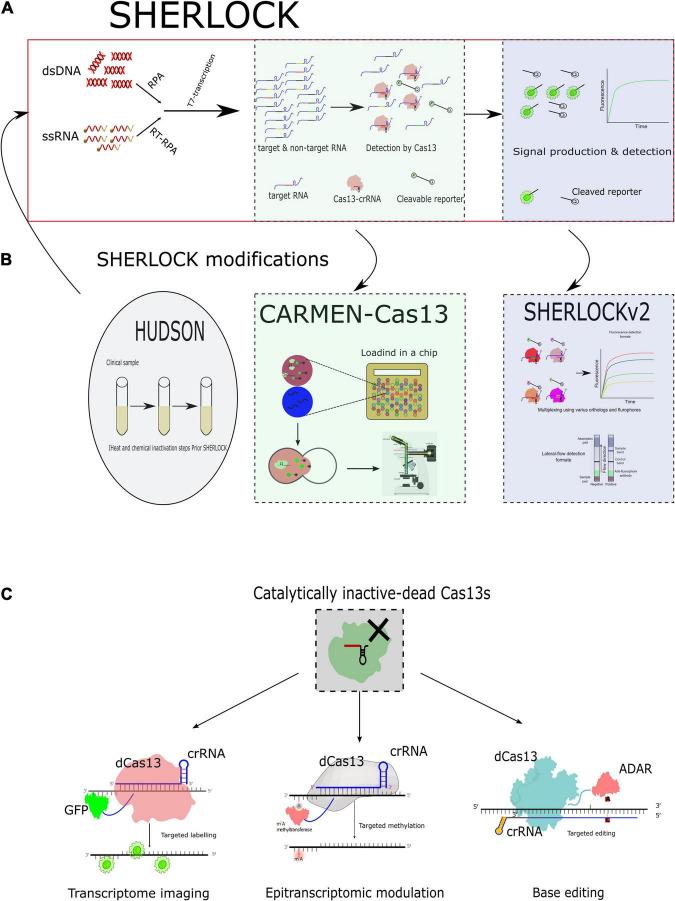
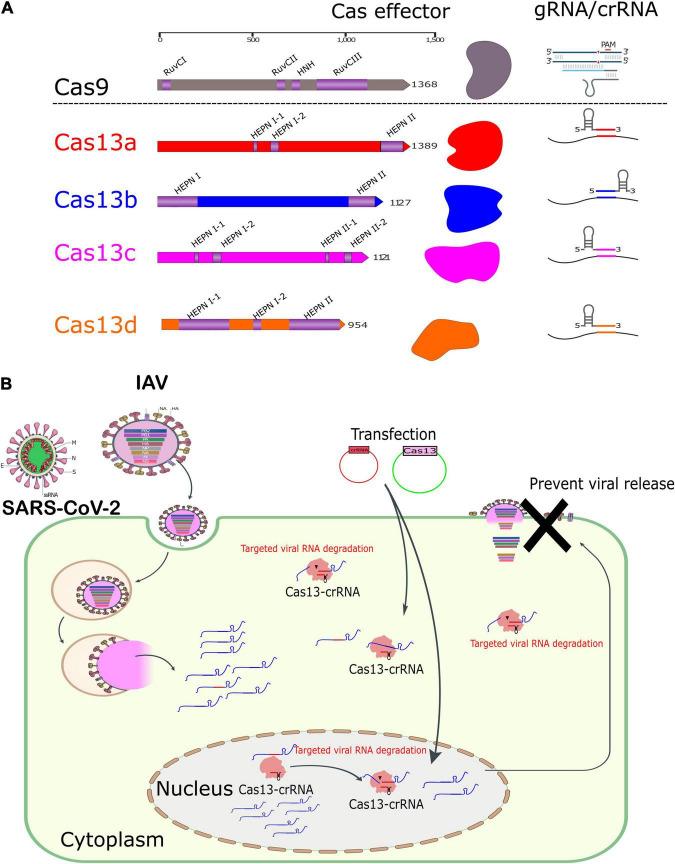
Prokaryotes have evolutionarily acquired an immune system to fend off invading mobile genetic elements, including viral phages and plasmids. Through recognizing specific sequences of the invading nucleic acid, prokaryotes mediate a subsequent degradation process collectively referred to as the Clustered Regularly Interspaced Short Palindromic Repeats (CRISPR)-CRISPR-associated (Cas) (CRISPR-Cas) system. The CRISPR-Cas systems are divided into two main classes depending on the structure of the effector Cas proteins. Class I systems have effector modules consisting of multiple proteins, while class II systems have a single multidomain effector. Additionally, the CRISPR-Cas systems can also be categorized into types depending on the spacer acquisition components and their evolutionary features, namely, types I-VI. Among CRISPR/Cas systems, Cas9 is one of the most common multidomain nucleases that identify, degrade, and modulate DNA. Importantly, variants of Cas proteins have recently been found to target RNA, especially the single-effector Cas13 nucleases. The Cas13 has revolutionized our ability to study and perturb RNAs in endogenous microenvironments. The Cas13 effectors offer an excellent candidate for developing novel research tools in virological and biotechnological fields. Herein, in this review, we aim to provide a comprehensive summary of the recent advances of Cas13s for targeting viral RNA for either RNA-mediated degradation or CRISPR-Cas13-based diagnostics. Additionally, we aim to provide an overview of the proposed applications that could revolutionize our understanding of viral-host interactions using Cas13-mediated approaches.
原核生物在进化过程中获得了一种免疫系统,以抵御入侵的移动遗传元件,包括病毒噬菌体和质粒。通过识别入侵核酸的特定序列,原核生物介导了一个随后的降解过程,统称为成簇规律间隔短回文重复序列(CRISPR)-CRISPR相关蛋白(Cas)(CRISPR-Cas)系统。根据效应蛋白Cas的结构,CRISPR-Cas系统主要分为两类。I类系统的效应模块由多种蛋白质组成,而II类系统有一个单一的多结构域效应蛋白。此外,CRISPR-Cas系统还可以根据间隔序列获取组件及其进化特征分为不同类型,即I-VI型。在CRISPR/Cas系统中,Cas9是最常见的多结构域核酸酶之一,可识别、降解和调控DNA。重要的是,最近发现Cas蛋白的变体可以靶向RNA,特别是单效应蛋白Cas13核酸酶。Cas13彻底改变了我们在内源微环境中研究和干扰RNA的能力。Cas13效应蛋白为在病毒学和生物技术领域开发新型研究工具提供了一个极佳的候选对象。在本综述中,我们旨在全面总结Cas13在靶向病毒RNA以进行RNA介导的降解或基于CRISPR-Cas13的诊断方面的最新进展。此外,我们还旨在概述那些可能通过Cas13介导的方法彻底改变我们对病毒-宿主相互作用理解的应用。
 Zotero 插件