
21 个低、中、高收入国家基于人群队列的社会心理风险因素与心血管疾病和死亡
Psychosocial Risk Factors and Cardiovascular Disease and Death in a Population-Based Cohort From 21 Low-, Middle-, and High-Income Countries.
机构信息
School of Public Health and Community Medicine, Institute of Medicine, Sahlgrenska Academy, University of Gothenburg, Gothenburg, Sweden.
Department of Molecular and Clinical Medicine, Institute of Medicine, Sahlgrenska Academy, University of Gothenburg, and Region Västra Götaland, Sahlgrenska University Hospital, Goteborg, Sweden.
出版信息
JAMA Netw Open. 2021 Dec 1;4(12):e2138920. doi: 10.1001/jamanetworkopen.2021.38920.
IMPORTANCE
Stress may increase the risk of cardiovascular disease (CVD). Most studies on stress and CVD have been conducted in high-income Western countries, but whether stress is associated with CVD in other settings has been less well studied.
OBJECTIVE
To investigate the association of a composite measure of psychosocial stress and the development of CVD events and mortality in a large prospective study involving populations from 21 high-, middle-, and low-income countries across 5 continents.
DESIGN, SETTING, AND PARTICIPANTS: This population-based cohort study used data from the Prospective Urban Rural Epidemiology study, collected between January 2003 and March 2021. Participants included individuals aged 35 to 70 years living in 21 low-, middle-, and high-income countries. Data were analyzed from April 8 to June 15, 2021.
EXPOSURES
All participants were assessed on a composite measure of psychosocial stress assessed at study entry using brief questionnaires concerning stress at work and home, major life events, and financial stress.
MAIN OUTCOMES AND MEASURES
The outcomes of interest were stroke, major coronary heart disease (CHD), CVD, and all-cause mortality.
RESULTS
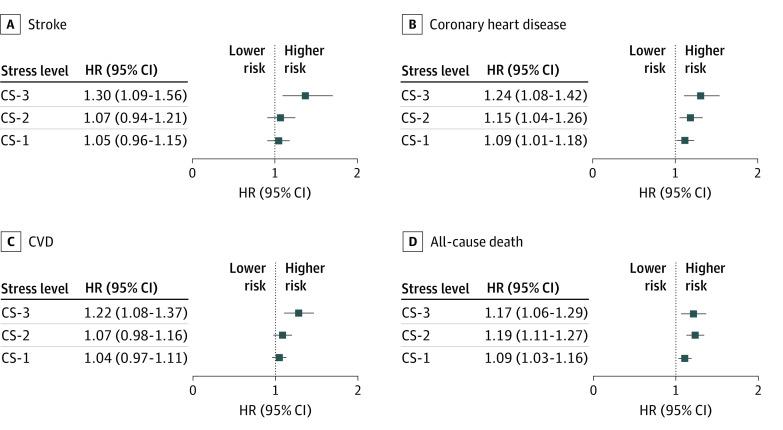
A total of 118 706 participants (mean [SD] age 50.4 [9.6] years; 69 842 [58.8%] women and 48 864 [41.2%] men) without prior CVD and with complete baseline and follow-up data were included. Of these, 8699 participants (7.3%) reported high stress, 21 797 participants (18.4%) reported moderate stress, 34 958 participants (29.4%) reported low stress, and 53 252 participants (44.8%) reported no stress. High stress, compared with no stress, was more likely with younger age (mean [SD] age, 48.9 [8.9] years vs 51.1 [9.8] years), abdominal obesity (2981 participants [34.3%] vs 10 599 participants [19.9%]), current smoking (2319 participants [26.7%] vs 10 477 participants [19.7%]) and former smoking (1571 participants [18.1%] vs 3978 participants [7.5%]), alcohol use (4222 participants [48.5%] vs 13 222 participants [24.8%]), and family history of CVD (5435 participants [62.5%] vs 20 255 participants [38.0%]). During a median (IQR) follow-up of 10.2 (8.6-11.9) years, a total of 7248 deaths occurred. During the course of follow-up, there were 5934 CVD events, 4107 CHD events, and 2880 stroke events. Compared with no stress and after adjustment for age, sex, education, marital status, location, abdominal obesity, hypertension, smoking, diabetes, and family history of CVD, as the level of stress increased, there were increases in risk of death (low stress: hazard ratio [HR], 1.09 [95% CI, 1.03-1.16]; high stress: 1.17 [95% CI, 1.06-1.29]) and CHD (low stress: HR, 1.09 [95% CI, 1.01-1.18]; high stress: HR, 1.24 [95% CI, 1.08-1.42]). High stress, but not low or moderate stress, was associated with CVD (HR, 1.22 [95% CI, 1.08-1.37]) and stroke (HR, 1.30 [95% CI, 1.09-1.56]) after adjustment.
CONCLUSIONS AND RELEVANCE
This cohort study found that higher psychosocial stress, measured as a composite score of self-perceived stress, life events, and financial stress, was significantly associated with mortality as well as with CVD, CHD, and stroke events.
重要性
压力可能会增加心血管疾病(CVD)的风险。大多数关于压力和 CVD 的研究都是在高收入的西方国家进行的,但在其他环境中,压力是否与 CVD 相关的研究还比较少。
目的
在一项涉及来自 5 大洲 21 个高、中、低收入国家的人群的大型前瞻性研究中,调查心理社会压力的综合衡量指标与 CVD 事件和死亡率发展之间的关系。
设计、地点和参与者:这项基于人群的队列研究使用了 Prospective Urban Rural Epidemiology 研究的数据,数据收集时间为 2003 年 1 月至 2021 年 3 月。参与者包括年龄在 35 至 70 岁之间、居住在 21 个低、中、高收入国家的个人。数据分析于 2021 年 4 月 8 日至 6 月 15 日进行。
暴露
所有参与者在研究开始时使用关于工作和家庭压力、重大生活事件和经济压力的简短问卷评估综合心理社会压力衡量指标。
主要结果和措施
感兴趣的结果是中风、主要冠心病(CHD)、CVD 和全因死亡率。
结果
共纳入了 118706 名参与者(平均[SD]年龄 50.4[9.6]岁;69842[58.8%]名女性和 48864[41.2%]名男性),这些参与者没有 CVD 且具有完整的基线和随访数据。其中,8699 名参与者(7.3%)报告压力高,21797 名参与者(18.4%)报告中度压力,34958 名参与者(29.4%)报告压力低,53252 名参与者(44.8%)报告无压力。与无压力相比,高压力更可能发生在年龄较小(平均[SD]年龄,48.9[8.9]岁 vs 51.1[9.8]岁)、腹部肥胖(2981 名参与者[34.3%] vs 10599 名参与者[19.9%])、当前吸烟(2319 名参与者[26.7%] vs 10477 名参与者[19.7%])和既往吸烟(1571 名参与者[18.1%] vs 3978 名参与者[7.5%])、饮酒(4222 名参与者[48.5%] vs 13222 名参与者[24.8%])和 CVD 家族史(5435 名参与者[62.5%] vs 20255 名参与者[38.0%])。在中位(IQR)随访 10.2(8.6-11.9)年期间,共有 7248 人死亡。在随访过程中,发生了 5934 例 CVD 事件、4107 例 CHD 事件和 2880 例中风事件。与无压力相比,在调整年龄、性别、教育程度、婚姻状况、地点、腹部肥胖、高血压、吸烟、糖尿病和 CVD 家族史后,压力水平升高与死亡风险增加相关(低压力:风险比[HR],1.09[95%CI,1.03-1.16];高压力:1.17[95%CI,1.06-1.29])和 CHD(低压力:HR,1.09[95%CI,1.01-1.18];高压力:HR,1.24[95%CI,1.08-1.42])。高压力(但不是低压力或中度压力)与 CVD(HR,1.22[95%CI,1.08-1.37])和中风(HR,1.30[95%CI,1.09-1.56])有关,调整后风险增加。
结论和相关性
这项队列研究发现,更高的心理社会压力,以自我感知压力、生活事件和经济压力的综合评分来衡量,与死亡率以及 CVD、CHD 和中风事件显著相关。
 Zotero 插件