
2000 年和 2015 年爱尔兰阿片类药物和镇痛药的使用情况:一项重复的横断面研究。
Opioid and analgesic utilization in Ireland in 2000 and 2015: A repeated cross-sectional study.
机构信息
HRB Centre for Primary Care Research, RCSI University of Medicine and Health Sciences, Dublin, Ireland.
School of Pharmacy and Biomolecular Sciences, RCSI University of Medicine and Health Sciences, Dublin, Ireland.
出版信息
Pharmacol Res Perspect. 2022 Jan;10(1):e00899. doi: 10.1002/prp2.899.
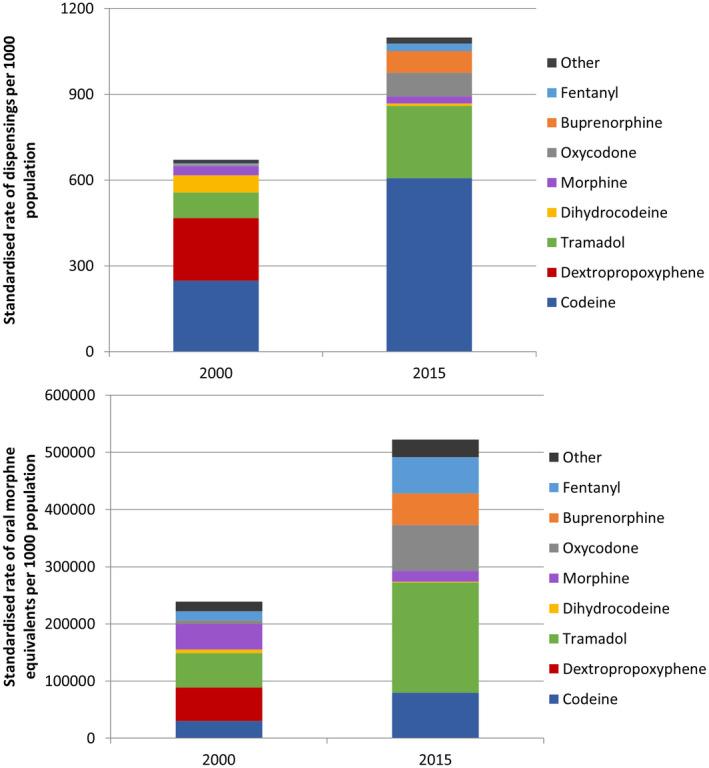
In recent decades, opioid use has increased internationally and is a major public health concern. This study aims to characterize changes in opioid and other analgesic prescribing in Ireland over a 15-year period (2000-2015). This is a repeated cross-sectional study of administrative pharmacy claims data in 2000 and 2015. Individuals of all ages in Ireland's Eastern Health Board region who were eligible for the General Medical Services (GMS) scheme were included. This scheme covers 40% of the population, mostly those on lower incomes and older people. The primary outcome was dispensing of opioids, both prevalence of any use and rate per 1000 GMS eligible population (standardized to the 2015 population). Logistic regression was used to assess odds of opioid dispensing in 2015 versus 2000, controlling for demographic differences. The eligible study population was 364 436 in 2000 and 523 653 in 2015. In 2000, 19.4% of the eligible population had at least one opioid dispensing compared to 20.8% in 2015. The rate increased from 671 to 1098 dispensings per 1000 population. The increase was highest in the dispensing rates of codeine, tramadol, oxycodone, buprenorphine, and fentanyl. Compared to 2000, there was higher odds in 2015 of being dispensed a strong opioid (adjusted odds ratio 2.0, 95%CI 1.97-2.04) or long-acting formulation (3.75, 95%CI 3.58-3.92). Increased prescribing of opioids, particularly strong opioids, between 2000 and 2015 is evident in Ireland. This is concerning due to the potential for misuse, and opioid-related morbidity/mortality.
在最近几十年中,阿片类药物的使用在国际范围内有所增加,成为一个主要的公共卫生关注点。本研究旨在描述 15 年来(2000-2015 年)爱尔兰阿片类药物和其他镇痛药处方的变化情况。这是一项针对 2000 年和 2015 年行政药房理赔数据的重复横断面研究。爱尔兰东部卫生委员会地区所有年龄段符合普通医疗服务(GMS)计划条件的个人均被纳入研究。该计划覆盖了 40%的人口,主要是低收入者和老年人。主要结果是开处阿片类药物,包括任何使用的流行率和每 1000 名符合 GMS 条件的人群的使用率(按 2015 年人口标准化)。使用逻辑回归评估 2015 年与 2000 年相比开处阿片类药物的可能性,同时控制人口统计学差异。符合研究条件的人群在 2000 年为 364436 人,在 2015 年为 523653 人。2000 年,符合条件的人群中有 19.4%至少开处了一种阿片类药物,而 2015 年则为 20.8%。使用率从每 1000 人 671 次增加到 1098 次。在可待因、曲马多、羟考酮、丁丙诺啡和芬太尼的配药率增幅最大。与 2000 年相比,2015 年被开处强阿片类药物(调整后的优势比 2.0,95%CI 1.97-2.04)或长效制剂(3.75,95%CI 3.58-3.92)的可能性更高。2000 年至 2015 年期间,爱尔兰阿片类药物,特别是强阿片类药物的处方量明显增加。这令人担忧,因为存在滥用的可能性,以及阿片类药物相关的发病率/死亡率。
 Zotero 插件