
吸烟与多基因风险评分对肺功能降低的交互作用。
Interaction of Cigarette Smoking and Polygenic Risk Score on Reduced Lung Function.
机构信息
Systems Biology and Computer Science Program, Ann Romney Center for Neurological Diseases, Department of Neurology, Brigham and Women's Hospital, Boston, Massachusetts.
Harvard Medical School, Boston, Massachusetts.
出版信息
JAMA Netw Open. 2021 Dec 1;4(12):e2139525. doi: 10.1001/jamanetworkopen.2021.39525.
IMPORTANCE
The risk of airflow limitation and chronic obstructive pulmonary disease (COPD) is influenced by combinations of cigarette smoking and genetic susceptibility, yet it remains unclear whether gene-by-smoking interactions are associated with quantitative measures of lung function.
OBJECTIVE
To assess the interaction of cigarette smoking and polygenic risk score in association with reduced lung function.
DESIGN, SETTING, AND PARTICIPANTS: This UK Biobank cohort study included UK citizens of European ancestry aged 40 to 69 years with genetic and spirometry data passing quality control metrics. Data was analyzed from July 2020 to March 2021.
EXPOSURES
PRS of combined forced expiratory volume in 1 second (FEV1) and percent of forced vital capacity exhaled in the first second (FEV1/FVC), self-reported pack-years of smoking, ever- vs never-smoking status, and current- vs former- or never-smoking status.
MAIN OUTCOMES AND MEASURES
FEV1/FVC was the primary outcome. Models were used to test for interactions with models, including the main effects of PRS, different smoking variables, and their cross-product terms. The association between pack-years of smoking and FEV1/FVC were compared for those in the highest vs lowest decile of estimated genetic risk for low lung function.
RESULTS
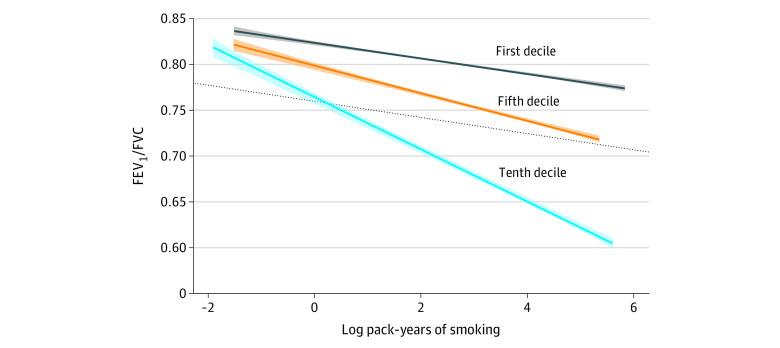
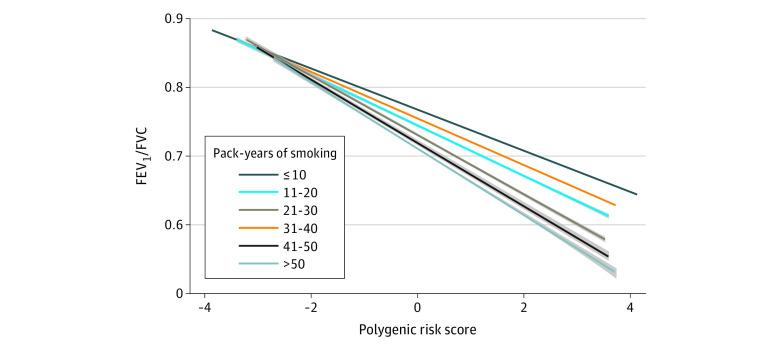
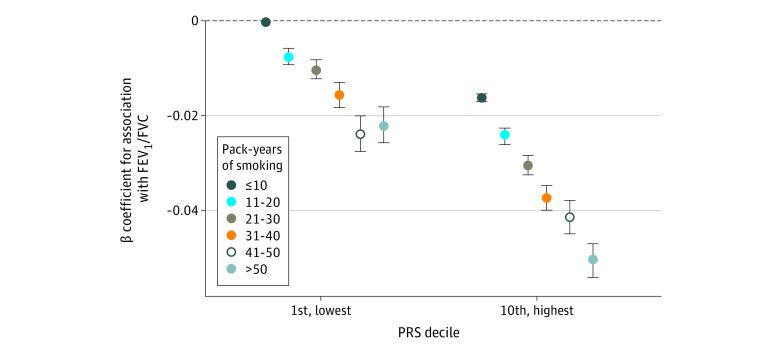
We included 319 730 individuals, of whom 24 915 (8%) had moderate-to-severe COPD cases, and 44.4% were men. Participants had a mean (SD) age 56.5 of (8.02) years. The PRS and pack-years were significantly associated with lower FEV1/FVC (PRS: β, -0.03; 95% CI, -0.031 to -0.03; pack-years: β, -0.0064; 95% CI, -0.0064 to -0.0063) and the interaction term (β, -0.0028; 95% CI, -0.0029 to -0.0026). A stepwise increment in estimated effect sizes for these interaction terms was observed per 10 pack-years of smoking exposure. The interaction of PRS with 11 to 20, 31 to 40, and more than 50 pack-years categories were β (interaction) -0.0038 (95% CI, -0.0046 to -0.0031); -0.013 (95% CI, -0.014 to -0.012); and -0.017 (95% CI, -0.019 to -0.016), respectively. There was evidence of significant interaction between PRS with ever- or never- smoking status (β, interaction; -0.0064; 95% CI, -0.0068 to -0.0060) and current or not-current smoking (β, interaction; -0.0091; 95% CI, -0.0097 to -0.0084). For any given level of pack-years of smoking exposure, FEV1/FVC was significantly lower for individuals in the tenth decile (ie, highest risk) than the first decile (ie, lowest risk) of genetic risk. For every 20 pack-years of smoking, those in the tenth decile compared with the first decile of genetic risk showed nearly a 2-fold reduction in FEV1/FVC.
CONCLUSIONS AND RELEVANCE
COPD is characterized by diminished lung function, and our analyses suggest there is substantial interaction between genome-wide PRS and smoking exposures. While smoking was associated with decreased lung function across all genetic risk categories, the associations were strongest in individuals with higher estimated genetic risk.
重要性
气流受限和慢性阻塞性肺疾病(COPD)的风险受到吸烟和遗传易感性的组合影响,但目前尚不清楚基因与吸烟的相互作用是否与肺功能的定量测量有关。
目的
评估吸烟与多基因风险评分在与肺功能下降相关中的相互作用。
设计、地点和参与者:这项英国生物库队列研究包括年龄在 40 至 69 岁之间的具有遗传和肺活量计数据通过质量控制指标的欧洲血统的英国公民。数据分析于 2020 年 7 月至 2021 年 3 月进行。
暴露因素
联合第一秒用力呼气量(FEV1)和第一秒用力呼气量占用力肺活量的百分比(FEV1/FVC)的多基因风险评分、自我报告的吸烟包年数、是否吸烟状态、当前吸烟状态或以前吸烟状态或从不吸烟状态。
主要结果和测量
FEV1/FVC 是主要结果。模型用于测试与模型的相互作用,包括 PRS、不同吸烟变量及其交叉乘积项的主要影响。对于那些肺功能低遗传风险最高和最低十分位数的人,比较了吸烟包年数与 FEV1/FVC 的关系。
结果
我们纳入了 319730 人,其中 24915 人(8%)患有中重度 COPD 病例,44.4%为男性。参与者的平均(SD)年龄为 56.5 岁(8.02)。PRS 和吸烟包年数与较低的 FEV1/FVC 显著相关(PRS:β,-0.03;95%CI,-0.031 至-0.03;吸烟包年数:β,-0.0064;95%CI,-0.0064 至-0.0063)和交互项(β,-0.0028;95%CI,-0.0029 至-0.0026)。观察到随着吸烟暴露量每增加 10 个吸烟包年,这些交互项的估计效应大小呈逐步递增。PRS 与 11 至 20、31 至 40 和超过 50 个吸烟包年类别的交互作用β(交互)分别为-0.0038(95%CI,-0.0046 至-0.0031);-0.013(95%CI,-0.014 至-0.012);和-0.017(95%CI,-0.019 至-0.016)。有证据表明,PRS 与曾经吸烟或从不吸烟状态(β,交互;-0.0064;95%CI,-0.0068 至-0.0060)和当前或非当前吸烟(β,交互;-0.0091;95%CI,-0.0097 至-0.0084)之间存在显著的相互作用。对于任何给定的吸烟包年暴露水平,与遗传风险最低十分位数(即最低风险)的个体相比,遗传风险最高十分位数(即最高风险)的个体 FEV1/FVC 明显较低。与吸烟相比,每 20 个吸烟包年,与遗传风险第十个十分位数相比,第一个十分位数的 FEV1/FVC 降低了近两倍。
结论和相关性
COPD 的特征是肺功能下降,我们的分析表明,全基因组 PRS 和吸烟暴露之间存在大量相互作用。虽然吸烟与所有遗传风险类别下的肺功能下降有关,但在估计遗传风险较高的个体中,相关性最强。
 Zotero 插件