
去极化的线粒体膜电位和二氢奎尼酮对高氧暴露大鼠离体灌流肺的保护作用。
Depolarized mitochondrial membrane potential and protection with duroquinone in isolated perfused lungs from rats exposed to hyperoxia.
机构信息
Department of Biomedical Engineering, Marquette University-Medical College of Wisconsin, Milwaukee, Wisconsin.
Clement J. Zablocki V.A. Medical Center, Milwaukee, Wisconsin.
出版信息
J Appl Physiol (1985). 2022 Feb 1;132(2):346-356. doi: 10.1152/japplphysiol.00565.2021. Epub 2021 Dec 23.
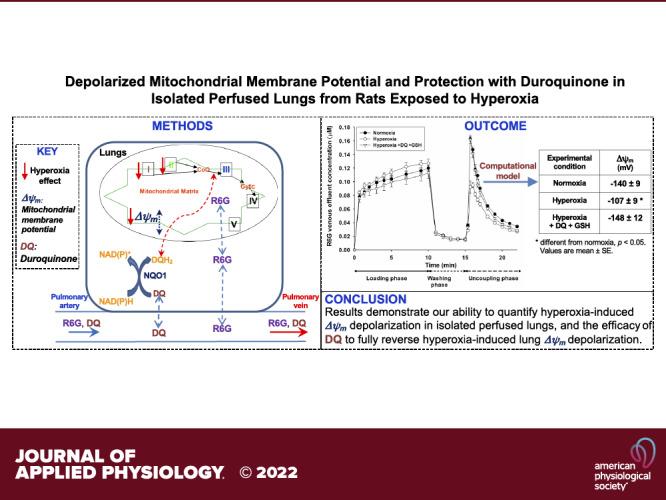
Dissipation of mitochondrial membrane potential (Δψ) is a hallmark of mitochondrial dysfunction. Our objective was to use a previously developed experimental-computational approach to estimate tissue Δψ in intact lungs of rats exposed to hyperoxia and to evaluate the ability of duroquinone (DQ) to reverse any hyperoxia-induced depolarization of lung . Rats were exposed to hyperoxia (>95% O) or normoxia (room air) for 48 h, after which lungs were excised and connected to a ventilation-perfusion system. The experimental protocol consisted of measuring the concentration of the fluorescent dye rhodamine 6 G (R6G) during three single-pass phases: loading, washing, and uncoupling, in which the lungs were perfused with and without R6G and with the mitochondrial uncoupler FCCP, respectively. For normoxic lungs, the protocol was repeated with ) rotenone (complex I inhibitor), ) rotenone and either DQ or its vehicle (DMSO), and ) rotenone, glutathione (GSH), and either DQ or DMSO added to the perfusate. Hyperoxic lungs were studied with and without DQ and GSH added to the perfusate. Computational modeling was used to estimate lung Δψ from R6G data. Rat exposure to hyperoxia resulted in partial depolarization (-33 mV) of lung Δψ and complex I inhibition depolarized lung Δψ by -83 mV. Results also demonstrate the efficacy of DQ to fully reverse both rotenone- and hyperoxia-induced lung Δψ depolarization. This study demonstrates hyperoxia-induced Δψ depolarization in intact lungs and the utility of this approach for assessing the impact of potential therapies such as exogenous quinones that target mitochondria in intact lungs. This study is the first to measure hyperoxia-induced Δψ depolarization in isolated perfused lungs. Hyperoxia resulted in a partial depolarization of Δψ, which was fully reversed with duroquinone, demonstrating the utility of this approach for assessing the impact of potential therapies that target mitochondria such as exogenous quinones.
线粒体膜电位(Δψ)耗散是线粒体功能障碍的一个标志。我们的目的是使用以前开发的实验计算方法来估计暴露于高氧的大鼠完整肺组织中的组织 Δψ,并评估二氢醌(DQ)逆转任何高氧诱导的肺去极化的能力。大鼠暴露于高氧(>95% O)或常氧(室内空气)48 小时后,取出肺并连接到通气-灌注系统。实验方案包括在三个单次通过阶段测量荧光染料罗丹明 6G(R6G)的浓度:加载、洗涤和去耦,分别用和不用 R6G 以及线粒体解偶联剂 FCCP 灌注肺。对于常氧肺,重复该方案,用)鱼藤酮(复合物 I 抑制剂)、)鱼藤酮和 DQ 或其载体(DMSO)、)鱼藤酮、谷胱甘肽(GSH)和 DQ 或 DMSO 添加到灌流液中。高氧肺在添加或不添加 DQ 和 GSH 到灌流液中进行研究。计算模型用于从 R6G 数据估计肺 Δψ。大鼠暴露于高氧导致肺 Δψ 的部分去极化(-33 mV),复合物 I 抑制使肺 Δψ 去极化-83 mV。结果还表明 DQ 能够完全逆转鱼藤酮和高氧诱导的肺 Δψ 去极化。这项研究表明,在完整的肺中,高氧诱导的 Δψ 去极化,并证明了这种方法在评估潜在治疗方法(如靶向线粒体的外源性醌)对完整肺的影响方面的效用。这是首次在离体灌注肺中测量高氧诱导的 Δψ 去极化。高氧导致 Δψ 部分去极化,用二氢醌完全逆转,证明了这种方法在评估潜在治疗方法(如靶向线粒体的外源性醌)对线粒体的影响方面的效用。
 Zotero 插件