
姜黄素和槲皮素对 LPS 损伤的大鼠肠上皮(IEC-6)细胞的体外抗炎活性受热处理的影响。
The In Vitro Anti-Inflammatory Activities of Galangin and Quercetin towards the LPS-Injured Rat Intestinal Epithelial (IEC-6) Cells as Affected by Heat Treatment.
机构信息
Key Laboratory of Dairy Science, Ministry of Education, Northeast Agricultural University, Harbin 150030, China.
School of Biology and Food Engineering, Guangdong University of Petrochemical Technology, Maoming 525000, China.
出版信息
Molecules. 2021 Dec 10;26(24):7495. doi: 10.3390/molecules26247495.
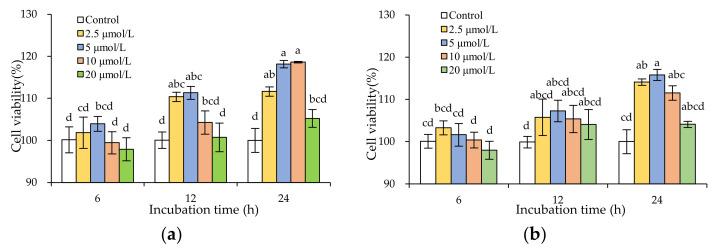
Flavonols possess several beneficial bioactivities in vitro and in vivo. In this study, two flavonols galangin and quercetin with or without heat treatment (100 °C for 15-30 min) were assessed for their anti-inflammatory activities in lipopolysaccharide (LPS)-stimulated rat intestinal epithelial (IEC-6) cells and whether the heat treatment caused activity changes. The flavonol dosages of 2.5-20 μmol/L had no cytotoxicity on the cells but could enhance cell viability (especially using 5 μmol/L flavonol dosage). The flavonols could decrease the production of prostaglandin E and three pro-inflammatory cytokines interleukin-1β (IL-1β), IL-6, and tumor necrosis factor-α, and simultaneously promote the production of two anti-inflammatory cytokines IL-10 and transforming growth factor-β. The Western-blot results verified that the flavonols could suppress the LPS-induced expression of TLR4 and phosphorylated IκBα and p65, while the molecular docking results also illustrated that the flavonols could bind with TLR4 and NF-κB to yield energy decreases of -(21.9-28.6) kJ/mol. Furthermore, an inhibitor BAY 11-7082 blocked the NF-κB signaling pathway by inhibiting the expression of phosphorylated IκBα/p65 and thus mediated the production of IL-6/IL-10 as the flavonols did, which confirmed the assessed anti-inflammatory effect of the flavonols. Consistently, galangin had higher anti-inflammatory activity than quercetin, while the heated flavonols (especially those with longer heat time) were less active than the unheated counterparts to exert these target anti-inflammatory effects. It is highlighted that the flavonols could antagonize the LPS-caused IEC-6 cells inflammation via suppressing TLR4/NF-κB activation, but heat treatment of the flavonols led to reduced anti-inflammatory efficacy.
类黄酮在体外和体内具有多种有益的生物活性。在这项研究中,评估了两种类黄酮(姜黄素和槲皮素)及其热处理(100°C 15-30 分钟)产物,以研究它们在脂多糖(LPS)刺激的大鼠肠上皮(IEC-6)细胞中的抗炎活性,以及热处理是否会引起活性变化。类黄酮剂量为 2.5-20 μmol/L 对细胞没有细胞毒性,但可以提高细胞活力(特别是使用 5 μmol/L 类黄酮剂量)。类黄酮可以降低前列腺素 E 和三种促炎细胞因子白细胞介素-1β(IL-1β)、IL-6 和肿瘤坏死因子-α的产生,同时促进两种抗炎细胞因子 IL-10 和转化生长因子-β的产生。Western-blot 结果验证了类黄酮可以抑制 LPS 诱导的 TLR4 和磷酸化 IκBα 和 p65 的表达,而分子对接结果也表明,类黄酮可以与 TLR4 和 NF-κB 结合,产生-(21.9-28.6) kJ/mol 的能量降低。此外,抑制剂 BAY 11-7082 通过抑制磷酸化 IκBα/p65 的表达阻断 NF-κB 信号通路,从而介导 IL-6/IL-10 的产生,这与类黄酮的作用一致,证实了类黄酮的抗炎作用。一致地,姜黄素的抗炎活性高于槲皮素,而热处理的类黄酮(特别是热时间较长的类黄酮)的抗炎活性低于未热处理的类黄酮,从而发挥这些靶向抗炎作用。值得强调的是,类黄酮可以通过抑制 TLR4/NF-κB 的激活来拮抗 LPS 引起的 IEC-6 细胞炎症,但类黄酮的热处理会导致抗炎效果降低。




 Zotero 插件