
18q- 综合征的临床特征及长期重组人生长激素治疗:病例报告及文献复习。
Clinical Characteristics and Long-Term Recombinant Human Growth Hormone Treatment of 18q- Syndrome: A Case Report and Literature Review.
机构信息
Key Laboratory of Endocrinology of National Health Commission, Department of Endocrinology, State Key Laboratory of Complex Severe and Rare Diseases Peking Union Medical College Hospital, Chinese Academy of Medical Science and Peking Union Medical College, Beijing, China.
出版信息
Front Endocrinol (Lausanne). 2021 Dec 9;12:776835. doi: 10.3389/fendo.2021.776835. eCollection 2021.
BACKGROUND
18q- syndrome is a rare chromosomal disease caused by the deletion of the long arm of chromosome 18. Some cases with 18q- syndrome can be combined with growth hormone deficiency (GHD), but data on the efficacy of recombinant human growth hormone (rhGH) treatment in 18q- syndrome are limited.
METHODS
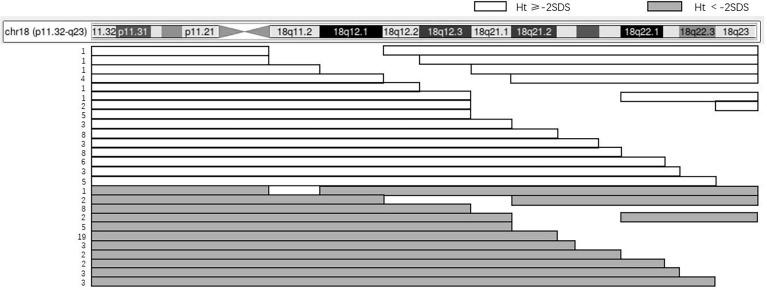
Here, we report one case of 18q- syndrome successfully treated with long-term rhGH supplement. Previously reported cases in the literature are also reviewed to investigate the karyotype-phenotype relationship and their therapeutic response to rhGH.
RESULTS
A 7.9-year-old girl was referred for evaluation for short stature. Physical exam revealed proportionally short stature with a height of 111.10 cm (-3.02 SD score (SDS)), low-set ears, a high-arched palate, a small jaw, webbed neck, widely spaced nipples, long and tapering fingers, and cubitus valgus. Thyroid function test indicated subclinical hypothyroidism. The peak value of growth hormone was 10.26 ng/ml in the levodopa provocation test. Insulin-like growth factor 1 (IGF-1) was 126 ng/ml (57-316 ng/ml). Other laboratory investigations, including complete blood cell count, liver and kidney function, gonadal function, serum adrenocorticotropin levels, and serum cortisol levels, were all within normal ranges. Karyotype analysis showed 46, XX, del (18) (q21). L-Thyroxine replacement and rhGH treatment were initiated and maintained in the following 7 years. At the age of 14.8, her height has reached 159.5 cm with a height SDS increase of 2.82 SDS (from -3.02 SDS to -0.20 SDS). No significant side effects were found during the treatment. The literature review indicated the average rhGH treatment duration of 16 patients was 5.9 ± 3.3 years, and the average height SDS significantly increased from -3.12 ± 0.94 SDS to -1.38 ± 1.29 SDS after the rhGH treatment (p < 0.0001).
CONCLUSION
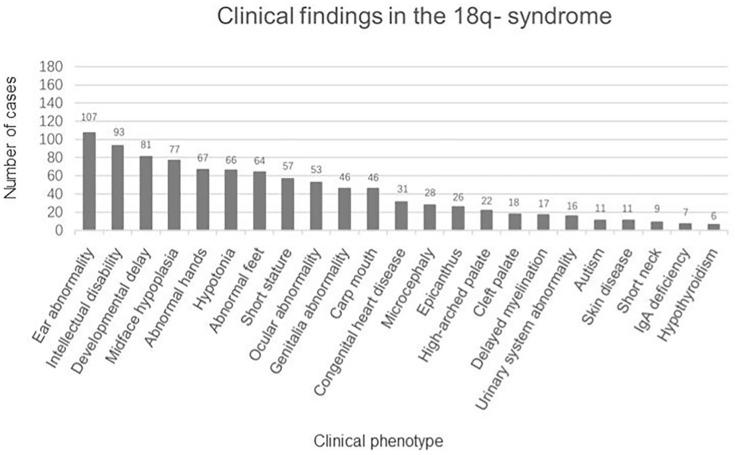
The main clinical manifestations of 18q- syndrome include characteristic appearance, intellectual disability, and abnormal genital development. The literature review suggested a significant height benefit for short stature with 18q- syndrome from long-term rhGH treatment.
背景
18q- 综合征是一种罕见的染色体疾病,由 18 号染色体长臂缺失引起。一些 18q- 综合征病例可合并生长激素缺乏症(GHD),但有关 rhGH 治疗 18q- 综合征疗效的数据有限。
方法
本文报道了一例 18q- 综合征患者经长期 rhGH 补充治疗成功的病例。同时还回顾了文献中报道的既往病例,以探讨核型-表型关系及其对 rhGH 的治疗反应。
结果
一名 7.9 岁女孩因身材矮小就诊。体格检查显示身材比例矮小,身高 111.10cm(-3.02 SDS),低位耳、高拱形腭、小下颌、蹼颈、乳头间距宽、手指长而尖、肘外翻。甲状腺功能检查提示亚临床甲状腺功能减退。左旋多巴激发试验中生长激素峰值为 10.26ng/ml。胰岛素样生长因子 1(IGF-1)为 126ng/ml(57-316ng/ml)。其他实验室检查,包括全血细胞计数、肝肾功能、性腺功能、血清促肾上腺皮质激素水平和血清皮质醇水平,均在正常范围内。核型分析显示 46,XX,del(18)(q21)。随后开始给予左甲状腺素替代治疗和 rhGH 治疗,并在接下来的 7 年内维持治疗。在 14.8 岁时,她的身高达到 159.5cm,身高 SDS 增加了 2.82 SDS(从-3.02 SDS 增加到-0.20 SDS)。治疗过程中未发现明显的不良反应。文献复习显示 16 例患者 rhGH 治疗的平均时间为 5.9±3.3 年,rhGH 治疗后平均身高 SDS 从-3.12±0.94 SDS 显著增加至-1.38±1.29 SDS(p<0.0001)。
结论
18q- 综合征的主要临床表现包括特征性外貌、智力障碍和生殖器发育异常。文献复习表明,长期 rhGH 治疗对 18q- 综合征导致的身材矮小有显著的身高获益。

 Zotero 插件