
健康行动改善癌症幸存者及其配偶的生活方式行为:干预效果的可行性和初步结果。
Healthy Moves to Improve Lifestyle Behaviors of Cancer Survivors and Their Spouses: Feasibility and Preliminary Results of Intervention Efficacy.
机构信息
Department of Palliative Care, Rehabilitation & Integrative Medicine, The University of Texas MD Anderson Cancer Center, Houston, TX 77030, USA.
Moffitt Cancer Center, Tampa, FL 33612, USA.
出版信息
Nutrients. 2021 Dec 14;13(12):4460. doi: 10.3390/nu13124460.
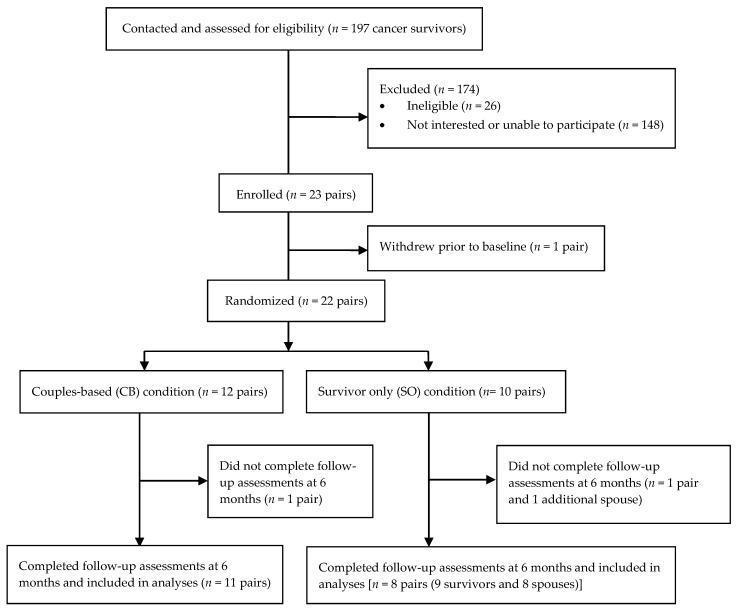
Spouses offer a primary source of support and may provide critical assistance for behavior change. A diet-exercise intervention previously found efficacious in improving cancer survivors' lifestyle behaviors was adapted to utilize a couples-based approach. The aims were to test the feasibility of this couples-based (CB) intervention and compare its efficacy to the same program delivered to the survivor-only (SO). Twenty-two survivor-spouse couples completed baseline assessments and were randomized to the CB or SO interventions. The study surpassed feasibility benchmarks; 91% of survivors and 86% of spouses completed a 6-month follow-up. Survivors and spouses attended 94% and 91% of sessions, respectively. The SO survivors showed significant improvements on the 30-s chair stand and arm curl tests, weight, and fruit and vegetable (F and V) consumption. The CB survivors showed significant improvements on the 6-min walk and 2-min step tests, body weight, and fat and F and V consumption. Improvement in the 30-s chair stand and arm curl tests was significantly better for SO survivors. The SO spouses showed no significant changes in outcome measures, but the CB spouses showed significant improvements in moderate-to-strenuous physical activity, weight, and fat and F and V consumption. Weight loss was significantly greater in CB spouses compared to SO spouses. Findings demonstrate feasibility, warranting further investigation of CB approaches to promote lifestyle change among cancer survivors and spouses.
配偶是主要的支持来源,他们可能为行为改变提供关键帮助。先前已证实一种针对改善癌症幸存者生活方式行为的饮食-运动干预措施,可通过夫妻为基础的方法进行调整。其目的是检验这种夫妻为基础(CB)干预的可行性,并将其与仅针对幸存者(SO)的相同方案进行比较。22 对幸存者-配偶夫妇完成了基线评估,并随机分配到 CB 或 SO 干预组。该研究超过了可行性基准;91%的幸存者和 86%的配偶完成了 6 个月的随访。幸存者和配偶分别参加了 94%和 91%的课程。SO 幸存者在 30 秒椅站立和手臂卷曲测试、体重以及水果和蔬菜(F 和 V)摄入量方面显示出显著改善。CB 幸存者在 6 分钟步行和 2 分钟踏步测试、体重以及脂肪和 F 和 V 摄入量方面显示出显著改善。SO 幸存者在 30 秒椅站立和手臂卷曲测试方面的改善明显更好。SO 配偶在各项结果衡量指标上没有显著变化,但 CB 配偶在适度至剧烈体力活动、体重以及脂肪和 F 和 V 摄入量方面显示出显著改善。与 SO 配偶相比,CB 配偶的体重减轻更为明显。研究结果表明,该干预措施具有可行性,值得进一步研究 CB 方法以促进癌症幸存者及其配偶的生活方式改变。
 Zotero 插件