
新冠病毒疫苗接种证书作为决定国家疫苗接种运动成功与否的一个因素:它有效吗?立陶宛与波兰的案例。
COVID-19 Passport as a Factor Determining the Success of National Vaccination Campaigns: Does It Work? The Case of Lithuania vs. Poland.
作者信息
Walkowiak Marcin Piotr, Walkowiak Justyna B, Walkowiak Dariusz
机构信息
Department of Preventive Medicine, Poznan University of Medical Sciences, 60-781 Poznań, Poland.
Department of Language Policy and Minority Studies, Adam Mickiewicz University in Poznan, 61-712 Poznań, Poland.
出版信息
Vaccines (Basel). 2021 Dec 18;9(12):1498. doi: 10.3390/vaccines9121498.
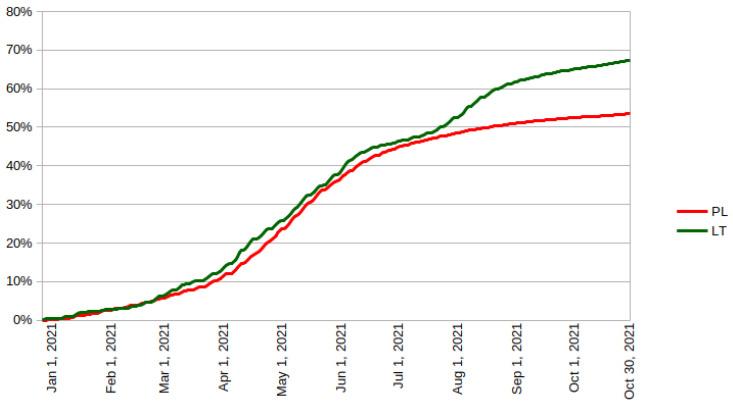
As the ongoing COVID-19 pandemic poses a global threat, it is of utmost importance that governments should find effective means of combating vaccine hesitancy and encouraging their citizens to vaccinate. In our article, we compare the vaccination outcomes in the past months in two neighbouring post-communist EU states, Lithuania and Poland. Both introduced COVID-19 certificates, but only the former followed with gradual limitations for those who failed to get vaccinated, beginning with restricted access to restaurants, sports facilities and indoor events, and finally banning residents without a certificate from entering supermarkets or larger shops and using most services. By contrast, in Poland, the certificate remained a tool for international travel only. We show using statistical data that Lithuania's strict policy, regardless of its social implications, led to markedly higher vaccination outcomes in all age groups than those in Poland at the time.
由于持续的新冠疫情构成全球威胁,各国政府找到有效方法应对疫苗犹豫并鼓励公民接种疫苗至关重要。在我们的文章中,我们比较了两个相邻的后共产主义欧盟国家立陶宛和波兰过去几个月的疫苗接种结果。两国都推出了新冠疫苗接种证书,但只有立陶宛对未接种疫苗者逐步实施限制,从限制进入餐厅、体育设施和室内活动开始,最终禁止无证书居民进入超市或大型商店以及使用大多数服务。相比之下,在波兰,该证书仅作为国际旅行的工具。我们通过统计数据表明,立陶宛的严格政策,无论其社会影响如何,在所有年龄组中都带来了比当时波兰明显更高的疫苗接种率。

 Zotero 插件