
将SYBC-H1的几丁质结合域与叶枝堆肥角质酶融合以增强聚对苯二甲酸乙二酯水解
Fusion of Chitin-Binding Domain From SYBC-H1 to the Leaf-Branch Compost Cutinase for Enhanced PET Hydrolysis.
作者信息
Xue Rui, Chen Yinping, Rong Huan, Wei Ren, Cui Zhongli, Zhou Jie, Dong Weiliang, Jiang Min
机构信息
State Key Laboratory of Materials-Oriented Chemical Engineering, College of Biotechnology and Pharmaceutical Engineering, Nanjing Tech University, Nanjing, China.
Junior Research Group Plastic Biodegradation, Department of Biotechnology and Enzyme Catalysis, Institute of Biochemistry, University of Greifswald, Greifswald, Germany.
出版信息
Front Bioeng Biotechnol. 2021 Dec 15;9:762854. doi: 10.3389/fbioe.2021.762854. eCollection 2021.
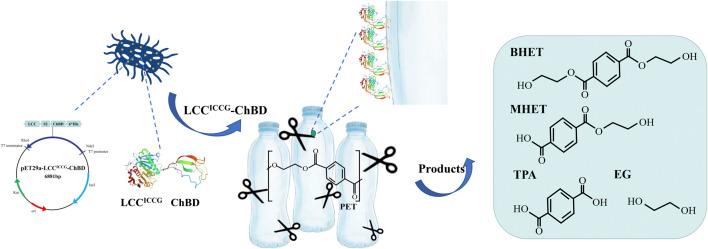
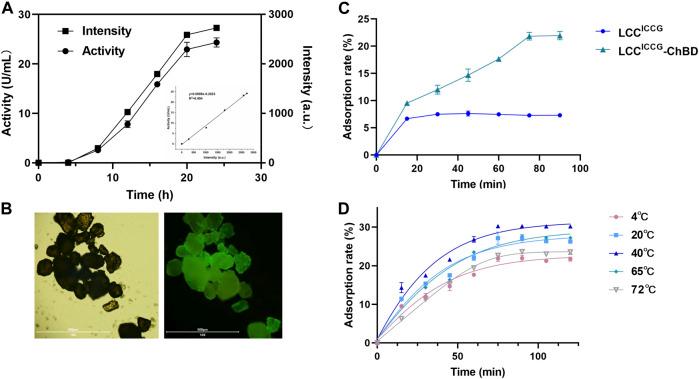
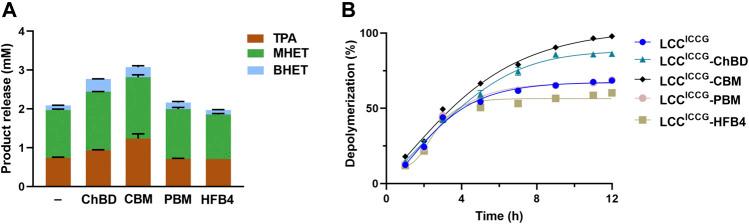
Polyethylene terephthalate (PET) is a mass-produced petroleum-based non-biodegradable plastic that contributes to the global plastic pollution. Recently, biocatalytic degradation has emerged as a viable recycling approach for PET waste, especially with thermophilic polyester hydrolases such as a cutinase (LCC) isolated from a leaf-branch compost metagenome and its variants. To improve the enzymatic PET hydrolysis performance, we fused a chitin-binding domain (ChBD) from SYBC-H1 to the C-terminus of the previously reported LCC variant, demonstrating higher adsorption to PET substrates and, as a result, improved degradation performance by up to 19.6% compared to with its precursor enzyme without the binding module. For compare hydrolysis with different binding module, the catalytic activity of LCC-ChBD, LCC-CBM, LCC-PBM and LCC-HFB4 were further investigated with PET substrates of various crystallinity and it showed measurable activity on high crystalline PET with 40% crystallinity. These results indicated that fusing a polymer-binding module to LCC is a promising method stimulating the enzymatic hydrolysis of PET.
聚对苯二甲酸乙二酯(PET)是一种大量生产的石油基不可生物降解塑料,是全球塑料污染的一个来源。最近,生物催化降解已成为一种可行的PET废料回收方法,特别是利用嗜热聚酯水解酶,如从叶枝堆肥宏基因组中分离出的角质酶(LCC)及其变体。为了提高酶促PET水解性能,我们将来自SYBC-H1的几丁质结合结构域(ChBD)融合到先前报道的LCC变体的C末端,结果表明其对PET底物的吸附能力更强,因此,与没有结合模块的前体酶相比,降解性能提高了19.6%。为了比较不同结合模块的水解情况,我们进一步研究了LCC-ChBD、LCC-CBM、LCC-PBM和LCC-HFB4对各种结晶度的PET底物的催化活性,结果表明它们对结晶度为40%的高结晶PET具有可测量的活性。这些结果表明,将聚合物结合模块融合到LCC上是一种促进PET酶促水解的有前景的方法。


 Zotero 插件