
急性胰腺炎的疼痛管理:随机对照试验的系统评价和荟萃分析
Pain Management in Acute Pancreatitis: A Systematic Review and Meta-Analysis of Randomised Controlled Trials.
作者信息
Cai Wenhao, Liu Fei, Wen Yongjian, Han Chenxia, Prasad Manya, Xia Qing, Singh Vikesh K, Sutton Robert, Huang Wei
机构信息
Department of Integrated Traditional Chinese and Western Medicine, Sichuan Provincial Pancreatitis Centre and West China-Liverpool Biomedical Research Centre, West China Hospital, Sichuan University, Chengdu, China.
Liverpool Pancreatitis Research Group, Liverpool University Hospitals NHS Foundation Trust and Institute of Systems, Molecular and Integrative Biology, University of Liverpool, Liverpool, United Kingdom.
出版信息
Front Med (Lausanne). 2021 Dec 17;8:782151. doi: 10.3389/fmed.2021.782151. eCollection 2021.
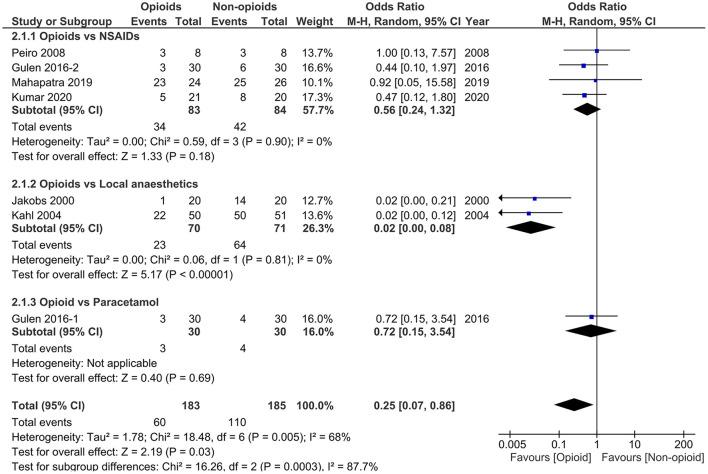
Pain management is an important priority in the treatment of acute pancreatitis (AP). Current evidence and guideline recommendations are inconsistent on the most effective analgesic protocol. This systematic review and meta-analysis of randomised controlled trials (RCTs) aimed to compare the safety and efficacy of analgesics for pain relief in AP. A literature search was performed to identify all RCTs assessing analgesics in patients with AP. The primary outcome was the number of participants who needed rescue analgesia. Study quality was assessed using Jadad score. Pooled odds ratios (ORs) or weighted mean differences (WMDs) with 95% confidence intervals (CI) were analysed using a random-effects model. Twelve studies comprising 699 patients with AP (83% mild AP) were analysed. The tested analgesics significantly decreased the need for rescue analgesia (3 studies, OR.36, 95% CI 0.21 to 0.60) vs. placebo or conventional treatment. The analgesics also improved the pain score [Visual Analogue Scale (Δ-VAS)] at 24 h (WMD 18.46, 0.84 to 36.07) and by the 3rd to 7th days (WMD 11.57, 0.87 to 22.28). Opioids vs. non-opioids were associated with a decrease in the need for rescue analgesia (6 studies, OR 0.25, 95% CI 0.07 to 0.86, = 0.03) but without significance in pain score. In subgroup analyses, opioids were similar to non-steroidal anti-inflammatory drugs (NSAIDs) regarding the primary outcome (4 studies, OR 0.56, 95% CI 0.24 to 1.32, = 0.18). There were no significant differences in other clinical outcomes and rate of adverse events. Other studies, comparing epidural anaesthesia vs. patient-controlled analgesia and opioid (buprenorphine) vs. opioid (pethidine) did not show significant difference in primary outcome. Study quality issues significantly contributed to overall study heterogeneity. NSAIDs and opioids are equally effective in decreasing the need for rescue analgesia in patients with mild AP. The relative paucity of trials and high-quality data in this setting is notable and the optimal analgesic strategy for patients with moderately severe and severe AP still requires to be determined.
疼痛管理是急性胰腺炎(AP)治疗中的一项重要优先事项。目前的证据和指南建议在最有效的镇痛方案上并不一致。这项对随机对照试验(RCT)的系统评价和荟萃分析旨在比较用于缓解AP疼痛的镇痛药的安全性和有效性。进行了文献检索,以确定所有评估AP患者镇痛药的RCT。主要结局是需要补救镇痛的参与者数量。使用Jadad评分评估研究质量。采用随机效应模型分析合并比值比(OR)或加权平均差(WMD)及95%置信区间(CI)。分析了12项研究,共699例AP患者(83%为轻度AP)。与安慰剂或传统治疗相比,所测试的镇痛药显著降低了补救镇痛的需求(3项研究,OR 0.36,95%CI 0.21至0.60)。镇痛药还改善了24小时时的疼痛评分[视觉模拟量表(Δ-VAS)](WMD 18.46,0.84至36.07)以及第3至7天时的疼痛评分(WMD (11.57,0.87至22.28)。与非阿片类药物相比,阿片类药物与补救镇痛需求的减少相关(6项研究,OR 0.25,95%CI 0.07至0.86,P = 0.03),但在疼痛评分方面无显著差异。在亚组分析中,就主要结局而言,阿片类药物与非甾体抗炎药(NSAIDs)相似(4项研究,OR 0.56,95%CI 0.24至1.32,P = 0.18)。在其他临床结局和不良事件发生率方面无显著差异。其他比较硬膜外麻醉与患者自控镇痛以及阿片类药物(丁丙诺啡)与阿片类药物(哌替啶)的研究在主要结局上未显示出显著差异。研究质量问题对总体研究异质性有显著影响。NSAIDs和阿片类药物在降低轻度AP患者补救镇痛需求方面同样有效。在这种情况下试验和高质量数据相对较少是值得注意的,中度重症和重症AP患者的最佳镇痛策略仍有待确定。


 Zotero 插件