
芬太尼从μ-阿片受体解离的动力学与机制
Kinetics and Mechanism of Fentanyl Dissociation from the μ-Opioid Receptor.
作者信息
Mahinthichaichan Paween, Vo Quynh N, Ellis Christopher R, Shen Jana
机构信息
Division of Applied Regulatory Science, Office of Clinical Pharmacology, Office of Translational Sciences, Center for Drug Evaluation and Research, United States Food and Drug Administration, Silver Spring, Maryland 20993, United States.
Department of Pharmaceutical Sciences, University of Maryland School of Pharmacy, Baltimore, Maryland 21201, United States.
出版信息
JACS Au. 2021 Nov 5;1(12):2208-2215. doi: 10.1021/jacsau.1c00341. eCollection 2021 Dec 27.
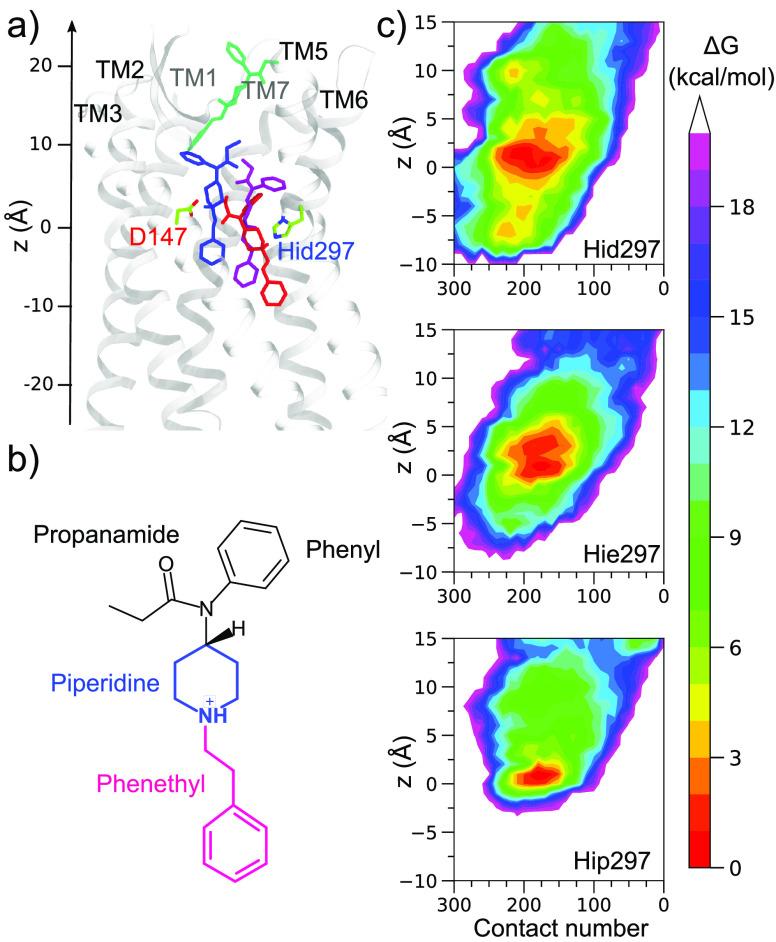
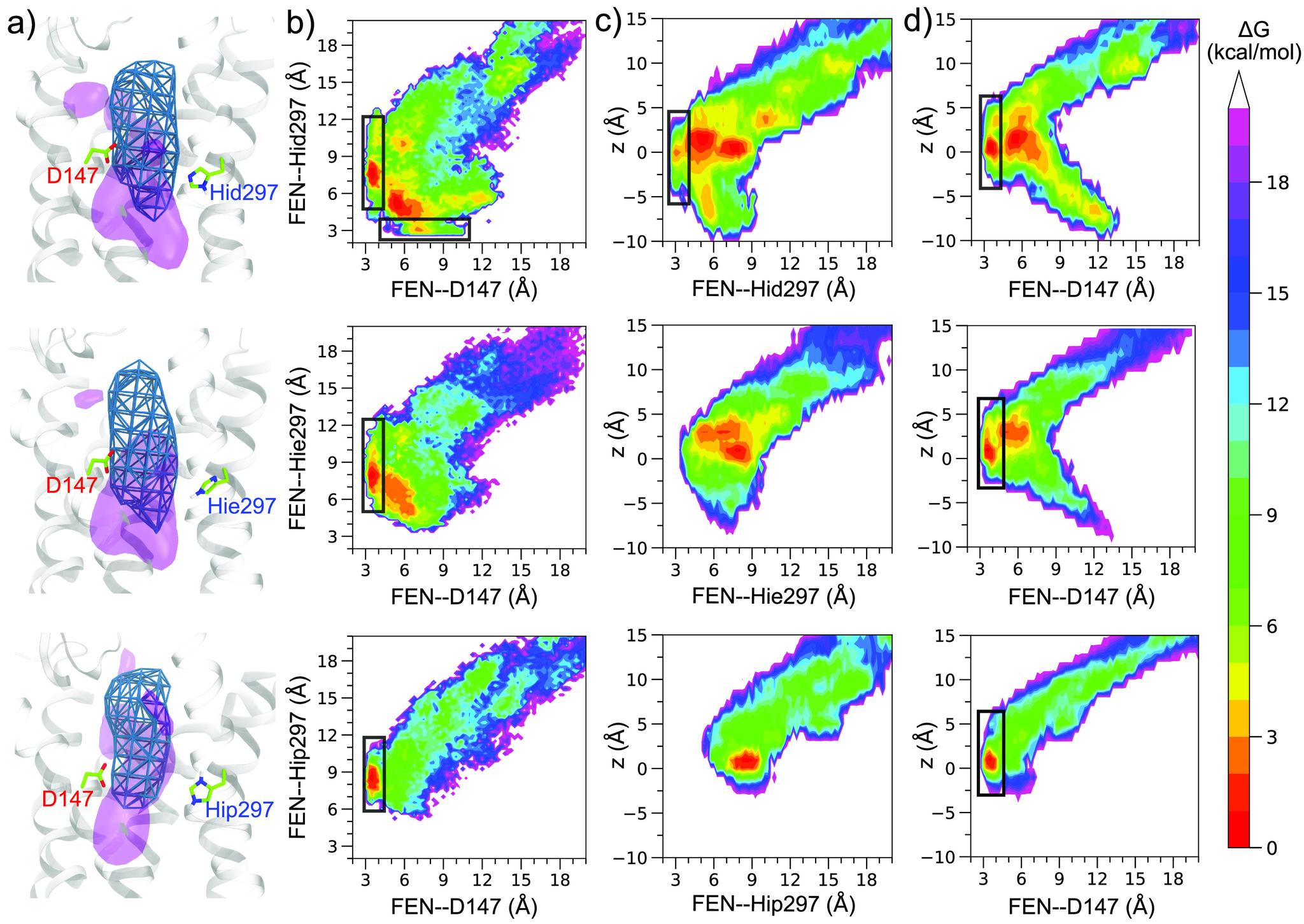
Driven by illicit fentanyl, opioid related deaths have reached the highest level in 2020. Currently, an opioid overdose is resuscitated by the use of naloxone, which competitively binds and antagonizes the μ-opioid receptor (mOR). Thus, knowledge of the residence times of opioids at mOR and the unbinding mechanisms is valuable for assessing the effectiveness of naloxone. In the present study, we calculate the fentanyl-mOR dissociation time and elucidate the mechanism by applying an enhanced sampling molecular dynamics (MD) technique. Two sets of metadynamics simulations with different initial structures were performed while accounting for the protonation state of the conserved H297, which has been suggested to modulate the ligand-mOR affinity and binding mode. Surprisingly, with the Nδ-protonated H297, fentanyl can descend as much as 10 Å below the level of the conserved D147 before escaping the receptor and has a calculated residence time τ of 38 s. In contrast, with the Nϵ- and doubly protonated H297, the calculated τ are 2.6 and 0.9 s, respectively. Analysis suggests that formation of the piperidine-Hid297 hydrogen bond strengthens the hydrophobic contacts with the transmembrane helix (TM) 6, allowing fentanyl to explore a deep pocket. Considering the experimental τ of ∼4 min for fentanyl and the role of TM6 in mOR activation, the deep insertion mechanism may be biologically relevant. The work paves the way for large-scale computational predictions of opioid dissociation rates to inform evaluation of strategies for opioid overdose reversal. The profound role of the histidine protonation state found here may shift the paradigm in computational studies of ligand-receptor kinetics.
在非法芬太尼的推动下,2020年与阿片类药物相关的死亡人数达到了最高水平。目前,阿片类药物过量使用纳洛酮进行复苏,纳洛酮竞争性结合并拮抗μ-阿片受体(mOR)。因此,了解阿片类药物在mOR上的停留时间和解离机制对于评估纳洛酮的有效性很有价值。在本研究中,我们通过应用增强采样分子动力学(MD)技术计算了芬太尼-mOR的解离时间并阐明了其机制。在考虑保守的H297的质子化状态的同时,进行了两组具有不同初始结构的元动力学模拟,有人认为该质子化状态可调节配体-mOR的亲和力和结合模式。令人惊讶的是,对于Nδ-质子化的H297,芬太尼在逃离受体之前可以下降到比保守的D147低多达10 Å的水平,计算得出的停留时间τ为38 s。相比之下,对于Nε-质子化和双质子化的H297,计算得出的τ分别为2.6 s和0.9 s。分析表明,哌啶-Hid297氢键的形成加强了与跨膜螺旋(TM)6的疏水接触,使芬太尼能够探索一个深口袋。考虑到芬太尼的实验停留时间约为4分钟以及TM6在mOR激活中的作用,这种深度插入机制可能具有生物学相关性。这项工作为阿片类药物解离速率的大规模计算预测铺平了道路,以便为阿片类药物过量逆转策略的评估提供信息。此处发现的组氨酸质子化状态的深远作用可能会改变配体-受体动力学计算研究的范式。


 Zotero 插件