
应用新型基因组工作流程对 16579 例新生儿进行 15 号染色体印迹障碍筛查的可行性。
Feasibility of Screening for Chromosome 15 Imprinting Disorders in 16 579 Newborns by Using a Novel Genomic Workflow.
机构信息
Diagnosis and Development, Murdoch Children's Research Institute, Royal Children's Hospital, Melbourne, Parkville, Victoria, Australia.
Faculty of Medicine, Dentistry and Health Sciences, Department of Paediatrics, University of Melbourne, Parkville, Victoria, Australia.
出版信息
JAMA Netw Open. 2022 Jan 4;5(1):e2141911. doi: 10.1001/jamanetworkopen.2021.41911.
IMPORTANCE
Newborn screening for Angelman syndrome (AS), Prader-Willi syndrome (PWS), and chromosome 15 duplication syndrome (Dup15q) may lead to benefit from early diagnosis and treatment.
OBJECTIVE
To examine the feasibility of newborn screening for these chromosome 15 imprinting disorders at population scale.
DESIGN, SETTING, AND PARTICIPANTS: In this diagnostic study, the validation data set for the first-tier SNRPN test, called methylation-specific quantitative melt analysis (MS-QMA), included 109 PWS, 48 AS, 9 Dup15q, and 1190 population control newborn blood spots (NBS) and peripheral tissue samples from participants recruited from January 2000 to December 2016. The test data set included NBS samples from 16 579 infants born in 2011. Infants with an NBS identified as positive for PWS, AS, or Dup15q by the first-tier test were referred for droplet digital polymerase chain reaction, real-time polymerase chain reaction, and low-coverage whole-genome sequencing for confirmatory testing. Data analyses were conducted between February 12, 2015, and August 15, 2020.
RESULTS
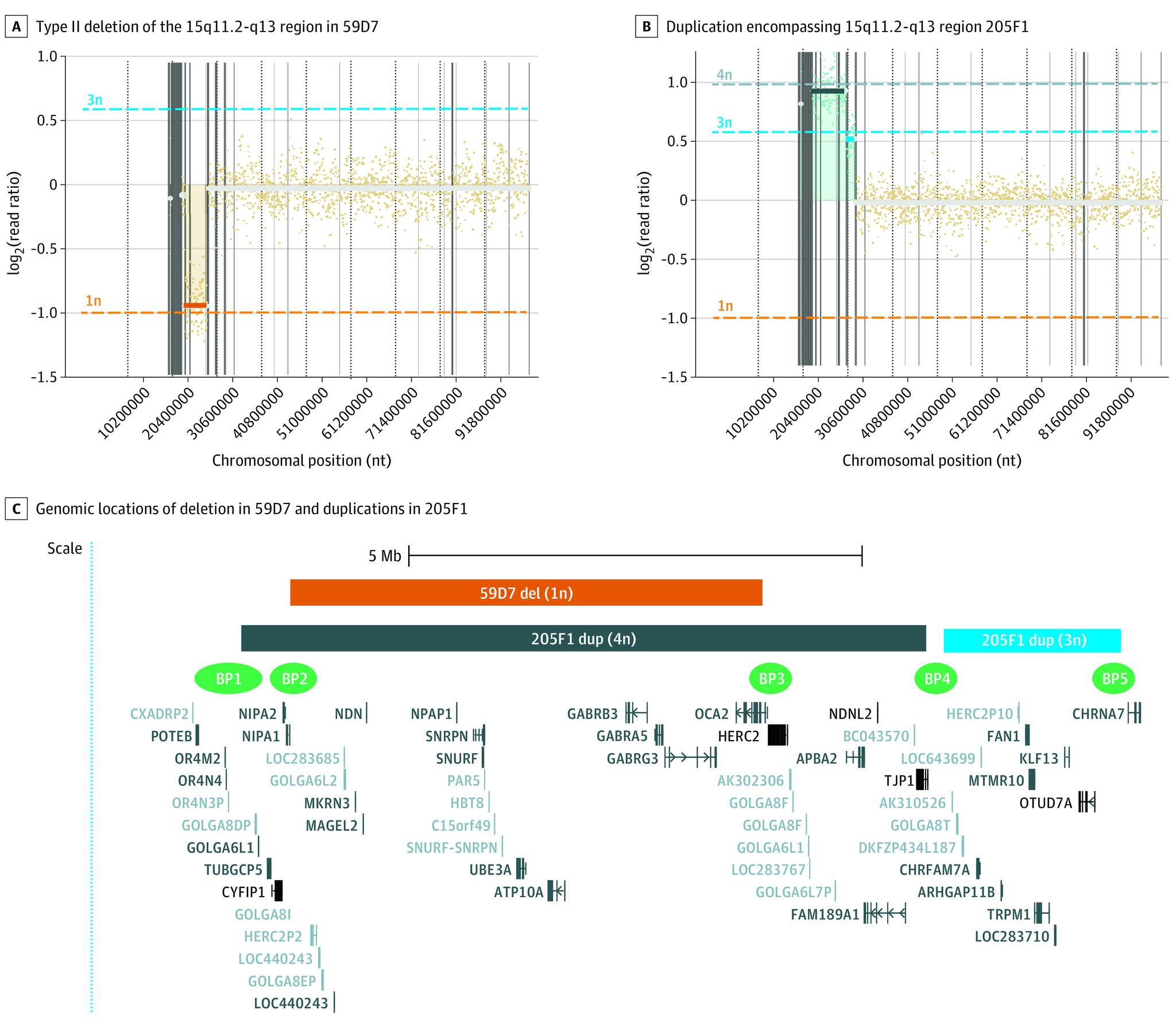
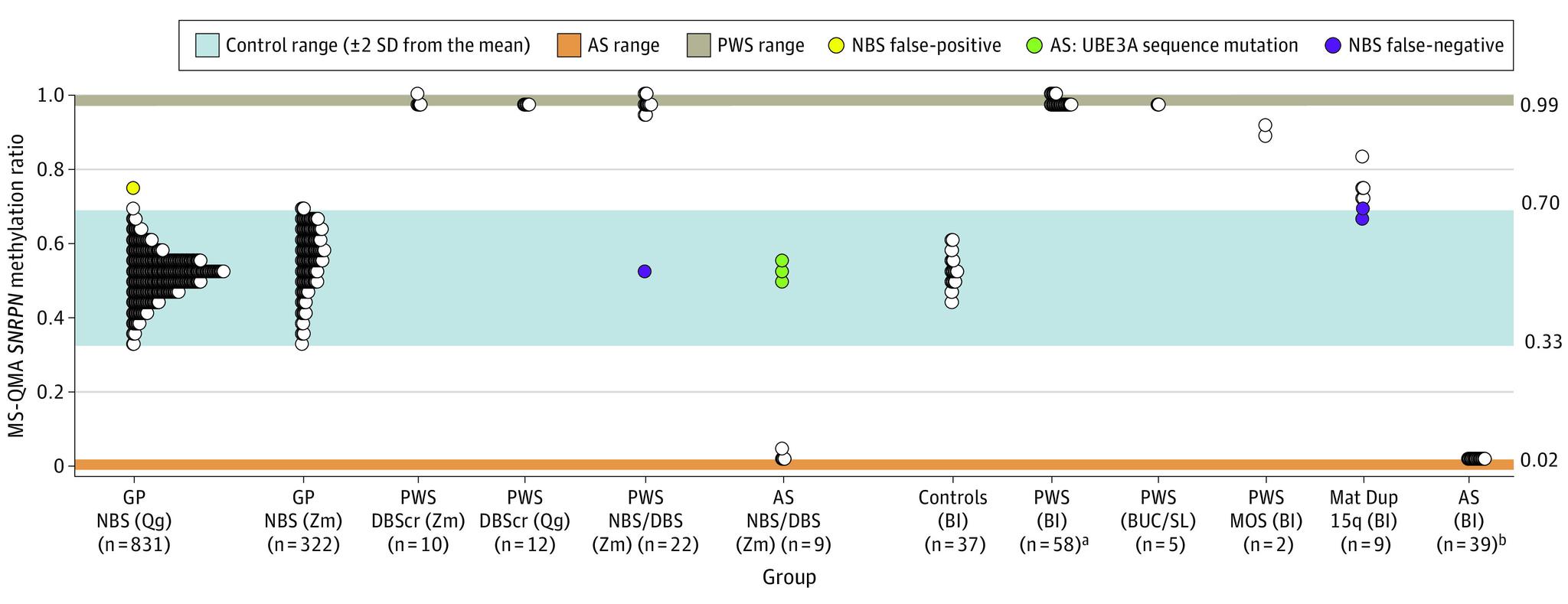
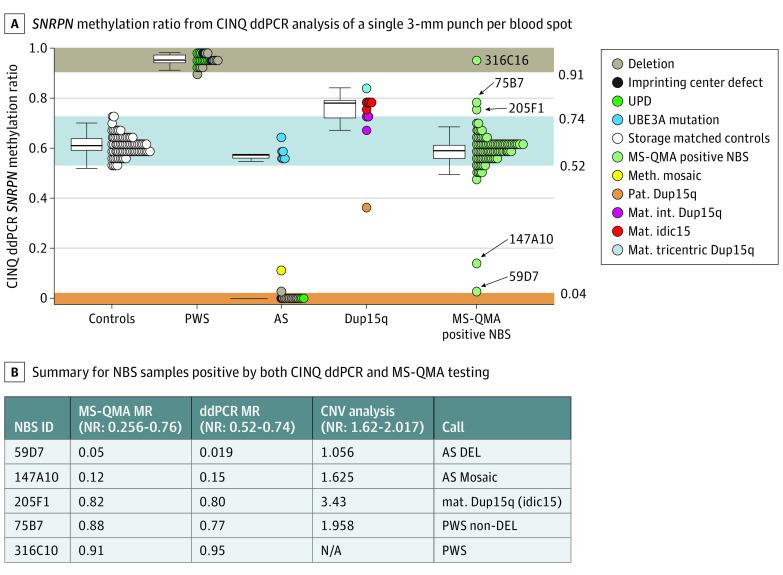
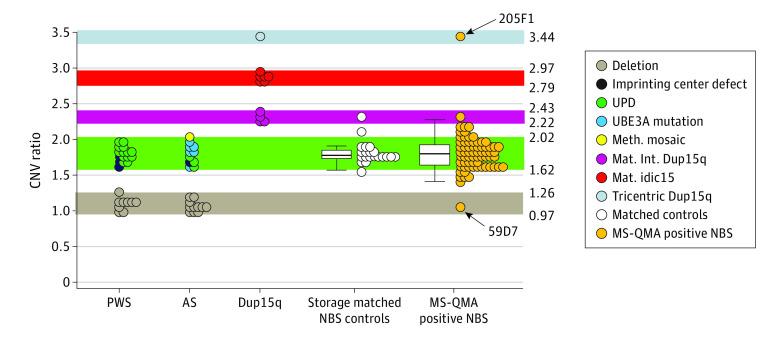
In the validation data set, the median age for the 77 patients with PWS was 3.00 years (IQR, 0.01-44.50 years); for the 46 patients with AS, 2.76 years (IQR, 0.028 to 49.00 years); and for the 9 patients with Dup15q, 4.00 years (IQR, 1.00 to 28.00 years). Thirty-eight patients (51.4%) in the PWS group, 20 patients (45.5%) in the AS group, and 6 patients (66.7%) in the Dup15q group who had sex reported were male. The validation data set showed MS-QMA sensitivity of 99.0% for PWS, 93.8% for AS, and 77.8% for Dup15q; specificity of 100% for PWS, AS, and Dup15q; positive predictive and negative predictive values of 100% for PWS and AS; and a positive predictive value of 87.5% and negative predictive value of 100% for Dup15q. In the test data set of NBS samples from 16 579 infants, 92 had a positive test result using a methylation ratio cut-off of 3 standard deviations from the mean. Of these patients, 2 were confirmed to have PWS; 2, AS; and 1, maternal Dup15q. With the use of more conservative PWS- and AS-specific thresholds for positive calls from the validation data set, 9 positive NBS results were identified by MS-QMA in this cohort. The 2 PWS and 2 AS calls were confirmed by second-tier testing, but the 1 Dup15q case was not confirmed. Together, these results provided prevalence estimates of 1 in 8290 for both AS and PWS and 1 in 16 579 for maternal Dup15q, with positive predictive values for first-tier testing at 67.0% for AS, 33.0% for PWS, and 44.0% for combined detection of chromosome 15 imprinting disorders for the validation data set.
CONCLUSIONS AND RELEVANCE
The findings of this diagnostic study suggest that it is feasible to screen for all chromosome 15 imprinting disorders using SNRPN methylation analysis, with 5 individuals identified with these disorders out of 16 579 infants screened.
重要性
新生儿筛查 Angelman 综合征(AS)、Prader-Willi 综合征(PWS)和 15 号染色体重复综合征(Dup15q)可能会因早期诊断和治疗而受益。
目的
检验在人群中进行这些 15 号染色体印迹障碍新生儿筛查的可行性。
设计、地点和参与者:在这项诊断研究中,用于一级 SNRPN 测试的验证数据集,称为甲基化特异性定量熔解分析(MS-QMA),包括 109 例 PWS、48 例 AS、9 例 Dup15q 和 1190 例来自 2000 年 1 月至 2016 年 12 月招募的参与者的新生儿血斑(NBS)和外周组织样本。测试数据集包括 2011 年出生的 16579 名婴儿的 NBS 样本。通过一级测试确定 NBS 阳性的 PWS、AS 或 Dup15q 婴儿,需进行液滴数字聚合酶链反应、实时聚合酶链反应和低覆盖率全基因组测序以进行确认性检测。数据分析于 2015 年 2 月 12 日至 2020 年 8 月 15 日进行。
结果
在验证数据集中,77 例 PWS 患者的中位年龄为 3.00 岁(IQR,0.01-44.50 岁);46 例 AS 患者为 2.76 岁(IQR,0.028 至 49.00 岁);9 例 Dup15q 患者为 4.00 岁(IQR,1.00 至 28.00 岁)。PWS 组 38 例(51.4%)、AS 组 20 例(45.5%)和 Dup15q 组 6 例(66.7%)患者有性别报告,其中 38 例为男性。验证数据集中,MS-QMA 对 PWS 的敏感性为 99.0%,对 AS 的敏感性为 93.8%,对 Dup15q 的敏感性为 77.8%;特异性为 100%;阳性预测值和阴性预测值均为 100%;PWS 和 AS 的阳性预测值为 100%;Dup15q 的阳性预测值为 87.5%,阴性预测值为 100%。在 16579 名婴儿的 NBS 样本测试数据集中,92 份样本的甲基化比值比平均值高出 3 个标准差,测试结果呈阳性。这些患者中,2 例被确诊为 PWS;2 例,AS;1 例,Dup15q。在验证数据集中使用更保守的 PWS 和 AS 特异性阳性阈值,MS-QMA 在该队列中识别出 9 个阳性 NBS 结果。2 例 PWS 和 2 例 AS 呼叫得到了二级测试的确认,但 1 例 Dup15q 病例未得到确认。综合来看,这些结果表明,在 16579 名婴儿中,AS 和 PWS 的患病率估计值均为 1/8290,Dup15q 的患病率估计值为 1/16579,一级测试的阳性预测值分别为 67.0%、33.0%和 44.0%。
结论和相关性
这项诊断研究的结果表明,使用 SNRPN 甲基化分析对所有 15 号染色体印迹障碍进行筛查是可行的,在筛查的 16579 名婴儿中,有 5 名患有这些疾病。

 Zotero 插件