
耦合式外骨骼辅助可简化控制并保持代谢益处:一项模拟研究。
Coupled exoskeleton assistance simplifies control and maintains metabolic benefits: A simulation study.
机构信息
Department of Mechanical Engineering, Stanford University, Stanford, California, United States of America.
Department of Bioengineering, Stanford University, Stanford, California, United States of America.
出版信息
PLoS One. 2022 Jan 5;17(1):e0261318. doi: 10.1371/journal.pone.0261318. eCollection 2022.
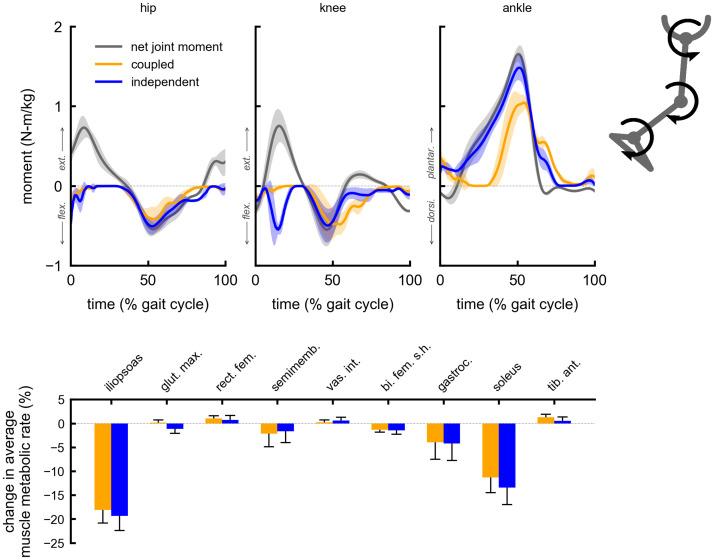
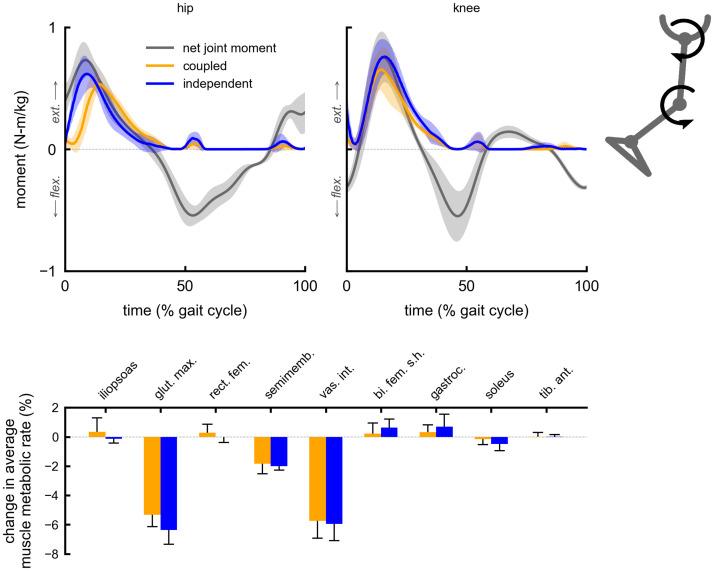
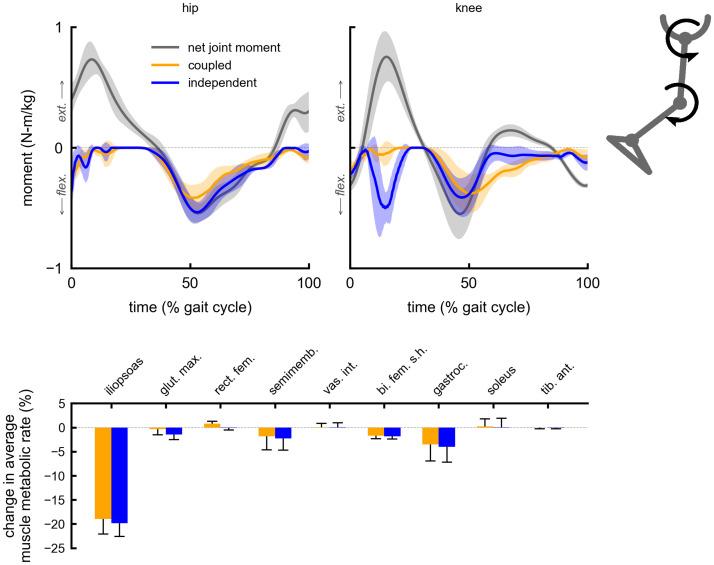
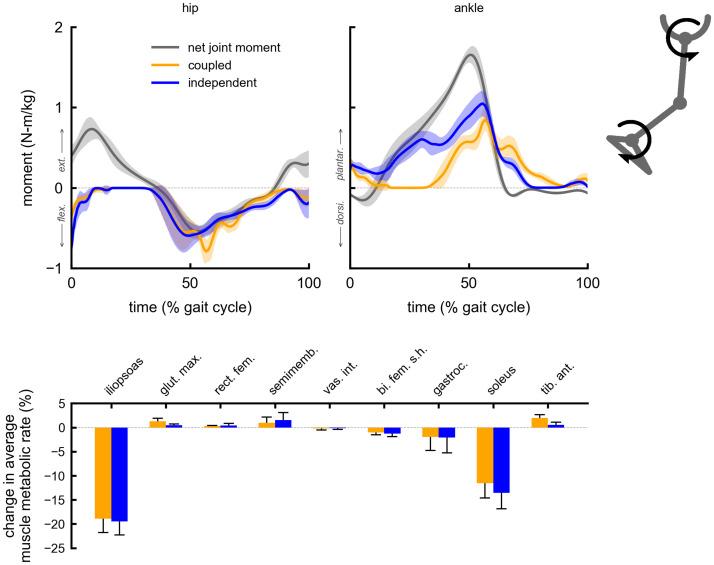
Assistive exoskeletons can reduce the metabolic cost of walking, and recent advances in exoskeleton device design and control have resulted in large metabolic savings. Most exoskeleton devices provide assistance at either the ankle or hip. Exoskeletons that assist multiple joints have the potential to provide greater metabolic savings, but can require many actuators and complicated controllers, making it difficult to design effective assistance. Coupled assistance, when two or more joints are assisted using one actuator or control signal, could reduce control dimensionality while retaining metabolic benefits. However, it is unknown which combinations of assisted joints are most promising and if there are negative consequences associated with coupled assistance. Since designing assistance with human experiments is expensive and time-consuming, we used musculoskeletal simulation to evaluate metabolic savings from multi-joint assistance and identify promising joint combinations. We generated 2D muscle-driven simulations of walking while simultaneously optimizing control strategies for simulated lower-limb exoskeleton assistive devices to minimize metabolic cost. Each device provided assistance either at a single joint or at multiple joints using massless, ideal actuators. To assess if control could be simplified for multi-joint exoskeletons, we simulated different control strategies in which the torque provided at each joint was either controlled independently or coupled between joints. We compared the predicted optimal torque profiles and changes in muscle and total metabolic power consumption across the single joint and multi-joint assistance strategies. We found multi-joint devices-whether independent or coupled-provided 50% greater metabolic savings than single joint devices. The coupled multi-joint devices were able to achieve most of the metabolic savings produced by independently-controlled multi-joint devices. Our results indicate that device designers could simplify multi-joint exoskeleton designs by reducing the number of torque control parameters through coupling, while still maintaining large reductions in metabolic cost.
辅助外骨骼可以降低步行的代谢成本,而外骨骼设备设计和控制方面的最新进展已经带来了大量的代谢节省。大多数外骨骼设备在脚踝或臀部提供辅助。辅助多个关节的外骨骼有可能提供更大的代谢节省,但可能需要许多执行器和复杂的控制器,从而难以设计有效的辅助。耦合辅助是指使用一个执行器或控制信号辅助两个或多个关节,它可以降低控制维度,同时保留代谢益处。然而,尚不清楚哪些辅助关节组合最有前途,以及耦合辅助是否存在负面后果。由于使用人体实验设计辅助非常昂贵且耗时,因此我们使用肌肉骨骼仿真来评估多关节辅助的代谢节省,并确定有前途的关节组合。我们生成了 2D 肌肉驱动的步行模拟,同时优化了模拟下肢外骨骼辅助设备的控制策略,以最小化代谢成本。每个设备要么在单个关节提供辅助,要么使用无质量、理想的执行器在多个关节提供辅助。为了评估多关节外骨骼的控制是否可以简化,我们模拟了不同的控制策略,其中每个关节提供的扭矩要么独立控制,要么在关节之间耦合。我们比较了单个关节和多关节辅助策略下的预测最优扭矩曲线以及肌肉和总代谢功率消耗的变化。我们发现,多关节设备——无论是独立的还是耦合的——比单关节设备提供了 50%更大的代谢节省。耦合的多关节设备能够实现独立控制的多关节设备产生的大部分代谢节省。我们的研究结果表明,设备设计人员可以通过耦合来减少扭矩控制参数的数量,从而简化多关节外骨骼设计,同时仍然保持代谢成本的大幅降低。


 Zotero 插件