
晚期不可切除食管鳞癌的治疗模式和生存:一项基于人群的研究。
Treatment patterns and survival in advanced unresectable esophageal squamous cell cancer: A population-based study.
机构信息
Department of Research & Development, Netherlands Comprehensive Cancer Organisation (IKNL), Utrecht, The Netherlands.
Department of Medical Oncology, Cancer Center Amsterdam, Amsterdam UMC, University of Amsterdam, Amsterdam, The Netherlands.
出版信息
Cancer Sci. 2022 Mar;113(3):1038-1046. doi: 10.1111/cas.15262. Epub 2022 Jan 25.
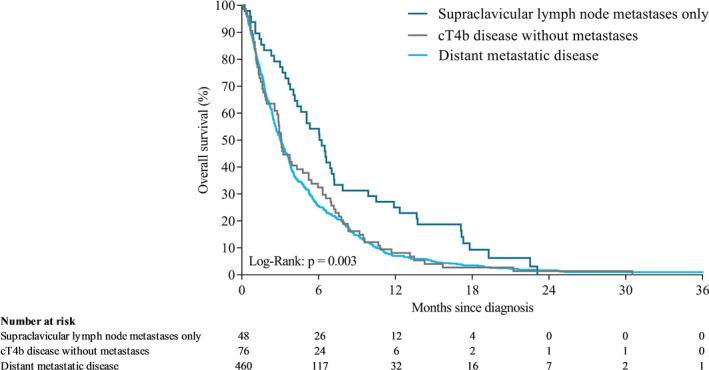
Data on treatment and survival of patients with advanced unresectable esophageal squamous cell carcinoma (ESCC) from Western populations are limited. Here we describe treatment and survival in patients with advanced unresectable ESCC: patients with cT4b disease without metastases (cT4b), metastases limited to the supraclavicular lymph nodes (SCLNM) or distant metastatic ESCC at the population level. All patients with unresectable (cT4b) or synchronous metastatic ESCC at primary diagnosis (2015-2018) or patients with metachronous metastases after primary non-metastatic diagnosis in 2015-2016 were selected from the Netherlands Cancer Registry. Fifteen percent of patients had cT4b disease (n = 146), 12% SCLNM (n = 118) and 72% distant metastases (n = 681). Median overall survival (OS) time was 6.3, 11.2, and 4.4 months in patients with cT4b, SCLNM, and distant metastases, respectively (P < .001). Multivariable Cox regression showed that patients with cT4b (hazard ratio 1.44, 95% CI 1.04-1.99) and patients with distant metastases (hazard ratio 1.42, 95% CI 1.12-1.80) had a worse survival time compared with patients with SCLNM. Among patients who received chemoradiotherapy and/or underwent resection (primary tumor and/or metastases), median OS was 11.9, 16.1, and 14.0 months in patients with cT4b, SCLNM, and distant metastases, respectively (P = .76). Patients with SCLNM had a better survival time compared with patients with cT4b and patients with distant metastases. Survival of patients with advanced unresectable ESCC in clinical practice was poor, even in patients treated with curative intent.
来自西方人群的晚期不可切除食管鳞癌(ESCC)患者的治疗和生存数据有限。在这里,我们描述了晚期不可切除 ESCC 患者的治疗和生存情况:无远处转移的 cT4b 疾病患者(cT4b)、锁骨上淋巴结(SCLNM)转移或远处转移性 ESCC 患者。所有在初诊时为不可切除(cT4b)或同步转移性 ESCC(2015-2018 年)或在 2015-2016 年原发性非转移性诊断后发生同步转移的患者,均从荷兰癌症登记处中选择。15%的患者为 cT4b 疾病(n=146),12%为 SCLNM(n=118),72%为远处转移(n=681)。cT4b、SCLNM 和远处转移患者的中位总生存期(OS)分别为 6.3、11.2 和 4.4 个月(P<.001)。多变量 Cox 回归显示,与 SCLNM 患者相比,cT4b 患者(危险比 1.44,95%CI 1.04-1.99)和远处转移患者(危险比 1.42,95%CI 1.12-1.80)的生存时间更差。在接受放化疗和/或接受切除术(原发性肿瘤和/或转移灶)的患者中,cT4b、SCLNM 和远处转移患者的中位 OS 分别为 11.9、16.1 和 14.0 个月(P=.76)。与 cT4b 患者和远处转移患者相比,SCLNM 患者的生存时间更好。晚期不可切除 ESCC 患者的临床实践预后较差,即使是接受根治性治疗的患者也是如此。



 Zotero 插件