
暴露于不同光强会影响满江红中挥发物的排放以及色素和酚类物质的积累。
Exposure to different light intensities affects emission of volatiles and accumulations of both pigments and phenolics in Azolla filiculoides.
机构信息
Institute for Sustainable Plant Protection (IPSP), National Research Council of Italy (CNR), Sesto Fiorentino, Italy.
Department of Chemistry, Biology and Biotechnology, University of Perugia, Perugia, Italy.
出版信息
Physiol Plant. 2022 Jan;174(1):e13619. doi: 10.1111/ppl.13619.
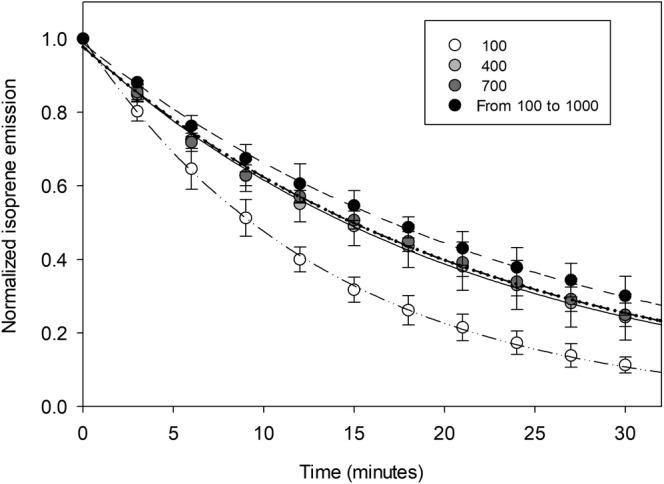
Many agronomic trials demonstrated the nitrogen-fixing ability of the ferns Azolla spp. and its obligate cyanobiont Trichormus azollae. In this study, we have screened the emission of volatile organic compounds (VOCs) and analyzed pigments (chlorophylls, carotenoids) as well as phenolic compounds in Azolla filiculoides-T. azollae symbionts exposed to different light intensities. Our results revealed VOC emission mainly comprising isoprene and methanol (~82% and ~13% of the overall blend, respectively). In particular, by dissecting VOC emission from A. filiculoides and T. azollae, we found that the cyanobacterium does not emit isoprene, whereas it relevantly contributes to the methanol flux. Enhanced isoprene emission capacity (15.95 ± 2.95 nmol m s ), along with increased content of both phenolic compounds and carotenoids, was measured in A. filiculoides grown for long-term under high (700 μmol m s ) rather than medium (400 μmol m s ) and low (100 μmol m s ) light intensity. Moreover, light-responses of chlorophyll fluorescence demonstrated that A. filiculoides was able to acclimate to high growth light. However, exposure of A. filiculoides from low (100 μmol m s ) to very high light (1000 μmol m s ) did not affect, in the short term, photosynthesis, but slightly decreased isoprene emission and leaf pigment content whereas, at the same time, dramatically raised the accumulation of phenolic compounds (i.e. deoxyanthocyanidins and phlobaphenes). Our results highlight a coordinated photoprotection mechanism consisting of isoprene emission and phenolic compounds accumulation employed by A. filiculoides to cope with increasing light intensities.
许多农艺试验证明了蕨类植物满江红属及其专性共生蓝藻满江红鱼腥藻的固氮能力。在这项研究中,我们筛选了挥发性有机化合物(VOC)的排放,并分析了暴露于不同光照强度下的满江红鱼腥藻共生体中的色素(叶绿素、类胡萝卜素)和酚类化合物。我们的结果表明,VOC 排放主要由异戊二烯和甲醇组成(分别占总混合物的82%和13%)。特别是,通过剖析满江红鱼腥藻和满江红鱼腥藻的 VOC 排放,我们发现蓝藻不排放异戊二烯,但它对甲醇通量有显著贡献。在长期高光照(700 μmol·m-2·s-1)而非中光照(400 μmol·m-2·s-1)和低光照(100 μmol·m-2·s-1)下生长的满江红鱼腥藻中,我们测量到其异戊二烯排放能力增强(15.95±2.95 nmol·m-2·s-1),同时酚类化合物和类胡萝卜素的含量也增加。此外,叶绿素荧光的光响应表明,满江红鱼腥藻能够适应高光生长。然而,将满江红鱼腥藻从低光照(100 μmol·m-2·s-1)暴露于极高光照(1000 μmol·m-2·s-1)在短期内不会影响光合作用,但会轻微降低异戊二烯排放和叶片色素含量,同时显著增加酚类化合物(即去氧花青素和叶色原)的积累。我们的结果强调了一种协调的光保护机制,该机制由满江红鱼腥藻用于应对不断增加的光照强度的异戊二烯排放和酚类化合物积累组成。




 Zotero 插件