
西班牙区域层面新冠疫苗接种水平与发病率和致死率之间的关联
On the association between COVID-19 vaccination levels and incidence and lethality rates at a regional scale in Spain.
作者信息
Briz-Redón Álvaro, Serrano-Aroca Ángel
机构信息
Department of Statistics and Operations Research, University of Valencia, Valencia, Spain.
Centro de Investigación Traslacional San Alberto Magno, Universidad Católica de Valencia San Vicente Mártir, Valencia, Spain.
出版信息
Stoch Environ Res Risk Assess. 2022;36(9):2941-2948. doi: 10.1007/s00477-021-02166-y. Epub 2022 Jan 5.
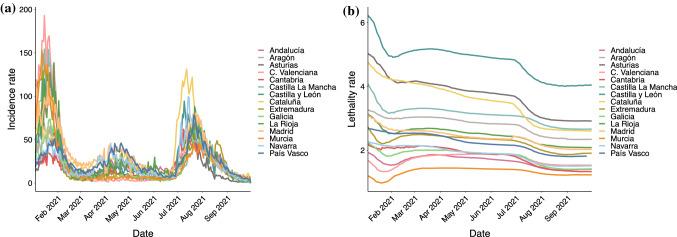
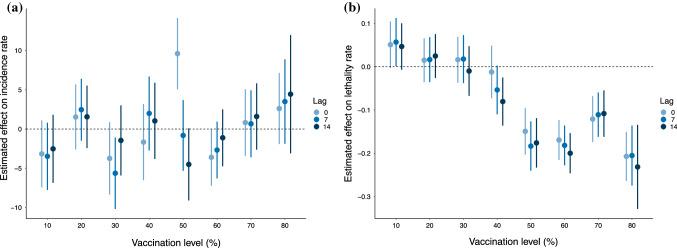
The severe acute respiratory syndrome coronavirus 2 (SARS-CoV-2), which causes the coronavirus disease 2019 (COVID-19), has led to the deepest global health and economic crisis of the current century. This dramatic situation has forced the public health authorities and pharmaceutical companies to develop anti-COVID-19 vaccines in record time. Currently, almost 80% of the population are vaccinated with the required number of doses in Spain. Thus, in this paper, COVID-19 incidence and lethality rates are analyzed through a segmented spatio-temporal regression model that allows studying if there is an association between a certain vaccination level and a change (in mean) in either the incidence or the lethality rates. Spatial dependency is included by considering the Besag-York-Mollié model, whereas natural cubic splines are used for capturing the temporal structure of the data. Lagged effects between the exposure and the outcome are also taken into account. The results suggest that COVID-19 vaccination has not allowed yet (as of September 2021) to observe a consistent reduction in incidence levels at a regional scale in Spain. In contrast, the lethality rates have displayed a declining tendency which has associated with vaccination levels above 50%.
导致2019冠状病毒病(COVID-19)的严重急性呼吸综合征冠状病毒2(SARS-CoV-2)引发了本世纪最严重的全球健康和经济危机。这种严峻形势迫使公共卫生当局和制药公司在创纪录的时间内研发抗COVID-19疫苗。目前,西班牙近80%的人口已接种规定剂量的疫苗。因此,本文通过分段时空回归模型分析COVID-19的发病率和致死率,该模型能够研究特定的疫苗接种水平与发病率或致死率的变化(均值)之间是否存在关联。通过考虑贝萨格-约克-莫利模型纳入空间依赖性,而使用自然三次样条来捕捉数据的时间结构。还考虑了暴露与结果之间的滞后效应。结果表明,截至2021年9月,COVID-19疫苗接种尚未在西班牙区域层面使发病率持续下降。相比之下,致死率呈现出下降趋势,这与50%以上的疫苗接种水平相关。




 Zotero 插件