
妊娠相关高血压中,中心至外周动脉僵硬度梯度减弱和/或逆转。
Center-To-Periphery Arterial Stiffness Gradient Is Attenuated and/or Reversed in Pregnancy-Associated Hypertension.
作者信息
Pereira María M, Torrado Juan, Sosa Claudio, Diaz Alejandro, Bia Daniel, Zócalo Yanina
机构信息
Department of Obstetrics and Gynecology, BronxCare Hospital Center a Clinical Affiliate of Mt Sinai Health Systems and Academic Affiliate of Icahn School of Medicine, Bronx, NY, United States.
Department of Internal Medicine, Jacobi Medical Center, Albert Einstein College of Medicine, Bronx, NY, United States.
出版信息
Front Cardiovasc Med. 2021 Dec 24;8:766723. doi: 10.3389/fcvm.2021.766723. eCollection 2021.
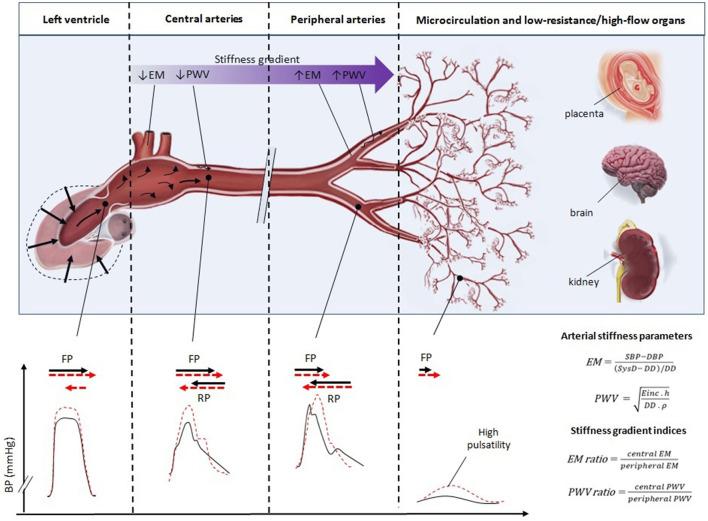
Non-pregnant (NP) women have a progressive increase in arterial stiffness from central-to-peripheral arteries ["stiffness gradient" (SG)], which is of physiologic importance since excessive pulsatility is filtered by the creation of wave reflections. If the aorta gets stiff with minimal or no change in the periphery, the SG is dissipated transmitting pressure disturbances to the microcirculation. It remains unknown the status of the SG in both women with healthy pregnancies (HP) and complicated by pregnancy-associated hypertension (PAH). To determine whether HP and PAH are associated with changes in SG. Secondarily, we aim at identifying potential differences between the subgroups of PAH (pre-eclampsia and gestational hypertension). HP ( = 10), PAH ( = 16), and healthy NP women ( = 401, to be matched for age, and cardiovascular risk with the pregnant women) were included. Carotid-to-femoral (cfPWV) and carotid-to-radial pulse wave velocity (crPWV), common carotid artery (CCA) and brachial artery (BA) diameters and elastic modulus (EM), and regional (cfPWV/crPWV or "PWV ratio") and local (CCA EM/BA EM or "EM ratio") SG were quantified. HP showed no changes in PWV ratio compared with NP, in the presence of significantly lower cfPWV and crPWV. HP exhibited higher arterial diameters and lower CCA EM/BA EM compared to NP, without differences with PAH. PAH was associated with a significant increase in the PWV ratio that exceeded the levels of both NP and HP, explained by a lower (although significant) reduction of cfPWV with respect to that observed in HP with respect to NP, and a higher reduction in crPWV with respect to that observed between HP and NP. The blunted reduction in cfPWV observed in PAH coincided with an increase in the CCA EM. Compared with NP, HP was associated with unchanged PWV ratio but with a reduction in CCA EM/BA EM, in the setting of a generalized drop in arterial stiffness. Compared with NP and HP, PAH was associated with an "exaggerated rise" in the PWV ratio without changes in CCA EM/BA EM, in the setting of a blunt reduction in cfPWV but exaggerated crPWV drop. The SG attenuation/reversal in PAH was mainly driven by pre-eclampsia.
未怀孕(NP)女性从中心动脉到外周动脉的动脉僵硬度呈渐进性增加[“僵硬度梯度”(SG)],这具有生理重要性,因为过度的搏动性可通过产生波反射来过滤。如果主动脉变硬而外周变化极小或无变化,SG就会消失,将压力干扰传递至微循环。目前尚不清楚健康妊娠(HP)女性以及合并妊娠相关高血压(PAH)的女性中SG的状态。为了确定HP和PAH是否与SG变化相关。其次,我们旨在识别PAH亚组(先兆子痫和妊娠期高血压)之间的潜在差异。纳入了HP组(n = 10)、PAH组(n = 16)以及健康NP女性组(n = 401,年龄和心血管风险与孕妇匹配)。对颈股脉搏波速度(cfPWV)和颈桡脉搏波速度(crPWV)、颈总动脉(CCA)和肱动脉(BA)直径及弹性模量(EM),以及区域(cfPWV/crPWV或“PWV比值”)和局部(CCA EM/BA EM或“EM比值”)SG进行了量化。与NP相比,HP的PWV比值无变化,但其cfPWV和crPWV显著更低。与NP相比,HP的动脉直径更大,CCA EM/BA EM更低,与PAH无差异。PAH与PWV比值显著增加相关,超过了NP和HP的水平,这是由于相对于HP与NP相比cfPWV降低幅度更小(尽管显著),以及相对于HP与NP之间crPWV降低幅度更大。在PAH中观察到的cfPWV降低变钝与CCA EM增加一致。与NP相比,HP在动脉僵硬度普遍下降的情况下,PWV比值不变,但CCA EM/BA EM降低。与NP和HP相比,PAH在cfPWV降低变钝但crPWV下降过度的情况下,与PWV比值“过度升高”相关,而CCA EM/BA EM无变化。PAH中的SG衰减/逆转主要由先兆子痫驱动。
 Zotero 插件