
非奈利酮用于主要为晚期慢性肾脏病和2型糖尿病且接受或未接受钠-葡萄糖协同转运蛋白2抑制剂治疗的患者
Finerenone in Predominantly Advanced CKD and Type 2 Diabetes With or Without Sodium-Glucose Cotransporter-2 Inhibitor Therapy.
作者信息
Rossing Peter, Filippatos Gerasimos, Agarwal Rajiv, Anker Stefan D, Pitt Bertram, Ruilope Luis M, Chan Juliana C N, Kooy Adriaan, McCafferty Kieran, Schernthaner Guntram, Wanner Christoph, Joseph Amer, Scheerer Markus F, Scott Charlie, Bakris George L
机构信息
Steno Diabetes Center Copenhagen, Gentofte, Denmark.
Department of Clinical Medicine, University of Copenhagen, Copenhagen, Denmark.
出版信息
Kidney Int Rep. 2021 Oct 14;7(1):36-45. doi: 10.1016/j.ekir.2021.10.008. eCollection 2022 Jan.
INTRODUCTION
FIDELIO-DKD (FInerenone in reducing kiDnEy faiLure and dIsease prOgression in Diabetic Kidney Disease) investigated the nonsteroidal, selective mineralocorticoid receptor (MR) antagonist finerenone in patients with CKD and type 2 diabetes (T2D). This analysis explores the impact of use of sodium-glucose cotransporter-2 inhibitor (SGLT-2i) on the treatment effect of finerenone.
METHODS
Patients ( = 5674) with T2D, urine albumin-to-creatinine ratio (UACR) of 30 to 5000 mg/g and estimated glomerular filtration rate (eGFR) of 25 to <75 ml/min per 1.73 m receiving optimized renin-angiotensin system (RAS) blockade were randomized to finerenone or placebo. Endpoints were change in UACR and a composite kidney outcome (time to kidney failure, sustained decrease in eGFR ≥40% from baseline, or renal death) and key secondary cardiovascular outcomes (time to cardiovascular death, nonfatal myocardial infarction, nonfatal stroke, or hospitalization for heart failure) (ClinicalTrials.gov, NCT02540993).
RESULTS
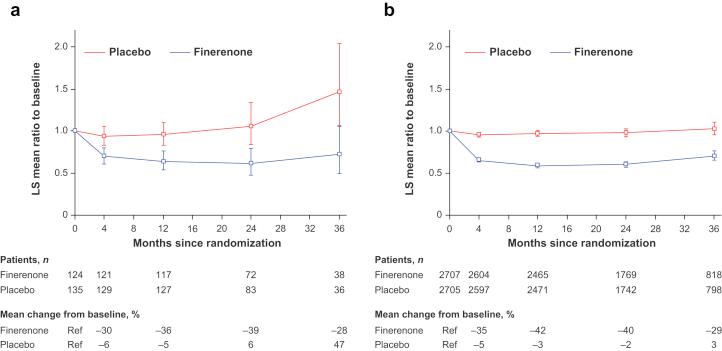
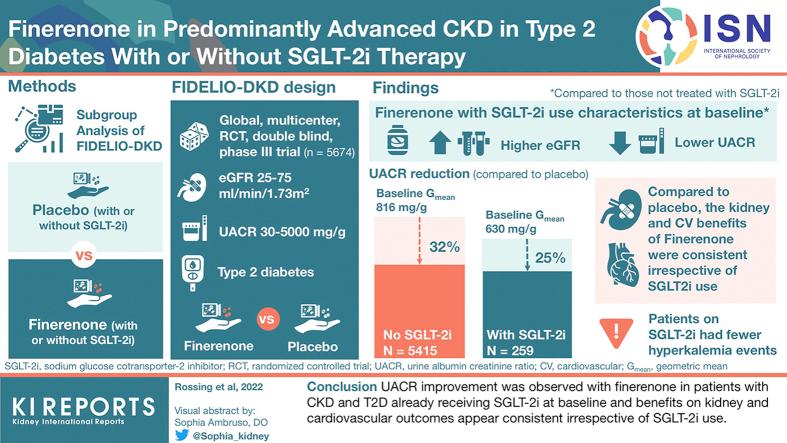
Of 5674 patients, 259 (4.6%) received an SGLT-2i at baseline. Reduction in UACR with finerenone was found with or without use of SGLT-2i at baseline, with ratio of least-squares means of 0.69 (95% CI = 0.66-0.71) and 0.75 (95% CI -= 0.62-0.90), respectively ( = 0.31). Finerenone also significantly reduced the kidney and key secondary cardiovascular outcomes versus placebo; there was no clear difference in the results by SGLT-2i use at baseline ( = 0.21 and 0.46, respectively) or at any time during the trial. Safety was balanced with or without SGLT-2i use at baseline, with fewer hyperkalemia events with finerenone in the SGLT-2i group (8.1% vs. 18.7% without).
CONCLUSION
UACR improvement was observed with finerenone in patients with CKD and T2D already receiving SGLT-2is at baseline, and benefits on kidney and cardiovascular outcomes appear consistent irrespective of use of SGLT-2i.
简介
FIDELIO-DKD(非奈利酮降低糖尿病肾病患者肾衰竭及疾病进展研究)对慢性肾脏病(CKD)合并2型糖尿病(T2D)患者使用非甾体类选择性盐皮质激素受体(MR)拮抗剂非奈利酮进行了研究。本分析探讨了使用钠-葡萄糖协同转运蛋白2抑制剂(SGLT-2i)对非奈利酮治疗效果的影响。
方法
将5674例T2D患者(尿白蛋白与肌酐比值[UACR]为30至5000 mg/g,估算肾小球滤过率[eGFR]为25至<75 ml/min/1.73 m²)接受优化肾素-血管紧张素系统(RAS)阻断治疗的患者随机分为非奈利酮组或安慰剂组。终点指标为UACR变化、复合肾脏结局(肾衰竭时间、eGFR自基线持续下降≥40%或肾脏死亡)以及关键次要心血管结局(心血管死亡时间、非致死性心肌梗死、非致死性卒中或因心力衰竭住院)(ClinicalTrials.gov,NCT02540993)。
结果
5674例患者中,259例(4.6%)在基线时接受了SGLT-2i治疗。无论基线时是否使用SGLT-2i,非奈利酮均能降低UACR,最小二乘均值比分别为0.69(95%CI = 0.66 - 0.71)和0.75(95%CI = 0.62 - 0.90)(P = 0.31)。与安慰剂相比,非奈利酮还显著降低了肾脏及关键次要心血管结局;基线时(P分别为0.21和0.46)或试验期间任何时间使用SGLT-2i的结果均无明显差异。基线时使用或不使用SGLT-2i的安全性相当,SGLT-2i组使用非奈利酮时高钾血症事件较少(8.1%对未使用时的18.7%)。
结论
在基线时已接受SGLT-2i治疗的CKD和T2D患者中,非奈利酮可改善UACR,且无论是否使用SGLT-2i,其对肾脏和心血管结局的益处似乎一致。

 Zotero 插件