
葡萄膜黑色素瘤的预后生物标志物:现状、最新进展与未来方向
Prognostic Biomarkers in Uveal Melanoma: The Status Quo, Recent Advances and Future Directions.
作者信息
Lamas Nuno Jorge, Martel Arnaud, Nahon-Estève Sacha, Goffinet Samantha, Macocco Adam, Bertolotto Corine, Lassalle Sandra, Hofman Paul
机构信息
Laboratory of Clinical and Experimental Pathology, Université Côte d'Azur, Pasteur Hospital, Centre Hospitalier Universitaire de Nice, Biobank BB-0033-00025, 06000 Nice, France.
Anatomic Pathology Service, Pathology Department, Centro Hospitalar e Universitário do Porto, Largo Professor Abel Salazar, 4099-001 Porto, Portugal.
出版信息
Cancers (Basel). 2021 Dec 25;14(1):96. doi: 10.3390/cancers14010096.
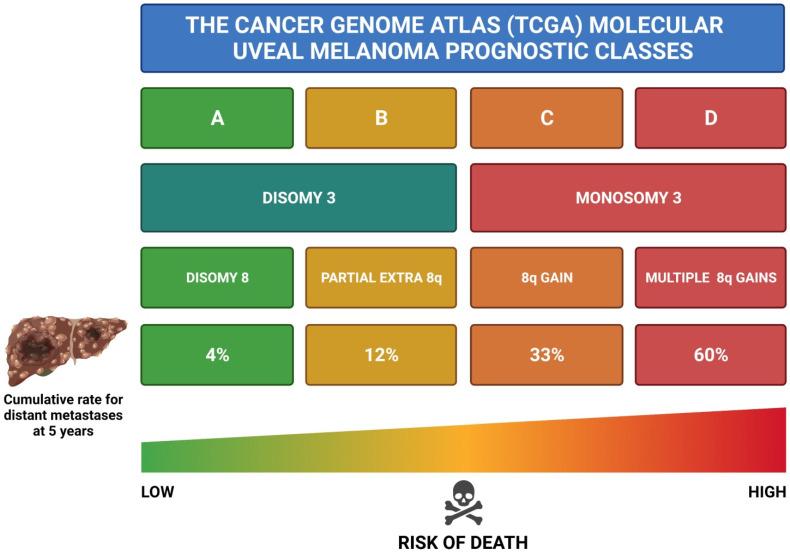
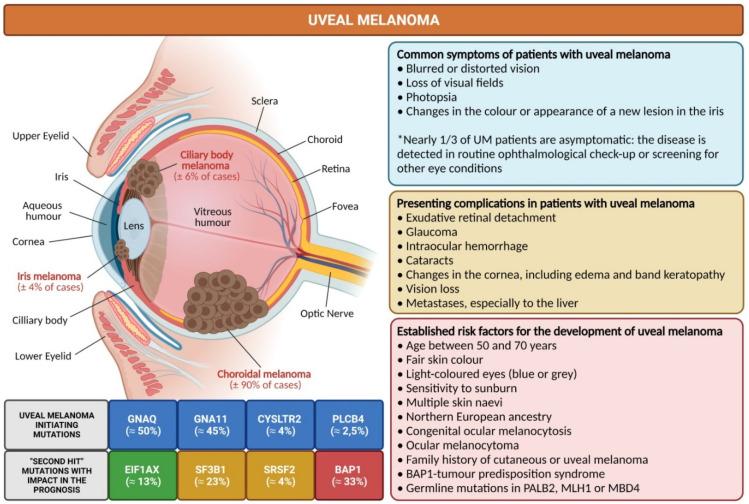
Uveal melanoma (UM) is the most common malignant intraocular tumour in the adult population. It is a rare cancer with an incidence of nearly five cases per million inhabitants per year, which develops from the uncontrolled proliferation of melanocytes in the choroid (≈90%), ciliary body (≈6%) or iris (≈4%). Patients initially present either with symptoms like blurred vision or photopsia, or without symptoms, with the tumour being detected in routine eye exams. Over the course of the disease, metastases, which are initially dormant, develop in nearly 50% of patients, preferentially in the liver. Despite decades of intensive research, the only approach proven to mildly control disease spread are early treatments directed to ablate liver metastases, such as surgical excision or chemoembolization. However, most patients have a limited life expectancy once metastases are detected, since there are limited therapeutic approaches for the metastatic disease, including immunotherapy, which unlike in cutaneous melanoma, has been mostly ineffective for UM patients. Therefore, in order to offer the best care possible to these patients, there is an urgent need to find robust models that can accurately predict the prognosis of UM, as well as therapeutic strategies that effectively block and/or limit the spread of the metastatic disease. Here, we initially summarized the current knowledge about UM by compiling the most relevant epidemiological, clinical, pathological and molecular data. Then, we revisited the most important prognostic factors currently used for the evaluation and follow-up of primary UM cases. Afterwards, we addressed emerging prognostic biomarkers in UM, by comprehensively reviewing gene signatures, immunohistochemistry-based markers and proteomic markers resulting from research studies conducted over the past three years. Finally, we discussed the current hurdles in the field and anticipated the future challenges and novel avenues of research in UM.
葡萄膜黑色素瘤(UM)是成年人群中最常见的眼内恶性肿瘤。它是一种罕见的癌症,年发病率约为每百万居民中近5例,由脉络膜(约90%)、睫状体(约6%)或虹膜(约4%)中的黑素细胞不受控制地增殖发展而来。患者最初表现为视力模糊或闪光感等症状,或无症状,肿瘤在常规眼科检查中被发现。在疾病过程中,近50%的患者会发生转移,最初处于休眠状态,转移部位以肝脏为主。尽管经过了数十年的深入研究,但唯一被证明能适度控制疾病扩散的方法是早期针对肝转移灶的治疗,如手术切除或化疗栓塞。然而,一旦发现转移,大多数患者的预期寿命有限,因为转移性疾病的治疗方法有限,包括免疫疗法,与皮肤黑色素瘤不同,免疫疗法对UM患者大多无效。因此,为了尽可能为这些患者提供最佳治疗,迫切需要找到能够准确预测UM预后的可靠模型,以及有效阻断和/或限制转移性疾病扩散的治疗策略。在这里,我们首先通过汇编最相关的流行病学、临床、病理和分子数据,总结了关于UM的现有知识。然后,我们回顾了目前用于原发性UM病例评估和随访的最重要的预后因素。之后,我们通过全面回顾过去三年研究得出的基因特征、基于免疫组织化学的标志物和蛋白质组学标志物,探讨了UM中新兴的预后生物标志物。最后,我们讨论了该领域目前的障碍,并预测了UM未来的挑战和新的研究途径。
 Zotero 插件