
关于为制定人群层面的健康研究议程而进行的循证优先排序过程,我们了解多少:综述概述
What do we know about evidence-informed priority setting processes to set population-level health-research agendas: an overview of reviews.
作者信息
Tan Audrey, Nagraj Sumanth Kumbagere, Nasser Mona, Sharma Tarang, Kuchenmüller Tanja
机构信息
Office of the Vice-Provost (Research, Innovation and Global Engagement), University College London, 2 Taviton Street, London, WC1H 0BT UK.
Faculty of Health: Medicine, Dentistry and Human Sciences, University of Plymouth, The John Bull Building, Research Way, Plymouth, PL6 8BU Devon UK.
出版信息
Bull Natl Res Cent. 2022;46(1):6. doi: 10.1186/s42269-021-00687-8. Epub 2022 Jan 6.
BACKGROUND
This overview aimed to synthesize existing systematic reviews to produce a draft framework of evidence-informed health priority setting that supports countries in identifying appropriate steps and methods when developing and implementing national research agendas.
MAIN BODY
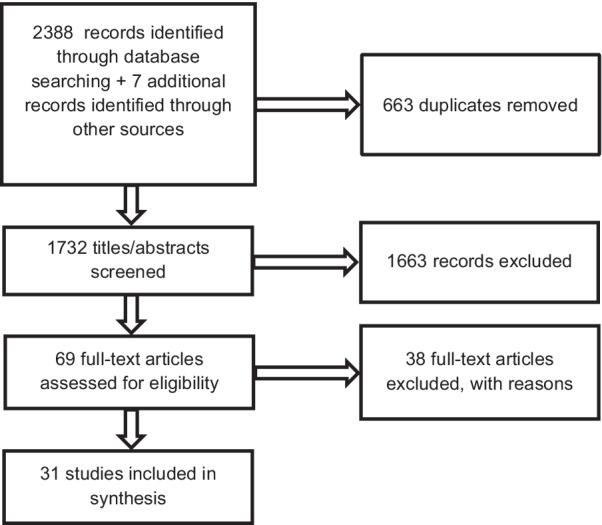
We searched Ovid MEDLINE and the WHO Institutional Repository for Information Sharing from 2010 to 2020 for critical or systematic reviews that evaluated research priority setting exercises. We adapted the AMSTAR checklist to assess the quality of included reviews and used adapted frameworks for data extraction and analysis. The search resulted in 2395 titles, of which 31 were included. Populations included in the reviews typically involved patients, families and carers, researchers, clinicians, policymakers and research funders. The topics covered in the reviews varied from specific diseases or conditions, approaches for healthcare practice or research priority setting methods itself. All the included systematic reviews were of low or critically low quality. The studies were thematically grouped based on their main focus: identifying and engaging with stakeholders; methods; context; and health area.
CONCLUSION
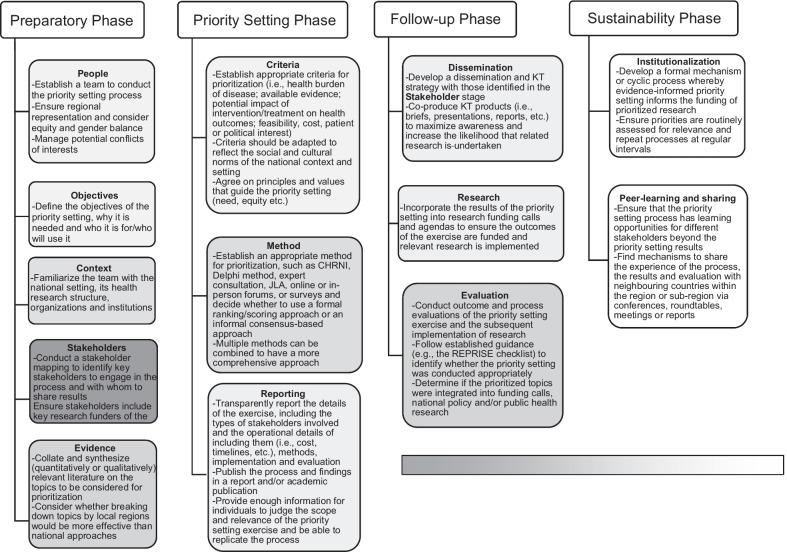
Our overview of reviews has reconfirmed aspects of existing frameworks, but has also identified new concepts for countries to consider while developing their national research agendas. We propose a preliminary framework for consideration that highlights four key phases: (1) preparatory, (2) priority setting, (3) follow-up phase and (4) sustainability phase, which have thirteen sub-domains to consider.
背景
本综述旨在综合现有的系统评价,以制定一个基于证据的卫生重点确定框架草案,支持各国在制定和实施国家研究议程时确定适当的步骤和方法。
主体内容
我们在Ovid MEDLINE和世界卫生组织信息共享机构知识库中检索了2010年至2020年期间评估研究重点确定活动的批判性或系统评价。我们采用AMSTAR清单来评估纳入评价的质量,并使用改编后的框架进行数据提取和分析。检索结果得到2395个标题,其中31个被纳入。评价中涉及的人群通常包括患者、家庭和护理人员、研究人员、临床医生、政策制定者和研究资助者。评价涵盖的主题从特定疾病或病症、医疗保健实践方法或研究重点确定方法本身各不相同。所有纳入的系统评价质量都很低或极低。这些研究根据其主要重点进行了主题分组:确定利益相关者并与之互动;方法;背景;以及卫生领域。
结论
我们对评价的综述再次确认了现有框架的一些方面,但也确定了各国在制定国家研究议程时需要考虑的新概念。我们提出了一个供审议的初步框架,突出了四个关键阶段:(1)筹备阶段,(2)重点确定阶段,(3)跟进阶段和(4)可持续性阶段,其中有13个需要考虑的子领域。
 Zotero 插件