
系统评价和荟萃分析帕金森病自我管理干预的临床效果。
Systematic review and meta-analysis of clinical effectiveness of self-management interventions in Parkinson's disease.
机构信息
Queen Square Institute of Neurology, University College London, London, UK.
South London & Maudsley NHS Foundation Trust, London, UK.
出版信息
BMC Geriatr. 2022 Jan 11;22(1):45. doi: 10.1186/s12877-021-02656-2.
BACKGROUND
Parkinson's disease is a complex neurodegenerative condition with significant impact on quality of life (QoL), wellbeing and function. The objective of this review is to evaluate the clinical effectiveness of self-management interventions for people with Parkinson's disease, taking a broad view of self-management and considering effects on QoL, wellbeing and function.
METHODS
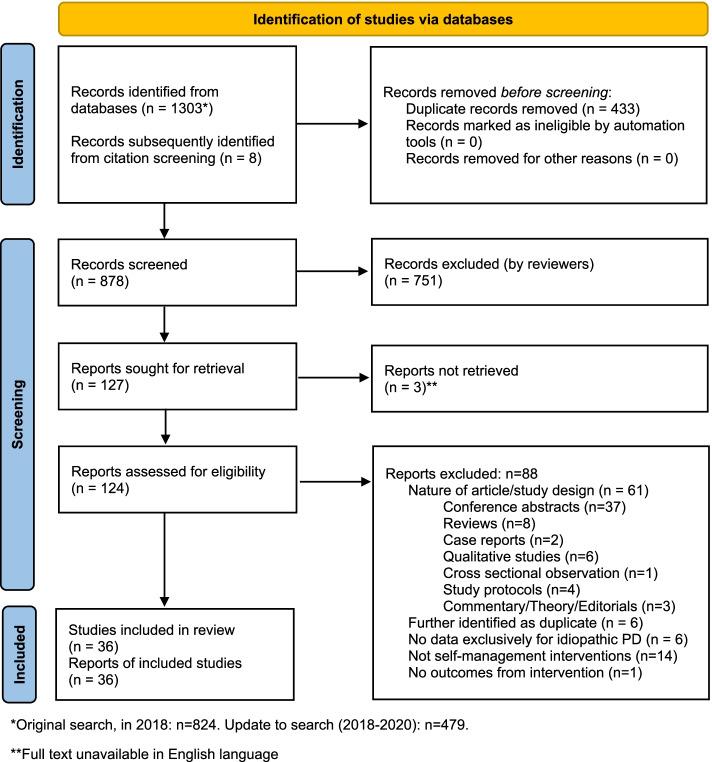
Systematic searches of four databases (MEDLINE, Embase, PsycINFO, Web of Science) were conducted for studies evaluating self-management interventions for people with Parkinson's disease published up to 16th November 2020. Original quantitative studies of adults with idiopathic Parkinson's disease were included, whilst studies of atypical Parkinsonism were excluded. Full-text articles were independently assessed by two reviewers, with data extracted by one reviewer and reliability checked by a second reviewer, then synthesised through a narrative approach and, for sufficiently similar studies, a meta-analysis of effect size was conducted (using a random-effects meta-analysis with restricted maximum likelihood method pooled estimate). Interventions were subdivided into self-management components according to PRISMS Taxonomy. Risk of bias was examined with the Cochrane Risk of Bias 2 (RoB2) tool or ROBIN-I tool as appropriate.
RESULTS
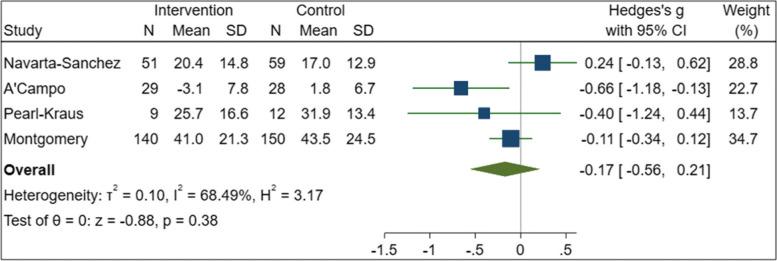
Thirty-six studies were included, evaluating a diverse array of interventions and encompassing a range of study designs (RCT n = 19; non-randomised CT n = five; within subject pre- and post-intervention comparisons n = 12). A total of 2884 participants were assessed in studies across ten countries, with greatest output from North America (14 studies) and UK (six studies). Risk of bias was moderate to high for the majority of studies, mostly due to lack of participant blinding, which is not often practical for interventions of this nature. Only four studies reported statistically significant improvements in QoL, wellbeing or functional outcomes for the intervention compared to controls. These interventions were group-based self-management education and training programmes, either alone, combined with multi-disciplinary rehabilitation, or combined with Cognitive Behaviour Therapy; and a self-guided community-based exercise programme. Four of the RCTs evaluated sufficiently similar interventions and outcomes for meta-analysis: these were studies of self-management education and training programmes evaluating QoL (n = 478). Meta-analysis demonstrated no significant difference between the self-management and the control groups with a standardised mean difference (Hedges g) of - 0.17 (- 0.56, 0.21) p = 0.38. By the GRADE approach, the quality of this evidence was deemed "very low" and the effect of the intervention is therefore uncertain. Components more frequently observed in effective interventions, as per PRISMS taxonomy analysis, were: information about resources; training or rehearsing psychological strategies; social support; and lifestyle advice and support. The applicability of these findings is weakened by the ambiguous and at times overlapping nature of self-management components.
CONCLUSION
Approaches and outcomes to self-management interventions in Parkinson's disease are heterogenous. There are insufficient high quality RCTs in this field to show effectiveness of self-management interventions in Parkinson's disease. Whilst it is not possible to draw conclusions on specific intervention components that convey effectiveness, there are promising findings from some studies, which could be targeted in future evaluations.
背景
帕金森病是一种复杂的神经退行性疾病,对生活质量(QoL)、幸福感和功能有重大影响。本综述的目的是评估针对帕金森病患者的自我管理干预的临床效果,从广泛的自我管理角度考虑,并考虑对 QoL、幸福感和功能的影响。
方法
系统检索了四个数据库(MEDLINE、Embase、PsycINFO、Web of Science),以评估截至 2020 年 11 月 16 日发表的针对帕金森病患者的自我管理干预研究。纳入了评估特发性帕金森病成人的原始定量研究,而排除了非典型帕金森病的研究。由两位评审员独立评估全文文章,由一位评审员提取数据,并由第二位评审员进行可靠性检查,然后通过叙述性方法进行综合,对于足够相似的研究,则进行效应大小的荟萃分析(使用随机效应荟萃分析和受限最大似然法合并估计)。干预措施根据 PRISMS 分类法分为自我管理组成部分。使用 Cochrane 风险偏倚 2(RoB2)工具或适当的 ROBIN-I 工具检查风险偏倚。
结果
共纳入 36 项研究,评估了各种干预措施,涵盖了一系列研究设计(RCT n=19;非随机对照试验 n=5;干预前后的自身比较 n=12)。来自十个国家的研究共评估了 2884 名参与者,其中北美(14 项研究)和英国(6 项研究)的产出最多。由于这种性质的干预措施通常不实用,大多数研究的偏倚风险为中度至高度,主要是由于缺乏参与者的盲法。只有四项研究报告了与对照组相比,干预组在 QoL、幸福感或功能结果方面有统计学意义的改善。这些干预措施是基于小组的自我管理教育和培训计划,要么单独进行,要么与多学科康复相结合,要么与认知行为疗法相结合;以及一个自我指导的社区为基础的锻炼计划。四项 RCT 评估了足够相似的干预措施和结果进行荟萃分析:这些是评估 QoL 的自我管理教育和培训计划研究(n=478)。荟萃分析表明,自我管理组和对照组之间没有显著差异,标准化均数差(Hedges g)为-0.17(-0.56,0.21),p=0.38。根据 GRADE 方法,该证据的质量被认为是“非常低”,因此干预的效果是不确定的。根据 PRISMS 分类法分析,在有效的干预措施中更频繁观察到的组成部分是:关于资源的信息;培训或排练心理策略;社会支持;以及生活方式建议和支持。由于自我管理组成部分的模糊性和有时重叠性,这些发现的适用性受到削弱。
结论
帕金森病患者的自我管理干预方法和结果具有异质性。该领域缺乏高质量的 RCT 来证明帕金森病自我管理干预的有效性。虽然不可能对具有有效性的特定干预措施进行总结,但一些研究有一些有希望的发现,这可以作为未来评估的目标。
 Zotero 插件