
北卡罗来纳州 9 个月期间的新冠疫苗有效性。
Effectiveness of Covid-19 Vaccines over a 9-Month Period in North Carolina.
机构信息
From the Gillings School of Global Public Health, University of North Carolina at Chapel Hill, Chapel Hill (D.-Y.L., Y.G., D.Z.), and the North Carolina Department of Health and Human Services (B.W., H.Y., Z.M.), North Carolina State University (S.H.), and the CDC Foundation, North Carolina Department of Health and Human Services (S.-K.S.), Raleigh.
出版信息
N Engl J Med. 2022 Mar 10;386(10):933-941. doi: 10.1056/NEJMoa2117128. Epub 2022 Jan 12.
BACKGROUND
The duration of protection afforded by coronavirus disease 2019 (Covid-19) vaccines in the United States is unclear. Whether the increase in postvaccination infections during the summer of 2021 was caused by declining immunity over time, the emergence of the B.1.617.2 (delta) variant, or both is unknown.
METHODS
We extracted data regarding Covid-19-related vaccination and outcomes during a 9-month period (December 11, 2020, to September 8, 2021) for approximately 10.6 million North Carolina residents by linking data from the North Carolina Covid-19 Surveillance System and the Covid-19 Vaccine Management System. We used a Cox regression model to estimate the effectiveness of the BNT162b2 (Pfizer-BioNTech), mRNA-1273 (Moderna), and Ad26.COV2.S (Johnson & Johnson-Janssen) vaccines in reducing the current risks of Covid-19, hospitalization, and death, as a function of time elapsed since vaccination.
RESULTS
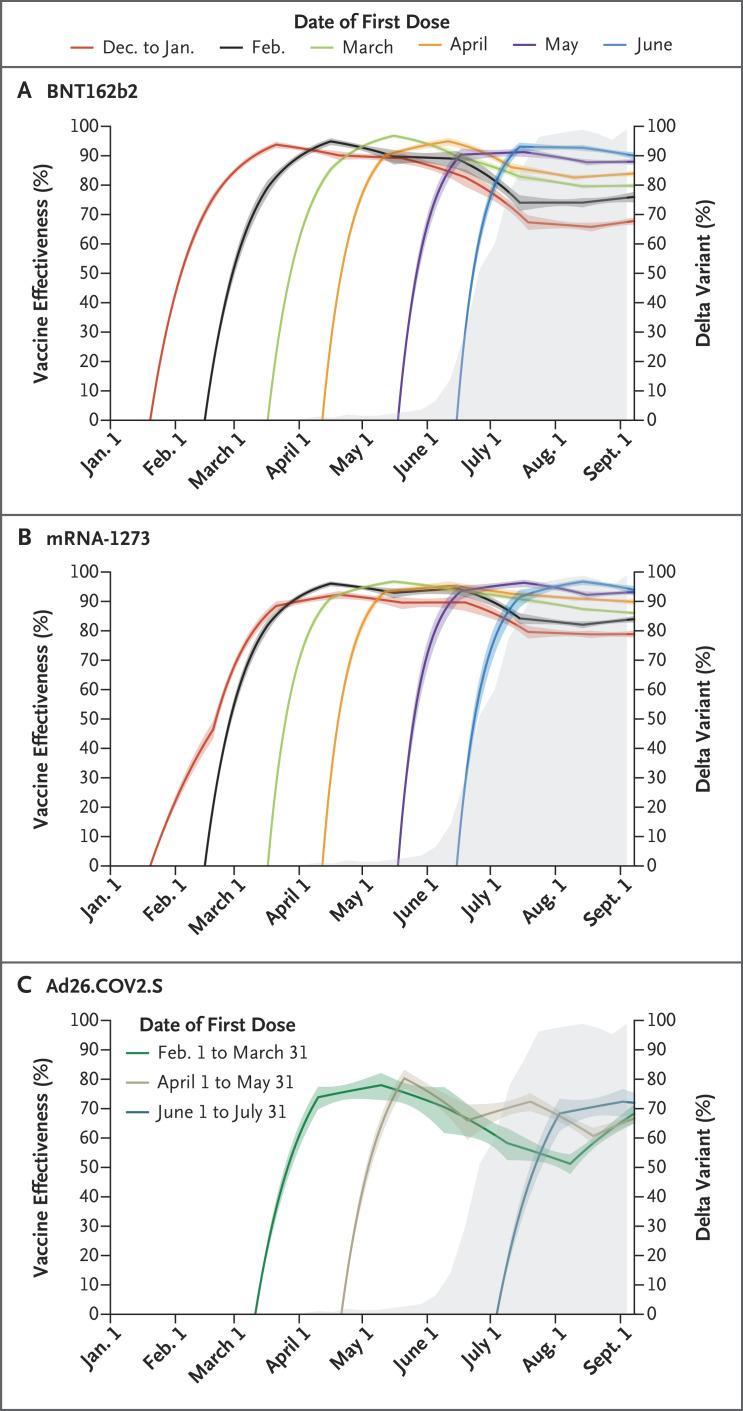
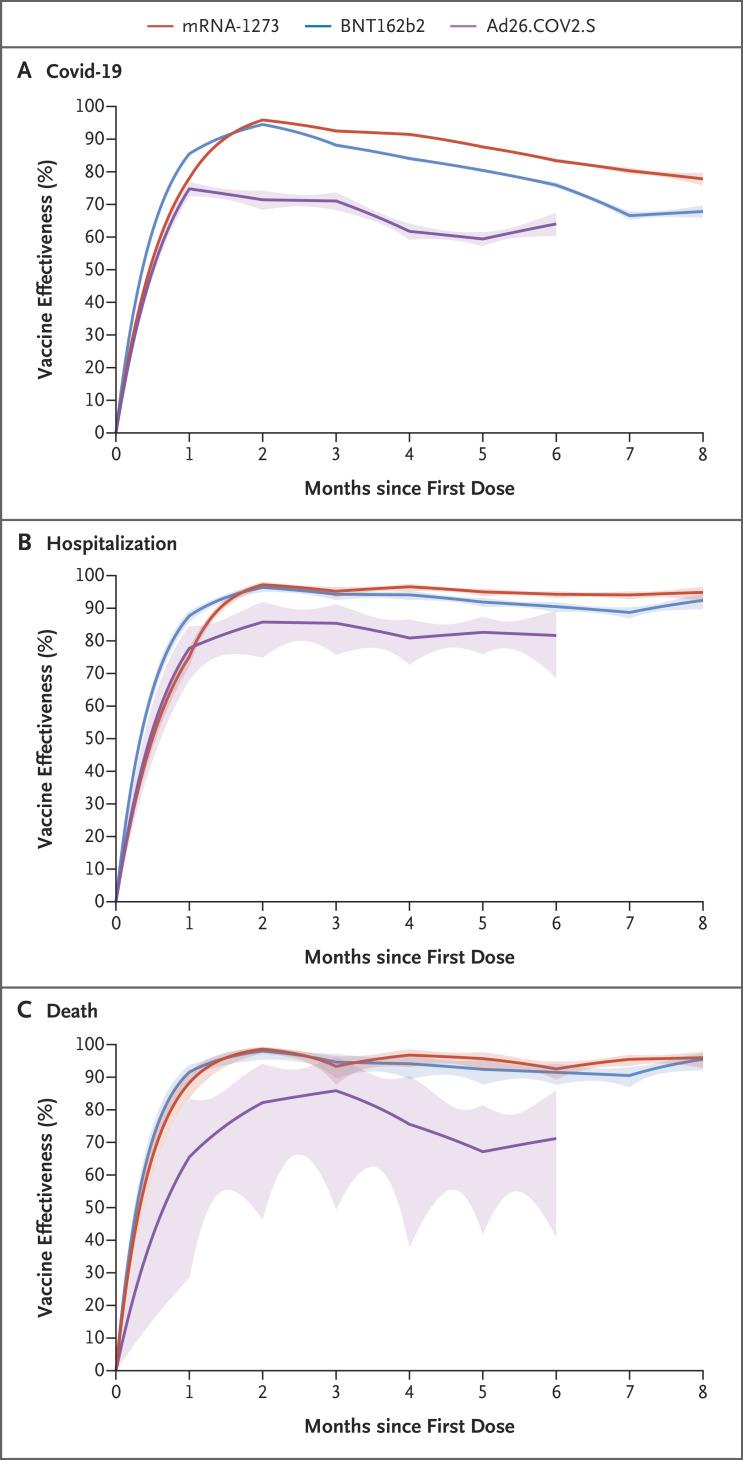
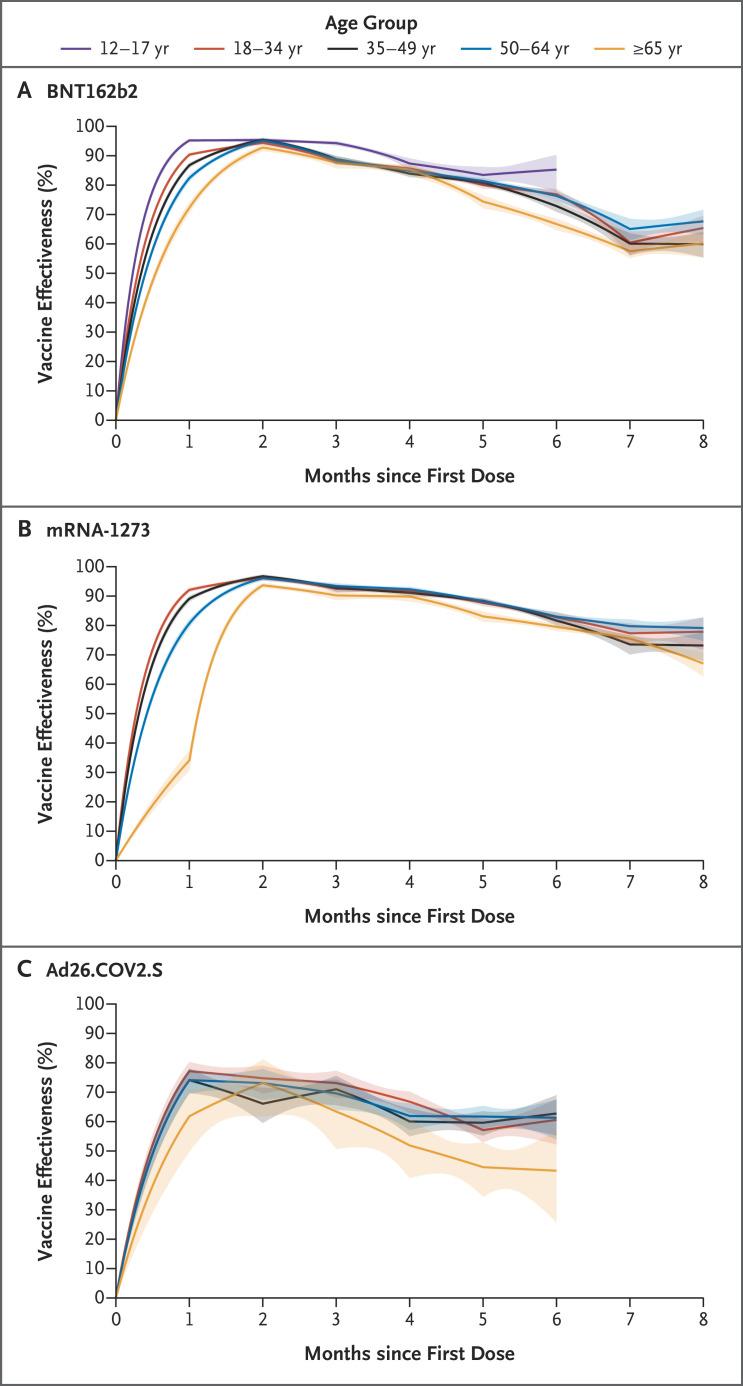
For the two-dose regimens of messenger RNA (mRNA) vaccines BNT162b2 (30 μg per dose) and mRNA-1273 (100 μg per dose), vaccine effectiveness against Covid-19 was 94.5% (95% confidence interval [CI], 94.1 to 94.9) and 95.9% (95% CI, 95.5 to 96.2), respectively, at 2 months after the first dose and decreased to 66.6% (95% CI, 65.2 to 67.8) and 80.3% (95% CI, 79.3 to 81.2), respectively, at 7 months. Among early recipients of BNT162b2 and mRNA-1273, effectiveness decreased by approximately 15 and 10 percentage points, respectively, from mid-June to mid-July, when the delta variant became dominant. For the one-dose regimen of Ad26.COV2.S (5 × 10 viral particles), effectiveness against Covid-19 was 74.8% (95% CI, 72.5 to 76.9) at 1 month and decreased to 59.4% (95% CI, 57.2 to 61.5) at 5 months. All three vaccines maintained better effectiveness in preventing hospitalization and death than in preventing infection over time, although the two mRNA vaccines provided higher levels of protection than Ad26.COV2.S.
CONCLUSIONS
All three Covid-19 vaccines had durable effectiveness in reducing the risks of hospitalization and death. Waning protection against infection over time was due to both declining immunity and the emergence of the delta variant. (Funded by a Dennis Gillings Distinguished Professorship and the National Institutes of Health.).
背景
新冠病毒疾病 2019(Covid-19)疫苗在美国提供的保护持续时间尚不清楚。2021 年夏季接种疫苗后感染人数增加是由于随时间推移免疫力下降,还是由于 B.1.617.2(德尔塔)变体的出现,或者两者兼而有之,目前尚不清楚。
方法
我们通过将北卡罗来纳州 Covid-19 监测系统和 Covid-19 疫苗管理系统的数据进行链接,从大约 1060 万北卡罗来纳州居民中提取了 9 个月(2020 年 12 月 11 日至 2021 年 9 月 8 日)与 Covid-19 相关的疫苗接种和结果数据。我们使用 Cox 回归模型估计 BNT162b2(辉瑞-生物技术公司)、mRNA-1273(Moderna)和 Ad26.COV2.S(强生-杨森)疫苗在减少当前感染、住院和死亡风险方面的有效性,作为接种疫苗后时间流逝的函数。
结果
对于 BNT162b2(每剂 30μg)和 mRNA-1273(每剂 100μg)两种剂量的信使 RNA(mRNA)疫苗,疫苗对 Covid-19 的有效性分别为 94.5%(95%置信区间[CI],94.1 至 94.9)和 95.9%(95%CI,95.5 至 96.2),在第一剂后 2 个月,分别下降至 66.6%(95%CI,65.2 至 67.8)和 80.3%(95%CI,79.3 至 81.2),在 7 个月时。在 BNT162b2 和 mRNA-1273 的早期接受者中,从 6 月中旬到 7 月中旬,当 delta 变体成为主导时,有效性分别下降了约 15 和 10 个百分点。Ad26.COV2.S(5×10 病毒颗粒)的一剂方案对 Covid-19 的有效性为 1 个月时为 74.8%(95%CI,72.5 至 76.9),5 个月时下降至 59.4%(95%CI,57.2 至 61.5)。随着时间的推移,所有三种疫苗在预防住院和死亡方面都保持了比预防感染更好的效果,尽管两种 mRNA 疫苗提供了更高水平的保护。
结论
所有三种 Covid-19 疫苗在降低住院和死亡风险方面均具有持久的效果。随着时间的推移,感染保护能力下降是由于免疫力下降和 delta 变体的出现。(由 Dennis Gillings 杰出教授职位和美国国立卫生研究院资助)。
 Zotero 插件