
女性在收到针对乳腺癌风险评估的个性化筛查和预防建议后,其健康行为发生改变。
Women's health behaviour change after receiving breast cancer risk estimates with tailored screening and prevention recommendations.
机构信息
Radboud Institute for Health Sciences, Radboud University Medical Center, PO Box 9101, 6500 HB, Nijmegen, The Netherlands.
Dutch Expert Centre for Screening, PO Box 6873, 6503 GJ, Nijmegen, The Netherlands.
出版信息
BMC Cancer. 2022 Jan 16;22(1):69. doi: 10.1186/s12885-022-09174-3.
BACKGROUND
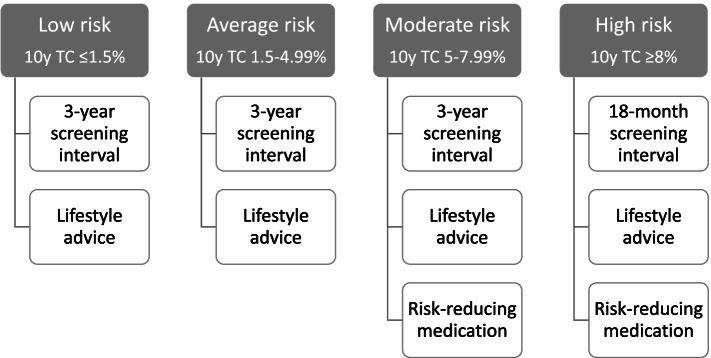
The Predicting Risk of Cancer at Screening (PROCAS) study provided women who were eligible for breast cancer screening in Greater Manchester (United Kingdom) with their 10-year risk of breast cancer, i.e., low (≤1.5%), average (1.5-4.99%), moderate (5.-7.99%) or high (≥8%). The aim of this study is to explore which factors were associated with women's uptake of screening and prevention recommendations. Additionally, we evaluated women's organisational preferences regarding tailored screening.
METHODS
A total of 325 women with a self-reported low (n = 60), average (n = 125), moderate (n = 80), or high (n = 60) risk completed a two-part web-based survey. The first part contained questions about personal characteristics. For the second part women were asked about uptake of early detection and preventive behaviours after breast cancer risk communication. Additional questions were posed to explore preferences regarding the organisation of risk-stratified screening and prevention. We performed exploratory univariable and multivariable regression analyses to assess which factors were associated with uptake of primary and secondary breast cancer preventive behaviours, stratified by breast cancer risk. Organisational preferences are presented using descriptive statistics.
RESULTS
Self-reported breast cancer risk predicted uptake of (a) supplemental screening and breast self-examination, (b) risk-reducing medication and (c) preventive lifestyle behaviours. Further predictors were (a) having a first degree relative with breast cancer, (b) higher age, and (c) higher body mass index (BMI). Women's organisational preferences for tailored screening emphasised a desire for more intensive screening for women at increased risk by further shortening the screening interval and moving the starting age forward.
CONCLUSIONS
Breast cancer risk communication predicts the uptake of key tailored primary and secondary preventive behaviours. Effective communication of breast cancer risk information is essential to optimise the population-wide impact of tailored screening.
背景
在大曼彻斯特(英国)有资格进行乳腺癌筛查的女性参加了预测癌症筛查风险(PROCAS)研究,该研究为她们提供了其 10 年乳腺癌风险,即低(≤1.5%)、中(1.5-4.99%)、中高(5.-7.99%)或高(≥8%)。本研究旨在探讨哪些因素与女性接受筛查和预防建议的情况相关。此外,我们还评估了女性对量身定制筛查的组织偏好。
方法
共有 325 名自我报告低(n=60)、中(n=125)、中高(n=80)或高(n=60)风险的女性完成了一项基于网络的两部分调查。第一部分包含个人特征问题。对于第二部分,女性被问及在乳腺癌风险沟通后接受早期检测和预防行为的情况。提出了其他问题来探讨对分层风险筛查和预防的组织偏好。我们进行了探索性单变量和多变量回归分析,以评估哪些因素与乳腺癌风险分层后初级和二级乳腺癌预防行为的接受情况相关。组织偏好使用描述性统计数据呈现。
结果
自我报告的乳腺癌风险预测了(a)补充筛查和乳房自我检查、(b)降低风险的药物和(c)预防生活方式行为的接受情况。进一步的预测因素是(a)有乳腺癌一级亲属、(b)年龄较大和(c)较高的体重指数(BMI)。女性对量身定制筛查的组织偏好强调了对高风险女性进行更密集筛查的愿望,进一步缩短筛查间隔并提前开始筛查。
结论
乳腺癌风险沟通预测了关键量身定制的初级和二级预防行为的接受情况。有效沟通乳腺癌风险信息对于优化量身定制筛查的人群影响至关重要。
 Zotero 插件