
恶性胸膜间皮瘤患者的身体成分变化及其与活动水平和饮食摄入的关系。
Changes in body composition in patients with malignant pleural mesothelioma and the relationship with activity levels and dietary intake.
机构信息
Exercise Medicine Research Institute, Edith Cowan University, Joondalup, WA, Australia.
School of Medical and Health Sciences, Edith Cowan University, Joondalup, WA, Australia.
出版信息
Eur J Clin Nutr. 2022 Jul;76(7):979-986. doi: 10.1038/s41430-021-01062-6. Epub 2022 Jan 17.
BACKGROUND
Skeletal muscle loss is common in advanced cancer and is associated with negative outcomes. In malignant pleural mesothelioma (MPM), no study has reported body composition changes or factors associated with these changes. This study aimed to describe changes in body composition over time and its relationship with activity levels, dietary intake and survival.
METHODS
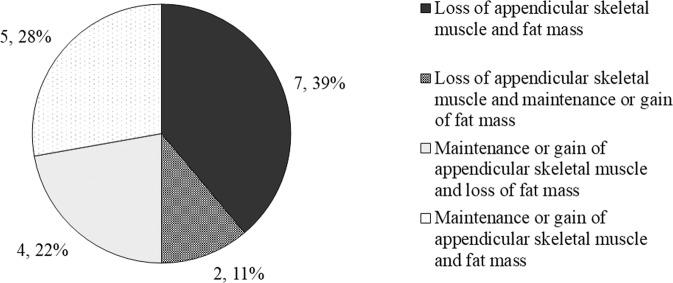
The study was a secondary analysis of data collected from a longitudinal observational study of patients with MPM. Participants completed 3-month assessments for up to 18 months. Participants with two dual-energy x-ray absorptiometry (DXA) scans were included. Changes in appendicular skeletal muscle mass (ASM) and total fat mass were used to categorise participants into phenotypes. Activity levels were measured with an ActiGraph GT3X+ accelerometer and energy and protein intake was measured with a 3-day food record and 24-h recall.
RESULTS
Eighteen participants were included (89% men, mean age 68.9 ± 7.1 years). Median time between DXA was 91 [IQR 84-118] days. Compared to participants with ASM maintenance (n = 9), fewer participants with ASM loss (n = 9) survived ≥12 months from follow-up (p = 0.002). Participants with ASM loss increased sedentary time (p = 0.028) and decreased light activity (p = 0.028) and step count (p = 0.008). Activity levels did not change in participants with ASM maintenance (p > 0.05). Energy and protein intake did not change in either group (p > 0.05).
CONCLUSIONS
Muscle loss was associated with poorer survival and decreased activity levels. Interventions that improve physical activity or muscle mass could benefit patients with MPM.
背景
晚期癌症患者常出现骨骼肌丢失,且与不良结局相关。在恶性胸膜间皮瘤(MPM)中,尚无研究报道其身体成分的变化或与这些变化相关的因素。本研究旨在描述身体成分随时间的变化及其与活动水平、饮食摄入和生存的关系。
方法
本研究为一项对 MPM 患者进行的纵向观察性研究数据的二次分析。参与者每 3 个月接受一次评估,最长达 18 个月。纳入了两次双能 X 射线吸收法(DXA)扫描的参与者。使用四肢骨骼肌质量(ASM)和总脂肪量的变化将参与者分为表型。使用 ActiGraph GT3X+加速度计测量活动水平,使用 3 天食物记录和 24 小时回忆测量能量和蛋白质摄入量。
结果
纳入了 18 名参与者(89%为男性,平均年龄 68.9±7.1 岁)。两次 DXA 检查的中位时间间隔为 91[IQR 84-118]天。与 ASM 维持的参与者(n=9)相比,ASM 丢失的参与者(n=9)从随访中存活≥12 个月的比例较低(p=0.002)。ASM 丢失的参与者久坐时间增加(p=0.028),轻活动(p=0.028)和步数(p=0.008)减少。ASM 维持的参与者的活动水平没有变化(p>0.05)。两组的能量和蛋白质摄入量均无变化(p>0.05)。
结论
肌肉丢失与较差的生存和较低的活动水平相关。改善体力活动或肌肉质量的干预措施可能使 MPM 患者受益。


 Zotero 插件