
与美国成年人糖尿病患者的低血糖和高血糖危象相关的地区社会经济剥夺程度的相关性。
Association of Area-Level Socioeconomic Deprivation With Hypoglycemic and Hyperglycemic Crises in US Adults With Diabetes.
机构信息
Division of Health Care Delivery Research, Mayo Clinic, Rochester, Minnesota.
Mayo Clinic Robert D. and Patricia E. Kern Center for the Science of Health Care Delivery, Rochester, Minnesota.
出版信息
JAMA Netw Open. 2022 Jan 4;5(1):e2143597. doi: 10.1001/jamanetworkopen.2021.43597.
IMPORTANCE
Social determinants of health play a role in diabetes management and outcomes, including potentially life-threatening complications of severe hypoglycemia and diabetic ketoacidosis (DKA) or hyperglycemic hyperosmolar state (HHS). Although several person-level socioeconomic factors have been associated with these complications, the implications of area-level socioeconomic deprivation are unknown.
OBJECTIVE
To examine the association between area-level deprivation and the risks of experiencing emergency department visits or hospitalizations for hypoglycemic and hyperglycemic crises (ie, DKA or HHS).
DESIGN, SETTING, AND PARTICIPANTS: This cohort study used deidentified administrative claims data for privately insured individuals and Medicare Advantage beneficiaries across the US. The analysis included adults with diabetes who met the claims criteria for diabetes between January 1, 2016, and December 31, 2017. Data analyses were performed from November 17, 2020, to November 11, 2021.
EXPOSURES
Area deprivation index (ADI) was derived for each county for 2016 and 2017 using 17 county-level indicators from the American Community Survey. ADI values were applied to patients who were living in each county based on their index dates and were categorized according to county-level ADI quintile (with quintile 1 having the least deprivation and quintile 5 having the most deprivation).
MAIN OUTCOMES AND MEASURES
The numbers of emergency department visits or hospitalizations related to the primary diagnoses of hypoglycemia and DKA or HHS (ascertained using validated diagnosis codes in the first or primary position of emergency department or hospital claims) between 2016 and 2019 were calculated for each ADI quintile using negative binomial regression models and adjusted for patient age, sex, health plan type, comorbidities, glucose-lowering medication type, and percentage of White residents in the county.
RESULTS
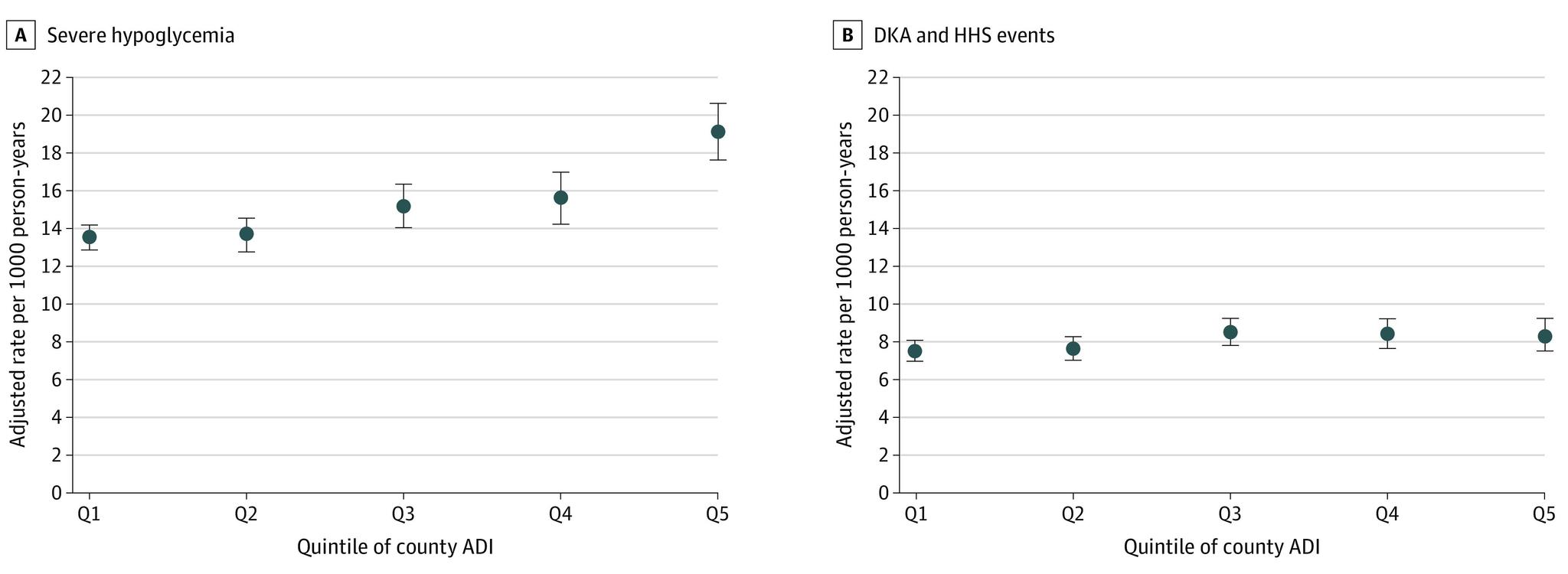
The study population included 1 116 361 individuals (563 943 women [50.5%]), with a mean (SD) age of 64.9 (13.2) years. Of these patients, 343 726 (30.8%) resided in counties with the least deprivation (quintile 1) and 121 810 (10.9%) lived in counties with the most deprivation (quintile 5). Adjusted rates of severe hypoglycemia increased from 13.54 (95% CI, 12.91-14.17) per 1000 person-years in quintile 1 counties to 19.13 (95% CI, 17.62-20.63) per 1000 person-years in quintile 5 counties, corresponding to an incidence rate ratio of 1.41 (95% CI, 1.29-1.54; P < .001). Adjusted rates of DKA or HHS increased from 7.49 (95% CI, 6.96-8.02) per 1000 person-years in quintile 1 counties to 8.37 (95% CI, 7.50-9.23) per 1000 person-years in quintile 5 counties, corresponding to an incidence rate ratio of 1.12 (95% CI, 1.00-1.25; P = .049).
CONCLUSIONS AND RELEVANCE
This study found that living in counties with a high area-level deprivation was associated with an increased risk of severe hypoglycemia and DKA or HHS. The concentration of these preventable events in areas of high deprivation signals the need for interventions that target the structural barriers to optimal diabetes management and health.
重要性
社会决定因素在糖尿病管理和结果中起作用,包括严重低血糖和糖尿病酮症酸中毒(DKA)或高血糖高渗状态(HHS)等潜在危及生命的并发症。尽管已经有几个个人层面的社会经济因素与这些并发症相关,但尚不清楚区域层面的社会经济贫困的影响。
目的
研究区域贫困程度与低血糖和高血糖危机(即 DKA 或 HHS)急诊就诊或住院风险之间的关系。
设计、地点和参与者:这项队列研究使用了美国私人保险和医疗保险优势受益人的匿名行政索赔数据。分析包括符合糖尿病索赔标准的成年人,其糖尿病诊断时间为 2016 年 1 月 1 日至 2017 年 12 月 31 日。数据分析于 2020 年 11 月 17 日至 2021 年 11 月 11 日进行。
暴露
使用美国社区调查中的 17 个县一级指标,为 2016 年和 2017 年的每个县计算了地区剥夺指数(ADI)。根据索引日期将 ADI 值应用于居住在每个县的患者,并根据县一级 ADI 五分位数(五分位数 1 为剥夺程度最低,五分位数 5 为剥夺程度最高)进行分类。
主要结果和测量
使用负二项回归模型计算了 2016 年至 2019 年期间每个 ADI 五分位数与低血糖和 DKA 或 HHS 主要诊断相关的急诊就诊或住院人数(使用急诊或住院索赔中第一位或主要位置的验证诊断代码确定),并根据患者年龄、性别、健康计划类型、合并症、降血糖药物类型以及县内白人居民的比例进行了调整。
结果
研究人群包括 1116361 人(563943 名女性[50.5%]),平均(SD)年龄为 64.9(13.2)岁。其中,343726 人(30.8%)居住在剥夺程度最低(五分位数 1)的县,121810 人(10.9%)居住在剥夺程度最高(五分位数 5)的县。严重低血糖的调整后发生率从五分位数 1 县的 13.54(95% CI,12.91-14.17)/1000 人年增加到五分位数 5 县的 19.13(95% CI,17.62-20.63)/1000 人年,对应的发病率比为 1.41(95% CI,1.29-1.54;P<0.001)。DKA 或 HHS 的调整后发生率从五分位数 1 县的 7.49(95% CI,6.96-8.02)/1000 人年增加到五分位数 5 县的 8.37(95% CI,7.50-9.23)/1000 人年,对应的发病率比为 1.12(95% CI,1.00-1.25;P=0.049)。
结论和相关性
这项研究发现,生活在高区域剥夺程度的县与严重低血糖和 DKA 或 HHS 的风险增加相关。这些可预防事件在高剥夺程度地区集中发生,表明需要采取干预措施,以解决糖尿病管理和健康的结构性障碍。
 Zotero 插件