
分枝杆菌 DNA 回旋酶的分子特征及降低喹诺酮类药物敏感性突变的鉴定
Molecular Characterization of Mycobacterium ulcerans DNA Gyrase and Identification of Mutations Reducing Susceptibility to Quinolones .
机构信息
Department of Bacteriology II, National Institute of Infectious Diseasesgrid.410795.e, Tokyo, Japan.
Division of Bioresources, Hokkaido Universitygrid.39158.36 International Institute for Zoonosis Control, Sapporo, Japan.
出版信息
Antimicrob Agents Chemother. 2022 Apr 19;66(4):e0190221. doi: 10.1128/AAC.01902-21. Epub 2022 Jan 18.
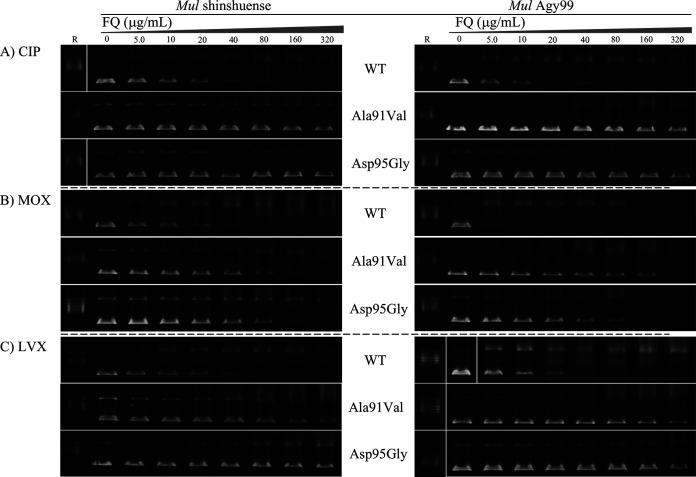
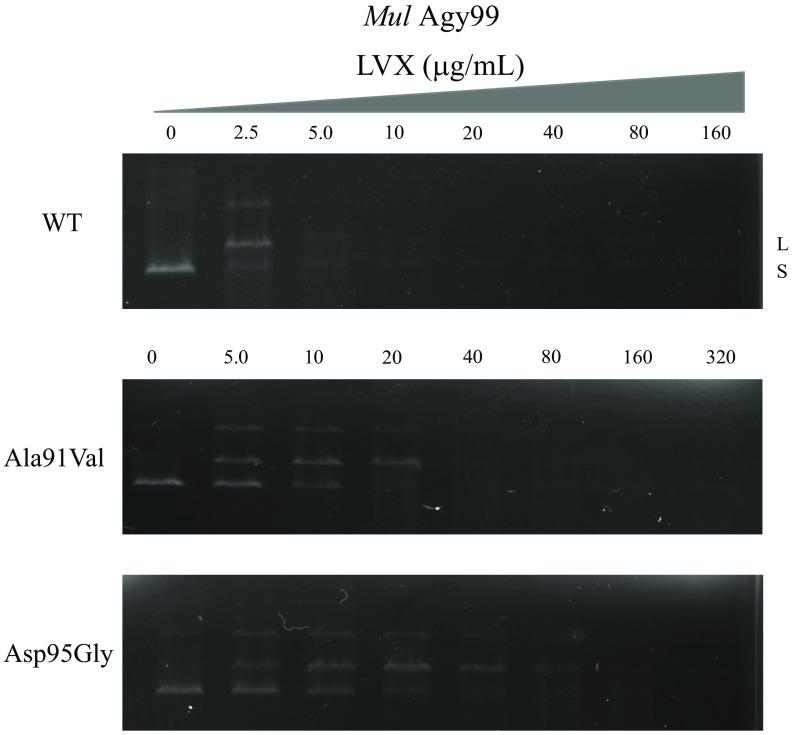
Buruli ulcer disease is a neglected necrotizing and disabling cutaneous tropical illness caused by Mycobacterium ulcerans. Fluoroquinolone (FQ), used in the treatment of this disease, has been known to act by inhibiting the enzymatic activities of DNA gyrase. However, the detailed molecular basis of these characteristics and the FQ resistance mechanisms in M. ulcerans remains unknown. This study investigated the detailed molecular mechanism of M. ulcerans DNA gyrase and the contribution of FQ resistance using recombinant proteins from the M. ulcerans subsp. shinshuense and Agy99 strains with reduced sensitivity to FQs. The IC of FQs against Ala91Val and Asp95Gly mutants of M. ulcerans shinshuense and Agy99 GyrA subunits were 3.7- to 42.0-fold higher than those against wild-type (WT) enzyme. Similarly, the quinolone concentrations required to induce 25% of the maximum DNA cleavage (CC) was 10- to 210-fold higher than those for the WT enzyme. Furthermore, the interaction between the amino acid residues of the WT/mutant M. ulcerans DNA gyrase and FQ side chains were assessed by molecular docking studies. This was the first elaborative study demonstrating the contribution of mutations in M. ulcerans DNA GyrA subunit to FQ resistance .
布鲁里溃疡病是一种被忽视的坏死性和致残性热带疾病,由溃疡分枝杆菌引起。氟喹诺酮(FQ)用于治疗这种疾病,已知其作用是抑制 DNA 回旋酶的酶活性。然而,溃疡分枝杆菌中这些特性的详细分子基础和 FQ 耐药机制尚不清楚。本研究使用对 FQ 敏感性降低的溃疡分枝杆菌亚种 shinshuense 和 Agy99 株的重组蛋白,研究了溃疡分枝杆菌 DNA 回旋酶的详细分子机制和 FQ 耐药的贡献。FQ 对溃疡分枝杆菌 shinshuense 和 Agy99 GyrA 亚基 Ala91Val 和 Asp95Gly 突变体的 IC 是野生型(WT)酶的 3.7 至 42.0 倍。同样,诱导最大 DNA 切割(CC)的 25%所需的喹诺酮浓度比 WT 酶高 10 至 210 倍。此外,通过分子对接研究评估了 WT/突变型溃疡分枝杆菌 DNA 回旋酶的氨基酸残基与 FQ 侧链之间的相互作用。这是第一项详细研究,证明了溃疡分枝杆菌 DNA GyrA 亚基突变对 FQ 耐药的贡献。

 Zotero 插件