
体外和计算机模拟方法评估百里醌(2-甲基-5-异丙基环己-2,5-二烯-1,4-二酮)对特定人类病原体的抗菌活性、时间杀菌动力学及抗生物膜潜力
In Vitro and In Silico Approaches for the Evaluation of Antimicrobial Activity, Time-Kill Kinetics, and Anti-Biofilm Potential of Thymoquinone (2-Methyl-5-propan-2-ylcyclohexa-2,5-diene-1,4-dione) against Selected Human Pathogens.
作者信息
Qureshi Kamal A, Imtiaz Mahrukh, Parvez Adil, Rai Pankaj K, Jaremko Mariusz, Emwas Abdul-Hamid, Bholay Avinash D, Fatmi Muhammad Qaiser
机构信息
Department of Pharmaceutics, Unaizah College of Pharmacy, Qassim University, Unaizah 51911, Saudi Arabia.
Department of Biosciences, COMSATS University Islamabad, Islamabad 45600, Pakistan.
出版信息
Antibiotics (Basel). 2022 Jan 10;11(1):79. doi: 10.3390/antibiotics11010079.
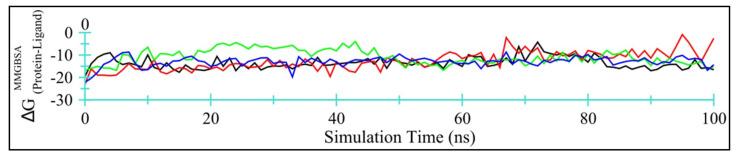
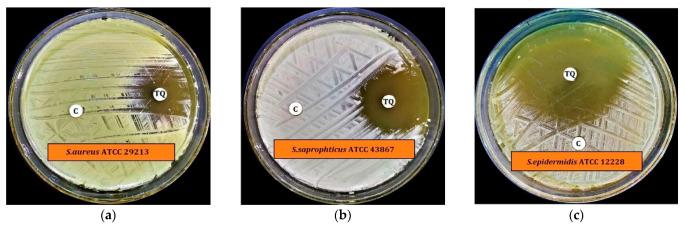
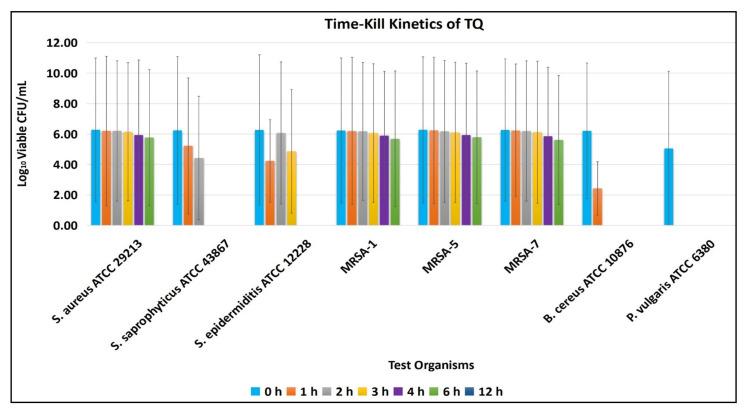
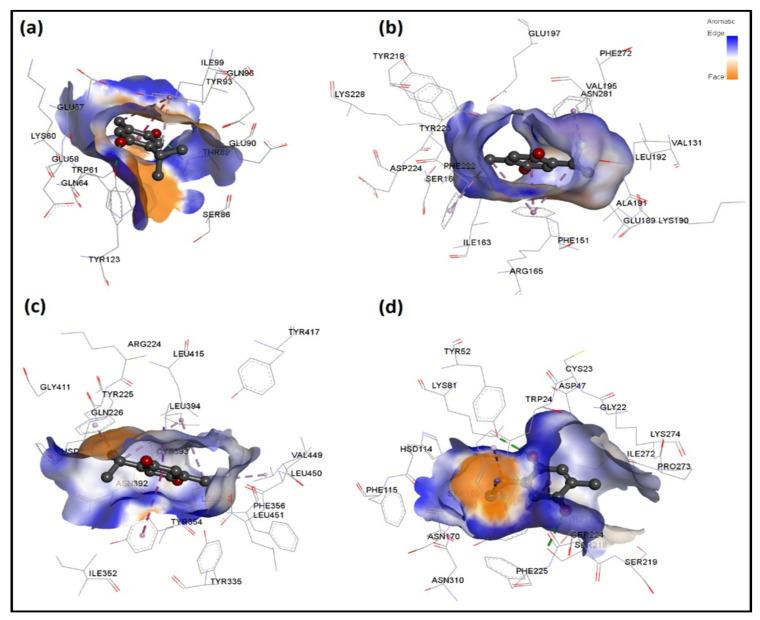
Thymoquinone (2-methyl-5-propan-2-ylcyclohexa-2,5-diene-1,4-dione; TQ), a principal bioactive phytoconstituent of essential oil, has been reported to have high antimicrobial potential. Thus, the current study evaluated TQ's antimicrobial potential against a range of selected human pathogens using in vitro assays, including time-kill kinetics and anti-biofilm activity. In silico molecular docking of TQ against several antimicrobial target proteins and a detailed intermolecular interaction analysis was performed, including binding energies and docking feasibility. Of the tested bacteria and fungi, ATCC 12228 and ATCC 10231 were the most susceptible to TQ, with 50.3 ± 0.3 mm and 21.1 ± 0.1 mm zones of inhibition, respectively. Minimum inhibitory concentration (MIC) values of TQ are in the range of 12.5-50 µg/mL, while minimum biocidal concentration (MBC) values are in the range of 25-100 µg/mL against the tested organisms. Time-kill kinetics of TQ revealed that the killing time for the tested bacteria is in the range of 1-6 h with the MBC of TQ. Anti-biofilm activity results demonstrate that the minimum biofilm inhibitory concentration (MBIC) values of TQ are in the range of 25-50 µg/mL, while the minimum biofilm eradication concentration (MBEC) values are in the range of 25-100 µg/mL, for the tested bacteria. In silico molecular docking studies revealed four preferred antibacterial and antifungal target proteins for TQ: D-alanyl-D-alanine synthetase (Ddl) from , transcriptional regulator qacR from , N-myristoyltransferase from , and NADPH-dependent D-xylose reductase from In contrast, the nitroreductase family protein from and spore coat polysaccharide biosynthesis protein from and UDP-N-acetylglucosamine pyrophosphorylase from are the least preferred antibacterial and antifungal target proteins for TQ, respectively. Molecular dynamics (MD) simulations revealed that TQ could bind to all four target proteins, with Ddl and NADPH-dependent D-xylose reductase being the most efficient. Our findings corroborate TQ's high antimicrobial potential, suggesting it may be a promising drug candidate for multi-drug resistant (MDR) pathogens, notably Gram-positive bacteria and
百里醌(2-甲基-5-丙-2-基环己-2,5-二烯-1,4-二酮;TQ)是精油的主要生物活性植物成分,据报道具有很高的抗菌潜力。因此,本研究使用体外试验,包括时间-杀菌动力学和抗生物膜活性,评估了TQ对一系列选定人类病原体的抗菌潜力。对TQ与几种抗菌靶蛋白进行了计算机分子对接,并进行了详细的分子间相互作用分析,包括结合能和对接可行性。在测试的细菌和真菌中,ATCC 12228和ATCC 10231对TQ最敏感,抑菌圈直径分别为50.3±0.3毫米和21.1±0.1毫米。TQ的最低抑菌浓度(MIC)值在12.5 - 50微克/毫升范围内,而对测试生物体的最低杀菌浓度(MBC)值在25 - 100微克/毫升范围内。TQ的时间-杀菌动力学表明,测试细菌的杀灭时间在1 - 6小时范围内,达到TQ的MBC。抗生物膜活性结果表明,对于测试细菌,TQ的最低生物膜抑制浓度(MBIC)值在25 - 50微克/毫升范围内,而最低生物膜根除浓度(MBEC)值在25 - 100微克/毫升范围内。计算机分子对接研究揭示了TQ的四种优选抗菌和抗真菌靶蛋白:来自[具体物种1]的D-丙氨酰-D-丙氨酸合成酶(Ddl)、来自[具体物种2]的转录调节因子qacR、来自[具体物种3]的N-肉豆蔻酰转移酶以及来自[具体物种4]的NADPH依赖性D-木糖还原酶。相比之下,来自[具体物种5]的硝基还原酶家族蛋白、来自[具体物种6]的孢子壁多糖生物合成蛋白以及来自[具体物种7]的UDP-N-乙酰葡糖胺焦磷酸化酶分别是TQ最不优选的抗菌和抗真菌靶蛋白。分子动力学(MD)模拟表明,TQ可以与所有四种靶蛋白结合,其中Ddl和NADPH依赖性D-木糖还原酶最为有效。我们的研究结果证实了TQ具有很高的抗菌潜力,表明它可能是多药耐药(MDR)病原体,特别是革兰氏阳性菌的一种有前景的候选药物,并且……(原文此处不完整)




 Zotero 插件