
HPV 疫苗接种:波兰语 Facebook 话语分析。
HPV Vaccination: Polish-Language Facebook Discourse Analysis.
机构信息
Faculty of Health Sciences, Medical University of Warsaw, 02-091 Warsaw, Poland.
Department of Public Health, Medical University of Warsaw, 02-097 Warsaw, Poland.
出版信息
Int J Environ Res Public Health. 2022 Jan 14;19(2):914. doi: 10.3390/ijerph19020914.
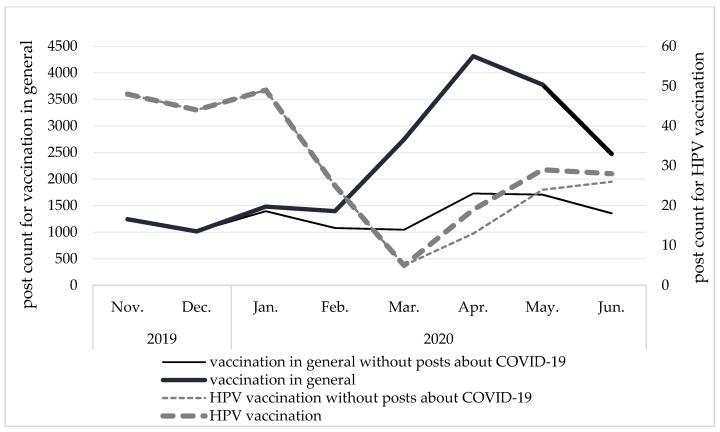
Social media platforms are widely used for spreading vaccine-related information. The objectives of this paper are to characterize Polish-language human papillomavirus (HPV) vaccination discourse on Facebook and to trace the possible influence of the COVID-19 pandemic on changes in the HPV vaccination debate. A quantitative and qualitative analysis was carried out based on data collected with a tool for internet monitoring and social media analysis. We found that the discourse about HPV vaccination bearing negative sentiment is centralized. There are leaders whose posts generate the bulk of anti-vaccine traffic and who possess relatively greater capability to influence recipients' opinions. At the beginning of the COVID-19 pandemic vaccination debate intensified, but there is no unequivocal evidence to suggest that interest in the HPV vaccination topic changed.
社交媒体平台被广泛用于传播与疫苗相关的信息。本文的目的是描述波兰语人乳头瘤病毒(HPV)疫苗接种在 Facebook 上的相关言论,并追溯 COVID-19 大流行对 HPV 疫苗接种辩论变化的可能影响。我们基于使用互联网监测和社交媒体分析工具收集的数据进行了定量和定性分析。我们发现,带有负面情绪的 HPV 疫苗接种相关言论是集中的。存在一些意见领袖,他们的帖子产生了大量的反疫苗流量,并且具有相对更大的能力来影响收件人的意见。在 COVID-19 大流行开始时,疫苗接种辩论加剧,但没有确凿的证据表明人们对 HPV 疫苗接种话题的兴趣发生了变化。

 Zotero 插件