
鉴定允许 HIV-1 进入和产生感染的 CCR5 核心受体群体:对体内研究的意义。
Identifying CCR5 coreceptor populations permissive for HIV-1 entry and productive infection: implications for in vivo studies.
机构信息
Institute of Human Virology, School of Medicine, University of Maryland, 725 W. Lombard St., Baltimore, MD, 21201, USA.
Department of Medicine, School of Medicine, University of Maryland, Baltimore, MD, 21201, USA.
出版信息
J Transl Med. 2022 Jan 24;20(1):39. doi: 10.1186/s12967-022-03243-8.
BACKGROUND
The chemokine receptor CCR5 is the major coreceptor for HIV-1 cell entry. We previously observed that not all CCR5 mAbs reduce HIV-1 infection, suggesting that only some CCR5 populations are permissive for HIV-1 entry. This study aims to better understand the relevant conformational states of the cellular coreceptor, CCR5, involved in HIV entry. We hypothesized that CCR5 assumes multiple configurations during normal cycling on the plasma membrane, but only particular forms facilitate HIV-1 infection.
METHODS
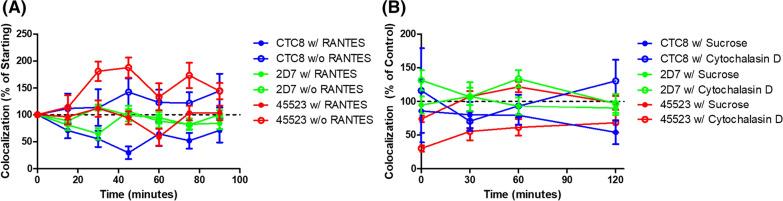
To this end, we quantified different CCR5 populations using six CCR5 monoclonal antibodies (mAbs) with different epitope specificities and visualized them with super-resolution microscopy. We quantified each surface CCR5 population before and after HIV-1 infection.
RESULTS
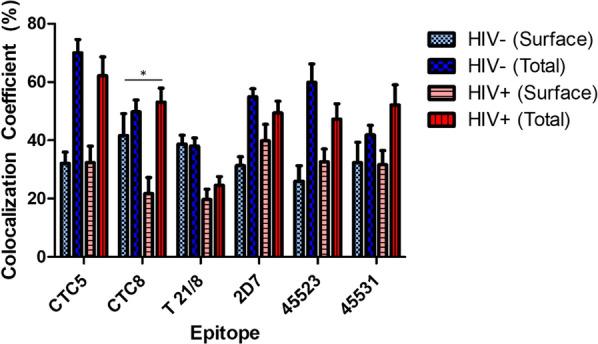
Based on CCR5 conformational changes, down-modulation, and trafficking rates (internalization and recycling kinetics), we were able to distinguish among heterogeneous CCR5 populations and thus which populations might best be targeted to inhibit HIV-1 entry. We assume that a decreased surface presence of a particular CCR5 subpopulation following infection means that it has been internalized due to HIV-1 entry, and that it therefore represents a highly relevant target for future antiviral therapy strategies. Strikingly, this was most true for antibody CTC8, which targets the N-terminal region of CCR5 and blocks viral entry more efficiently than it blocks chemokine binding.
CONCLUSIONS
Defining the virus-host interactions responsible for HIV-1 transmission, including specific coreceptor populations capable of establishing de novo infections, is essential for the development of an HIV-1 vaccine. This study hopefully will facilitate further development of inhibitors to block CCR5 usage by HIV-1, as well as inform future HIV-1 vaccine design.
背景
趋化因子受体 CCR5 是 HIV-1 细胞进入的主要辅助受体。我们之前观察到并非所有 CCR5 mAbs 都能降低 HIV-1 感染,这表明只有某些 CCR5 群体允许 HIV-1 进入。本研究旨在更好地了解参与 HIV 进入的细胞辅助受体 CCR5 的相关构象状态。我们假设 CCR5 在质膜上正常循环过程中会呈现多种构象,但只有特定的构象形式才能促进 HIV-1 感染。
方法
为此,我们使用具有不同表位特异性的六种 CCR5 单克隆抗体 (mAbs) 来量化不同的 CCR5 群体,并使用超分辨率显微镜对其进行可视化。我们在 HIV-1 感染前后量化了每个表面 CCR5 群体。
结果
基于 CCR5 构象变化、下调和转运率(内化和再循环动力学),我们能够区分不同的 CCR5 群体,从而确定哪些群体最适合靶向以抑制 HIV-1 进入。我们假设感染后特定 CCR5 亚群表面存在减少意味着它已被内化,因为 HIV-1 进入,因此它代表了未来抗病毒治疗策略的一个非常重要的目标。引人注目的是,这对靶向 CCR5 N 端区域并比阻断趋化因子结合更有效地阻断病毒进入的抗体 CTC8 最为真实。
结论
定义负责 HIV-1 传播的病毒-宿主相互作用,包括能够建立新感染的特定辅助受体群体,对于 HIV-1 疫苗的开发至关重要。本研究有望促进开发阻止 HIV-1 使用 CCR5 的抑制剂,并为未来的 HIV-1 疫苗设计提供信息。

 Zotero 插件