
奥密克戎(B.1.1.529)变异株的出现、显著特征、高全球健康关注以及在持续的 COVID-19 大流行期间应对它的策略。
Emergence of SARS-CoV-2 Omicron (B.1.1.529) variant, salient features, high global health concerns and strategies to counter it amid ongoing COVID-19 pandemic.
机构信息
Department of Biochemistry and Genetics, Barkatullah University, Bhopal, 462026, MP, India.
Department of Biochemistry and Genetics, Barkatullah University, Bhopal, 462026, MP, India.
出版信息
Environ Res. 2022 Jun;209:112816. doi: 10.1016/j.envres.2022.112816. Epub 2022 Jan 29.
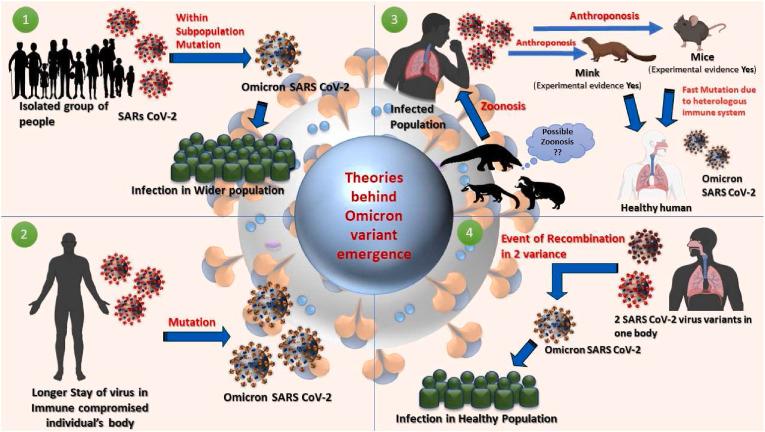
Since the appearance in the late of December 2019, SARS-CoV-2 is rapidly evolving and mutating continuously, giving rise to various variants with variable degrees of infectivity and lethality. The virus that initially appeared in China later mutated several times, wreaking havoc and claiming many lives worldwide amid the ongoing COVID-19 pandemic. After Alpha, Beta, Gamma, and Delta variants, the most recently emerged variant of concern (VOC) is the Omicron (B.1.1.529) that has evolved due to the accumulation of high numbers of mutations especially in the spike protein, raising concerns for its ability to evade from pre-existing immunity acquired through vaccination or natural infection as well as overpowering antibodies-based therapies. Several theories are on the surface to explain how the Omicron has gathered such a high number of mutations within less time. Few of them are higher mutation rates within a subgroup of population and then its introduction to a larger population, long term persistence and evolution of the virus in immune-compromised patients, and epizootic infection in animals from humans, where under different immune pressures the virus mutated and then got reintroduced to humans. Multifaceted approach including rapid diagnosis, genome analysis of emerging variants, ramping up of vaccination drives and receiving booster doses, efficacy testing of vaccines and immunotherapies against newly emerged variants, updating the available vaccines, designing of multivalent vaccines able to generate hybrid immunity, up-gradation of medical facilities and strict implementation of adequate prevention and control measures need to be given high priority to handle the on-going SARS-CoV-2 pandemic successfully.
自 2019 年 12 月下旬出现以来,SARS-CoV-2 迅速进化和不断突变,产生了各种具有不同程度传染性和致死率的变体。最初出现在中国的病毒后来发生了多次突变,在持续的 COVID-19 大流行中,在全球范围内肆虐并夺走了许多生命。继 Alpha、Beta、Gamma 和 Delta 变体之后,最近出现的关注变体(VOC)是奥密克戎(B.1.1.529),由于棘突蛋白中积累了大量突变,特别是棘突蛋白中的突变,引起了人们对其逃避通过疫苗接种或自然感染获得的现有免疫的能力以及克服基于抗体的治疗的担忧。有几种理论表面上解释了奥密克戎如何在如此短的时间内积累如此多的突变。其中一些理论是:在亚群人群中存在更高的突变率,然后将其引入更大的人群;病毒在免疫功能低下的患者中持续存在和进化;以及从人类到动物的动物中爆发性感染,在不同的免疫压力下,病毒发生突变,然后重新引入人类。需要高度重视多方面的方法,包括快速诊断、新兴变体的基因组分析、加快疫苗接种运动和接种加强针、对新出现的变体进行疫苗和免疫疗法的疗效测试、更新现有疫苗、设计能够产生混合免疫的多价疫苗、升级医疗设施以及严格实施充分的预防和控制措施,以成功应对持续的 SARS-CoV-2 大流行。
 Zotero 插件